When Should a Business Rebuild Its Website? Signs It Is Time for a Redesign

Table of Contents
- 1. Optimise vs Rebuild: The Core Question
- 2. Signal 1: Your Conversion Rate Is Consistently Poor
- 3. Signal 2: The Design No Longer Reflects Your Current Brand or Market Position
- 4. Signal 3: The Site Is Slow and Failing Core Web Vitals
- 5. Signal 4: The Site Cannot Be Updated Easily by Your Team
- 6. Signal 5: The Site Does Not Work Properly on Mobile
- 7. Signal 6: Your Competitors' Websites Are Significantly Better
- 8. Signal 7: The Technology Stack Is Outdated or No Longer Supported
- 9. What to Expect from a Website Rebuild
- 10. Website Redesign and Development with Synexis Softech
Website redesign decisions are expensive and time-consuming — which is exactly why so many businesses delay them far too long. The consequence is compounding: an outdated website quietly drains conversions, repels qualified prospects, and signals to the market that the business may not be as sophisticated as it actually is. Understanding when a website has reached the end of its productive life — and when optimisation alone is no longer the answer — is a critical digital strategy skill.
Optimise vs Rebuild: The Core Question
Before recommending a full rebuild, a good web development partner will ask whether the business's goals can be achieved through incremental improvement — better copy, improved conversion rate optimisation, updated design elements, performance improvements. A full rebuild is the right answer when the fundamental structure, technology, or design language of the site can no longer support what the business needs. Here are the clearest signals.
Signal 1: Your Conversion Rate Is Consistently Poor
If a meaningful volume of relevant traffic is landing on your website but converting at a rate significantly below industry benchmarks — and CRO testing has not moved the needle — the problem is likely structural. Poor conversion is often a symptom of fundamental issues with user journey design, trust signals, or page architecture that cannot be solved with surface-level changes.
Signal 2: The Design No Longer Reflects Your Current Brand or Market Position
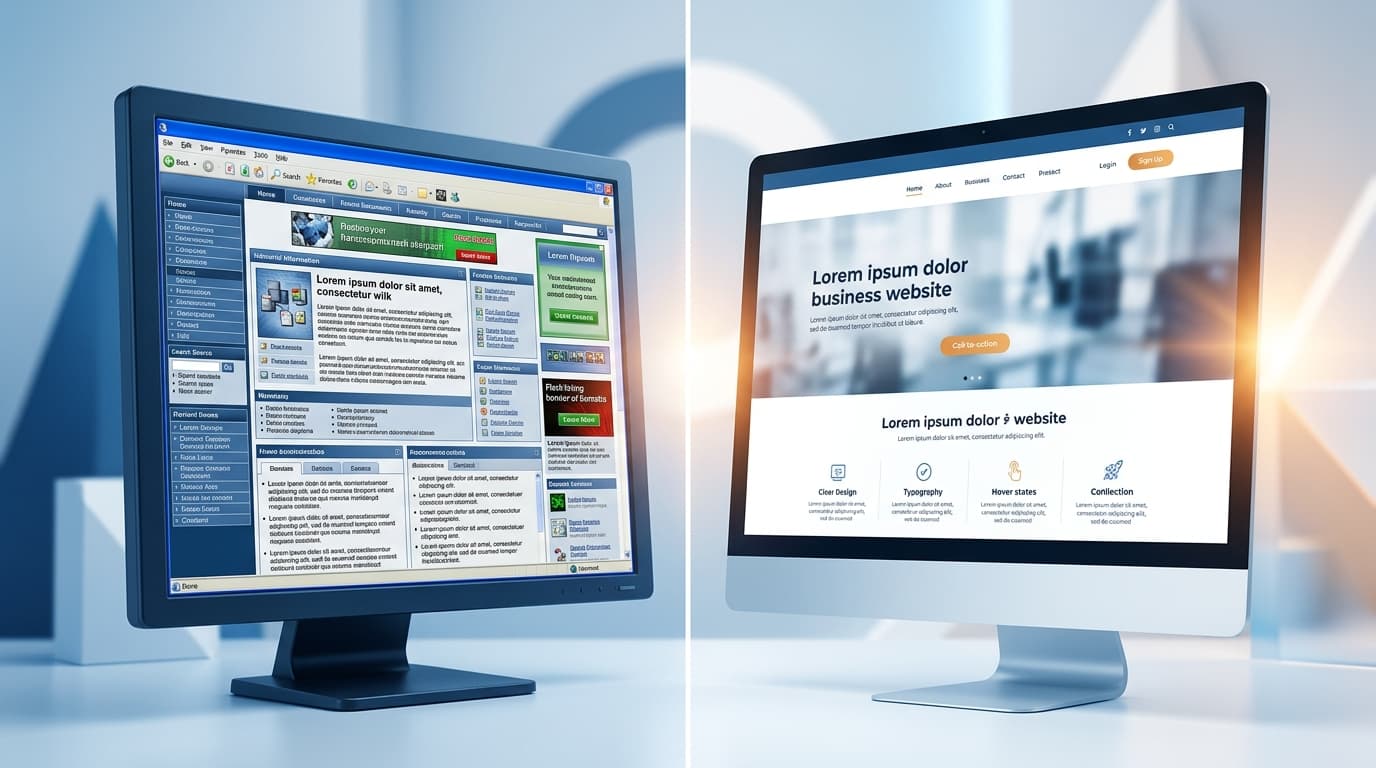
A website built four or five years ago reflects the brand and market positioning of four or five years ago. If the business has evolved — new markets, elevated positioning, new products, evolved brand identity — the website is communicating the old version of the business. In competitive markets, this misalignment actively costs revenue.
Signal 3: The Site Is Slow and Failing Core Web Vitals
Google's Core Web Vitals are now a ranking factor, and user tolerance for slow websites has decreased dramatically. A site that was built on legacy technology and has accumulated years of plugins, bloated code, and unoptimised media will often fail Core Web Vitals in ways that cannot be fixed without a rebuild. If your Largest Contentful Paint is over 2.5 seconds and every optimisation has only moved the needle marginally, the technical debt has accumulated beyond the point where optimisation alone can rescue it.
Signal 4: The Site Cannot Be Updated Easily by Your Team
If making routine content updates requires developer intervention, or if the CMS is so outdated or customised that your team avoids updating the site, the website is failing as an operational tool. A modern website should allow non-technical team members to update content, add pages, and make routine changes efficiently.
Signal 5: The Site Does Not Work Properly on Mobile
Over 60% of web traffic is mobile on most business websites. A site that was built before mobile-first design standards — or that has been patched for mobile responsiveness without being properly redesigned for mobile experience — is delivering a poor experience to the majority of visitors. This is a rebuild indicator, not an optimisation task.
Signal 6: Your Competitors' Websites Are Significantly Better
Competitive context matters. If your primary competitors have modern, fast, well-designed websites that clearly communicate their value and make it easy for customers to engage — and yours does not — the website gap is costing you competitive opportunities in a direct and measurable way.
Signal 7: The Technology Stack Is Outdated or No Longer Supported
Websites built on outdated technology stacks — old PHP versions, unmaintained CMS platforms, deprecated plugins — carry significant security risk and increasingly have functionality gaps. At some point, maintaining an outdated technology stack costs more than rebuilding on modern infrastructure.
What to Expect from a Website Rebuild
A well-executed website rebuild is a strategic project, not just a design exercise. Expect the process to include a thorough discovery and strategy phase, user research, conversion-focused design, technical development, content strategy, and launch planning. Budget and timeline both depend on scope — from a focused small business rebuild to a full enterprise platform migration.
Website Redesign and Development with Synexis Softech
At Synexis Softech, we work with businesses to assess whether a full website rebuild is the right investment and, when it is, to execute it with the strategic depth and technical quality the investment demands. Our websites are built on modern technology stacks, optimised for performance and SEO, and designed for conversion.
Contact us for a website assessment to understand whether your current site is serving your business as well as it should.
Need help with implementation? Synexis Softech provides robust custom website development services to help scale your business.
Synexis Softech Team
Senior Full-Stack Developer
Our team of experienced engineers and digital strategists at Synexis Softech specializes in building production-ready AI solutions, high-performance web applications, and data-driven marketing campaigns. Based in Pokhara, Nepal, we partner with growing businesses globally to turn complex technical challenges into competitive advantages.
Ready to grow your business with technology?
Let's build a practical digital solution for your business.
Talk to Our Team