ChatGPT Ads vs. Meta Ads: Which Channel Should Indian Brands Prioritise in 2026?

Table of Contents
- 1. A Question Every Indian Digital Marketer Is Asking
- 2. The Core Difference: Discovery vs. Decision
- 3. Side-by-Side Comparison
- 4. Where Meta Is Still Difficult to Beat for Indian Brands
- 5. Brand discovery at scale
- 6. Impulse and fashion categories
- 7. Retargeting
- 8. Budget flexibility
- 9. Where ChatGPT Ads Have a Genuine Advantage
- 10. High-consideration purchase categories
- 11. Buyer intent clarity
- 12. Early-mover advantage
- 13. Context-sensitive relevance
- 14. How Indian Brands Should Think About Budget Allocation
- 15. Budget Split Scenarios for Indian Brands
- 16. Creative Strategy: What Works Differently
- 17. How Synexis Softech Can Help
- 18. Frequently Asked Questions
- 19. Should I stop running Meta Ads and move to ChatGPT Ads?
- 20. Which channel has better ROAS — Meta or ChatGPT Ads?
- 21. What is the minimum budget for ChatGPT Ads in India?
- 22. Which Indian business types are best suited for ChatGPT Ads over Meta?
- 23. How do I access ChatGPT Ads in India as a small business?
A Question Every Indian Digital Marketer Is Asking
ChatGPT Ads launched in India on August 27, 2026. Within days, the question started appearing in marketing team meetings and founder conversations: "Should we shift some budget from Meta to ChatGPT?"
It is a reasonable question, but it is the wrong framing. ChatGPT Ads and Meta Ads are not substitutes for each other. They serve different roles in a buyer journey, reach users at different moments, and reward different creative and measurement logic. A business that moves budget from Meta to ChatGPT without understanding this difference will be disappointed in both directions.
This guide gives Indian brands the honest comparison they need — including where ChatGPT Ads have real advantages, where Meta is still difficult to beat, and how to think about budget allocation between the two.
The Core Difference: Discovery vs. Decision
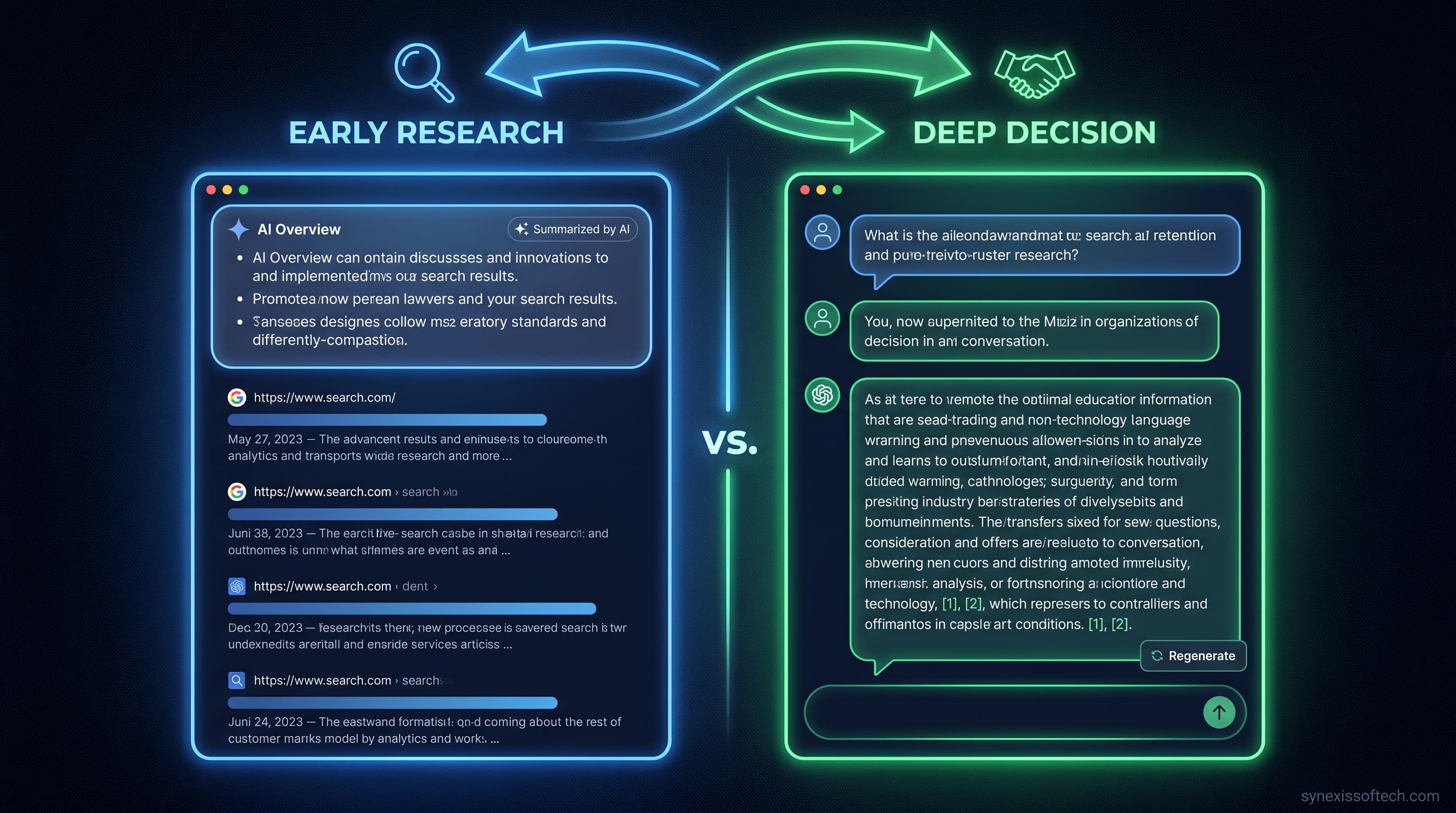
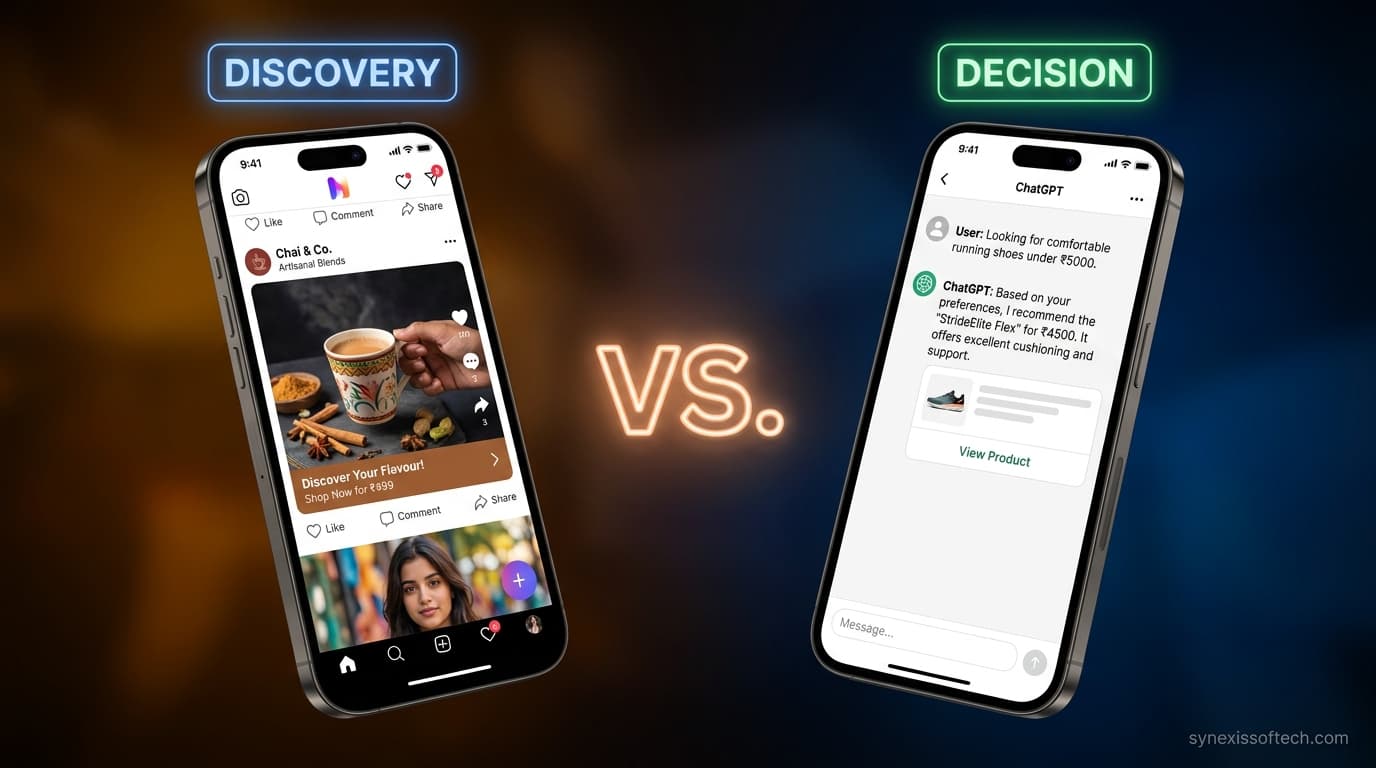
Meta advertising — Facebook and Instagram — is primarily a discovery channel. Users are not on Meta looking for your product. They are scrolling, consuming content, and your ad interrupts that experience. The best Meta ads create desire for something the user was not consciously looking for. This is powerful for brand building and impulse-category purchases, but it requires strong creative and significant frequency to work.
ChatGPT Ads operate in a different moment. A user who opens ChatGPT and asks "which D2C grooming brand in India is best for sensitive skin?" is not browsing — they are researching a decision. They have already reached the consideration or decision stage. An ad that appears in that context meets a buyer who is much closer to purchasing than the average Meta scroll suggests.
This is not a quality judgement about the channels. It is a structural difference in where they sit in the buyer journey. The strategic question is which channel you need at which stage — not which one is universally better.
Side-by-Side Comparison
| Dimension | Meta Ads (Facebook + Instagram) | ChatGPT Ads |
|---|---|---|
| User mindset | Passive scroll, entertainment, social | Active research, problem-solving, decision support |
| What the platform knows about the user | Demographics, interests, past behaviour, look-alike signals | The context and intent of the current conversation |
| Targeting input | Audience definition (age, interests, custom audiences) | Conversational context signals |
| Ad format | Image, video, carousel, stories, reels — highly visual | Not yet fully disclosed; appears within conversation flow |
| Creative requirements | Strong visual creative, stop-scroll hook | Message precision, relevance to conversational context |
| CPC benchmark (India) | ₹5–₹25 (varies widely by category and audience) | Not officially published; $3–$5 reported in other markets |
| Minimum daily budget | ₹100+ (very accessible) | ₹725 (~$7.60) per reported Ad Manager launch |
| Conversion tracking | Meta Pixel + Conversions API | Pixel-based system on advertiser website |
| Optimisation maturity | Highly mature — 15+ years of optimisation tools | Very early stage — limited optimisation tools |
| Audience size in India | Very large — 350M+ Facebook users in India | Growing — free tier users only see ads |
| Self-serve access in India | Fully available | Expected via Ad Manager post-August 27, 2026 |
| Best for | Brand discovery, impulse categories, retargeting, lookalike expansion | High-consideration purchases, B2B, research-intensive categories |
Where Meta Is Still Difficult to Beat for Indian Brands
Brand discovery at scale
India has over 350 million Facebook users and a highly engaged Instagram user base. For a D2C brand launching a new product, Meta's reach and targeting infrastructure is still the fastest path to broad awareness at a controllable cost. No other channel — including ChatGPT — currently offers the same combination of reach, visual creative options, and audience targeting depth.
Impulse and fashion categories
Fashion, accessories, beauty, and home decor have high impulse purchase rates. A visually compelling Reel or Instagram Story ad can move a user from awareness to purchase in a single session. These categories are well-served by Meta's creative formats. ChatGPT's conversational format is less suited to impulse-driven visually-led purchases, at least in its current form.
Retargeting
Meta's retargeting infrastructure — particularly when combined with the Conversions API — is mature and effective. Retargeting website visitors, cart abandoners, and past purchasers on Meta remains one of the highest-ROAS activities available to Indian e-commerce brands. ChatGPT Ads does not yet have an equivalent retargeting capability publicly confirmed.
Budget flexibility
Meta campaigns can be started for ₹100/day. ChatGPT Ads have a reported minimum of ₹725/day. For very small businesses or early tests, Meta's lower floor is an advantage.
Where ChatGPT Ads Have a Genuine Advantage
High-consideration purchase categories
Software, education, professional services, B2B solutions, financial products (where eligible), health and wellness (where eligible), and high-value consumer electronics — categories where buyers research extensively before deciding — are strong candidates for ChatGPT advertising. The conversational context provides purchasing intent signals that Meta's behavioural targeting cannot match.
Buyer intent clarity
A Meta targeting definition like "men aged 25–35 interested in fitness" reaches a wide audience with variable intent. A ChatGPT conversation that reads "I'm a 28-year-old man starting strength training after a shoulder injury, looking for a protein supplement that is safe for joints under ₹2,000" reaches one buyer with extremely clear intent. For the right product, this specificity has significant value.
Early-mover advantage
ChatGPT Ads in India are in their first weeks of operation. Auction competition is low. Early advertisers in any new channel typically benefit from lower costs, more inventory availability, and less creative fatigue before the market normalises. Indian brands that launch early campaigns — even small tests — will build learning that competitors who wait will not have.
Context-sensitive relevance
For brands with a clear positioning around a specific customer situation — "for runners with knee issues," "for small businesses filing GST," "for vegetarian families wanting high-protein meals" — ChatGPT's conversational context makes precise relevance possible in a way that interest-based targeting on Meta cannot fully replicate.
How Indian Brands Should Think About Budget Allocation
The question "should I shift budget from Meta to ChatGPT?" assumes a zero-sum trade-off that does not reflect how most successful media mixes work. A more useful framing:
"What role should ChatGPT play in my media mix alongside Meta — and at what budget level does it make sense to test?"
For most Indian brands in 2026, the practical guidance is:
- Do not reduce Meta budget to fund ChatGPT tests. Meta is a proven, mature channel. ChatGPT Ads are new and still establishing their optimisation logic. If your Meta campaigns are profitable, protect that spend.
- Allocate a test budget separately. A reasonable test allocation for a mid-size Indian D2C brand is ₹15,000–₹30,000 per month for an initial ChatGPT Ads experiment. This is enough to gather data at the minimum daily budget level (₹725/day) across 20–40 days.
- Test in your highest-intent category. Identify the product or service in your range that has the most research-intensive buyer journey — the one where customers ask the most questions and take the longest to decide. Start your ChatGPT test there.
- Measure incrementally. Do not compare ChatGPT ROAS directly to Meta ROAS in the first month. Understand what is truly incremental — sales that would not have happened without the ChatGPT ad.
Budget Split Scenarios for Indian Brands
| Brand Type | Suggested Meta Allocation | Suggested ChatGPT Test Allocation | Rationale |
|---|---|---|---|
| Early-stage D2C (fashion, beauty) | 85–90% | 10–15% test budget | Need Meta's reach for brand building; small ChatGPT test for learning |
| Established D2C with proven Meta ROAS | 70–75% | 20–25% test budget | Proven base; can afford meaningful ChatGPT experiment |
| B2B SaaS / software | 40–50% | 30–40% ChatGPT + Perplexity focus | High-consideration purchase; conversational intent highly relevant |
| High-consideration consumer (health, ed-tech) | 55–65% | 25–35% ChatGPT test | Research-intensive buyer; conversational advertising well-suited |
| Local service business | 50% | 20% ChatGPT + 30% Google Local | Local intent still strong on Google; ChatGPT test worthwhile |
These are starting frameworks, not formulas. Your category, your current Meta performance, and your product's buyer journey should drive the actual numbers.
Creative Strategy: What Works Differently
Meta creative is built to stop a scroll: a bold visual, a strong hook in the first two seconds of video, a headline that creates curiosity or desire before the user moves on.
ChatGPT creative — in a conversational context — needs to do something different. The user is already engaged and thinking. The ad does not need to stop a scroll; it needs to be relevant to a conversation that is already in progress. This means:
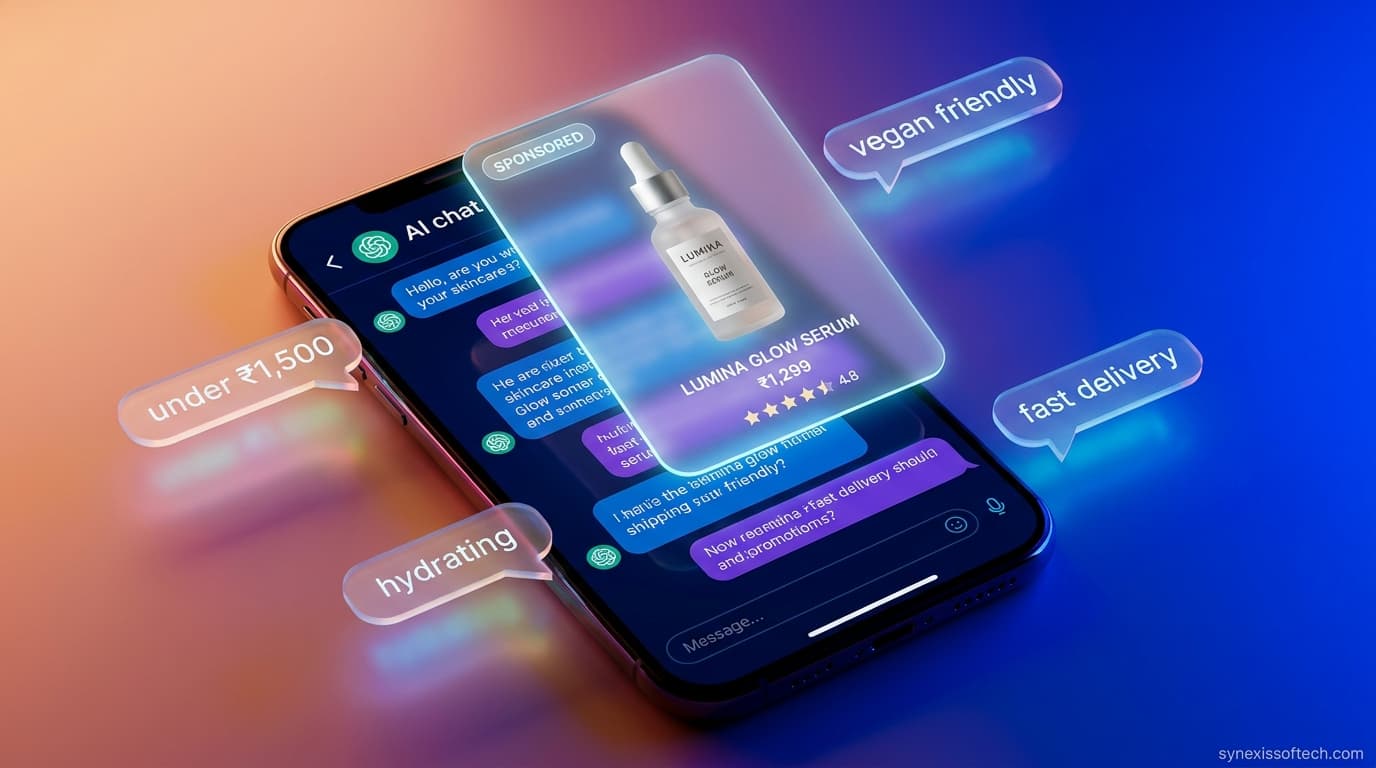
- Clarity over creativity: "Vegan protein powder under ₹1,800 with 25g protein per serve — free delivery in India" is more likely to work than an aspirational headline that requires emotional priming to understand.
- Specificity wins: An ad that clearly states what the product is, who it is for, and why it is relevant to the buyer's stated situation will outperform one that relies on brand recall.
- Social proof near the front: Reviews and trust signals matter more when the user is in active evaluation mode than when they are passively scrolling.
How Synexis Softech Can Help
Synexis Softech helps Indian and South Asian businesses build the digital infrastructure, AI solutions, and marketing technology needed to compete across both Meta and emerging AI advertising channels. From e-commerce development and conversion tracking setup to AI agents, GEO strategy, and custom software integrations — we work with the practical steps that make multi-channel advertising more effective.
Suggested internal links: E-Commerce Development | AI Solutions | ChatGPT Ads India Guide | ChatGPT Ads for D2C Brands
Frequently Asked Questions
Should I stop running Meta Ads and move to ChatGPT Ads?
No. Meta Ads and ChatGPT Ads serve different roles in the buyer journey. Meta excels at brand discovery, reach, and visual-led impulse categories. ChatGPT Ads are better suited to high-consideration purchases where buyers are actively researching. The most effective approach for most Indian brands in 2026 is to maintain Meta spend and allocate a separate test budget for ChatGPT — not to replace one with the other.
Which channel has better ROAS — Meta or ChatGPT Ads?
It is too early to compare meaningfully. ChatGPT Ads only launched in India on August 27, 2026, and optimisation tools are still limited. Meta has 15+ years of advertiser data and sophisticated optimisation infrastructure. In theory, ChatGPT's higher purchase intent context could deliver strong ROAS for the right category — but this needs to be verified with actual campaign data in the Indian market over time.
What is the minimum budget for ChatGPT Ads in India?
The reported minimum daily budget for the self-serve Ad Manager is ₹725 per day (~$7.60). This has been reported by TechCrunch based on the August 27, 2026 India launch announcement. Meta's minimum daily budget is significantly lower, starting around ₹100/day. Businesses should verify current minimum budgets directly with OpenAI's Ad Manager when it becomes available.
Which Indian business types are best suited for ChatGPT Ads over Meta?
B2B software and SaaS companies, education and edtech platforms, high-consideration consumer products (health, wellness, professional tools), and professional service businesses tend to have the strongest fit for ChatGPT's conversational intent model. Fashion, beauty, and impulse-buy categories typically perform better on Meta's visual-led discovery model — though ChatGPT can still play a role in the research phase.
How do I access ChatGPT Ads in India as a small business?
The initial India launch (August 27, 2026) was limited to approximately 50 invited brands. Self-serve access via OpenAI's Ad Manager is expected to follow shortly, with a minimum daily budget of ₹725. Small businesses should monitor OpenAI's official channels for access announcements, or enquire through authorised agency partners WPP or Omnicom for managed access.
Published August 2026. ChatGPT Ads are new to India and actively evolving. Verify current access, pricing, and features with OpenAI before budget decisions.
Need help with implementation? Synexis Softech provides robust custom website development services to help scale your business.
Synexis Softech Team
AI Marketing Manager
Our team of experienced engineers and digital strategists at Synexis Softech specializes in building production-ready AI solutions, high-performance web applications, and data-driven marketing campaigns. Based in Pokhara, Nepal, we partner with growing businesses globally to turn complex technical challenges into competitive advantages.
Ready to grow your business with technology?
Let's build a practical digital solution for your business.
Talk to Our Team