Google AI Overviews vs. ChatGPT Search: Where Should Your Business Focus in 2026?
Table of Contents
- 1. Two Different AI Channels, One Strategic Question
- 2. How Google AI Overviews Work
- 3. How ChatGPT Search Works
- 4. Direct Comparison: Google AI Overviews vs. ChatGPT Search
- 5. Which Channel Matters More for Your Business Type?
- 6. Local businesses (restaurants, hotels, clinics, retail)
- 7. E-commerce and D2C brands
- 8. SaaS and B2B software
- 9. Professional services (law, finance, consulting)
- 10. Content publishers and media
- 11. What Both Channels Have in Common — and Why It Simplifies Your Strategy
- 12. The Paid Layer: Ads in Both Channels
- 13. A Practical 90-Day Focus Plan
- 14. Days 1–30: Fix the foundations (affects both channels)
- 15. Days 31–60: Build citation-worthy content
- 16. Days 61–90: Measure and expand
- 17. How Synexis Softech Can Help
- 18. Frequently Asked Questions
- 19. What is Google AI Overviews?
- 20. Is ChatGPT Search different from regular ChatGPT?
- 21. Which is more important for my business — Google AI Overviews or ChatGPT?
- 22. Do ads appear in Google AI Overviews and ChatGPT?
Two Different AI Channels, One Strategic Question
Two AI-powered discovery channels now influence how customers find businesses, compare products, and make decisions — and they work very differently from each other.
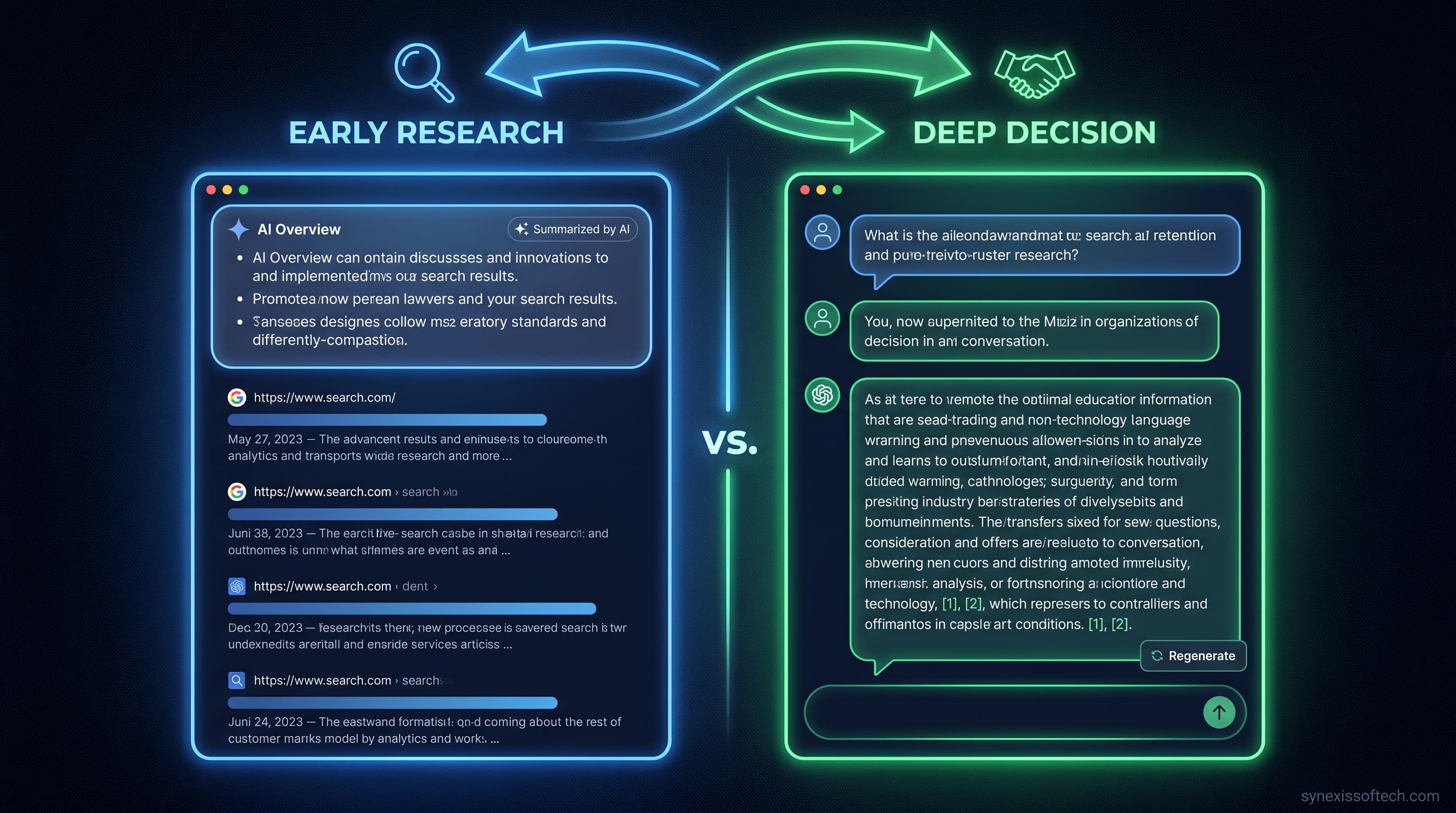
Google AI Overviews appear at the top of Google search results, summarising answers to search queries using AI-generated text and cited sources. ChatGPT Search — the web-connected version of ChatGPT — retrieves current web content and answers user questions conversationally, with citations.
Both can surface your business. Both can ignore it. The signals they weight are related but not identical. And the businesses that understand the difference between them will make better use of their marketing resources than those treating "AI search" as a single category.
This guide breaks down both channels, compares them directly, and explains where to focus based on your business type.
How Google AI Overviews Work
Google AI Overviews (formerly Google SGE — Search Generative Experience) appear on a growing proportion of Google search results pages, typically for informational and transactional queries. They generate a summary answer at the top of the results page, above the traditional blue links, drawing from web pages Google has indexed and ranked as credible.
Key characteristics:
- Triggered by: A standard Google search query, particularly informational ("how to"), transactional ("best X for Y"), and local queries
- Source selection: Google selects cited sources from its existing search index. Pages that rank well organically are more likely — but not guaranteed — to be cited in AI Overviews
- Format: A summarised answer with two to four cited source links, followed by traditional search results below
- Advertiser integration: Google has confirmed that ads appear in AI Mode (the fully conversational version of Google AI), expanding their presence in AI-driven search
- Volume: Google processes over 5 trillion searches annually. Even a small percentage with AI Overviews represents enormous reach
How ChatGPT Search Works
ChatGPT Search is the web-browsing capability of ChatGPT, which allows it to retrieve current web content when answering queries. Unlike the base ChatGPT model (which is trained on static data with a knowledge cutoff), ChatGPT Search actively retrieves and cites live web pages.
Key characteristics:
- Triggered by: A conversational query in ChatGPT, particularly when the user is asking about current events, specific products, local businesses, or information that changes over time
- Source selection: Retrieves content from pages that OpenAI's crawler (GPTBot) has indexed and that are permitted by the site's robots.txt
- Format: A conversational answer with inline citations. The user can ask follow-up questions, refine the answer, and go deeper into specific aspects
- Context: ChatGPT Search has access to the full conversation history, meaning it can factor in what the user said earlier — a capability Google's one-shot search does not have
- User tier: Available to ChatGPT Free, Go, Plus, Pro, and Business users
Direct Comparison: Google AI Overviews vs. ChatGPT Search
| Dimension | Google AI Overviews | ChatGPT Search |
|---|---|---|
| Entry point | Google search bar | ChatGPT conversation |
| Query type | Keyword or short phrase | Full conversational question or multi-turn dialogue |
| Context available | Current query only | Full conversation history |
| Source selection | Google's search index + authority signals | GPTBot-indexed content + robots.txt permissions |
| Citation style | 2–4 inline source links | Inline citations throughout the conversational response |
| Ad integration | Yes — in AI Mode | Yes — ChatGPT Ads on Free + Go tiers |
| User volume | Very high (5+ trillion searches/year) | Growing rapidly; exact figures not public |
| Primary user intent | Information retrieval, research, local search | Research, comparison, recommendations, decision support |
| Follow-up capability | Limited (requires new search) | Native multi-turn conversation |
| Most useful for discovering | Local businesses, how-to content, product comparisons, definitions | Complex decisions, multi-factor comparisons, recommendations with specific constraints |
Which Channel Matters More for Your Business Type?
Local businesses (restaurants, hotels, clinics, retail)
Priority: Google AI Overviews. Local queries — "best restaurant near me," "hotel in Goa under ₹3,000" — are still predominantly searched on Google. AI Overviews are appearing increasingly for these queries, drawing from Google Business Profile data, review signals, and local business schema. A well-optimised Google Business Profile with current hours, photos, reviews, and accurate category information is the most direct path to local AI visibility.
ChatGPT Search is growing for local queries but is secondary. A user asking ChatGPT for restaurant recommendations will get results — but the density of local intent queries on Google is still significantly higher.
E-commerce and D2C brands
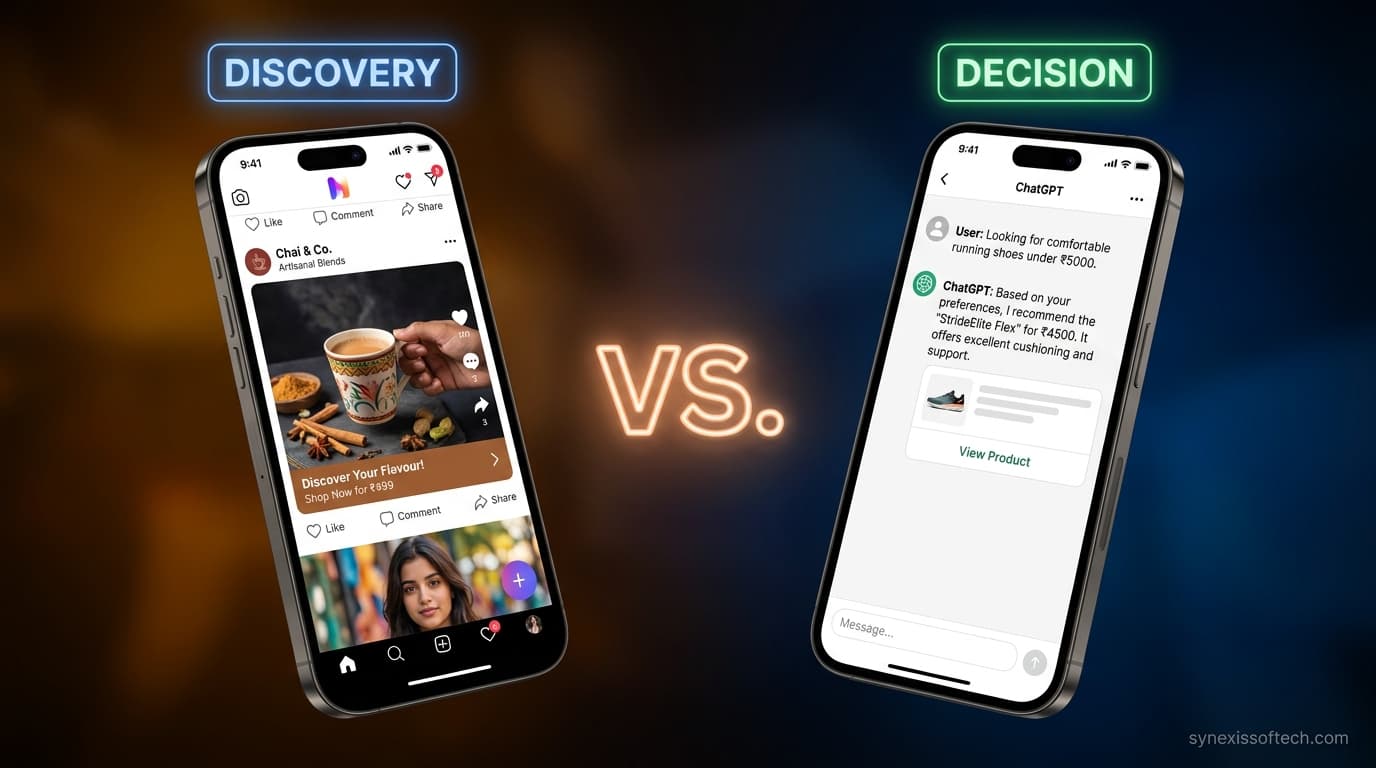
Priority: Both, for different stages. Product discovery (what category should I buy?) is happening in ChatGPT conversations. Product comparison (which of these three products is better?) is happening in both ChatGPT and Google AI Overviews. Product search with intent to buy immediately is still predominantly on Google. An e-commerce brand needs visibility in both channels at different points in the buyer journey.
SaaS and B2B software
Priority: ChatGPT Search. B2B software decisions are research-intensive. A buyer who asks ChatGPT "what are the best HR software tools for a 50-person company in India?" is doing serious comparative research. ChatGPT's ability to factor in multiple constraints across a conversation makes it particularly well-suited to complex B2B purchasing questions. Perplexity is also significant in this segment.
Professional services (law, finance, consulting)
Priority: Google AI Overviews, with growing ChatGPT relevance. Professional service queries are frequently searched on Google, and AI Overviews are appearing for advisory questions (what to look for in a CA, how to structure a company in India). At the same time, ChatGPT is increasingly used for initial professional guidance — creating organic visibility opportunities for firms with clear, expert content.
Content publishers and media
Priority: Both. Both channels cite source content, making content quality and authority the primary lever. Publishers should optimise for both Google's AI citation logic and GPTBot's crawling and indexing, with structured, factual, citation-friendly content.
What Both Channels Have in Common — and Why It Simplifies Your Strategy
Despite their differences, Google AI Overviews and ChatGPT Search share several core requirements. A business that does these things well will improve its visibility in both channels simultaneously:
- Content that answers questions directly: Both systems prefer sources that give a clear, specific answer early in the content, followed by supporting detail
- Structured data: Schema markup helps both Google's AI systems and OpenAI's retrieval systems understand what a page contains
- Authority signals: Credible external links, mentions in reputable publications, and consistent entity information across the web improve trust in both systems
- Technical accessibility: Pages that load quickly, are mobile-optimised, and are not blocked by robots.txt restrictions can be crawled by both Googlebot and GPTBot
- Factual, specific content: Both systems penalise vague, generic claims in favour of specific, verifiable information
The single highest-leverage investment for most businesses is clear, structured, factual content that directly answers the questions their ideal customers are asking. That content will improve performance in both AI channels simultaneously.
The Paid Layer: Ads in Both Channels
Both channels now have commercial advertising integrated:
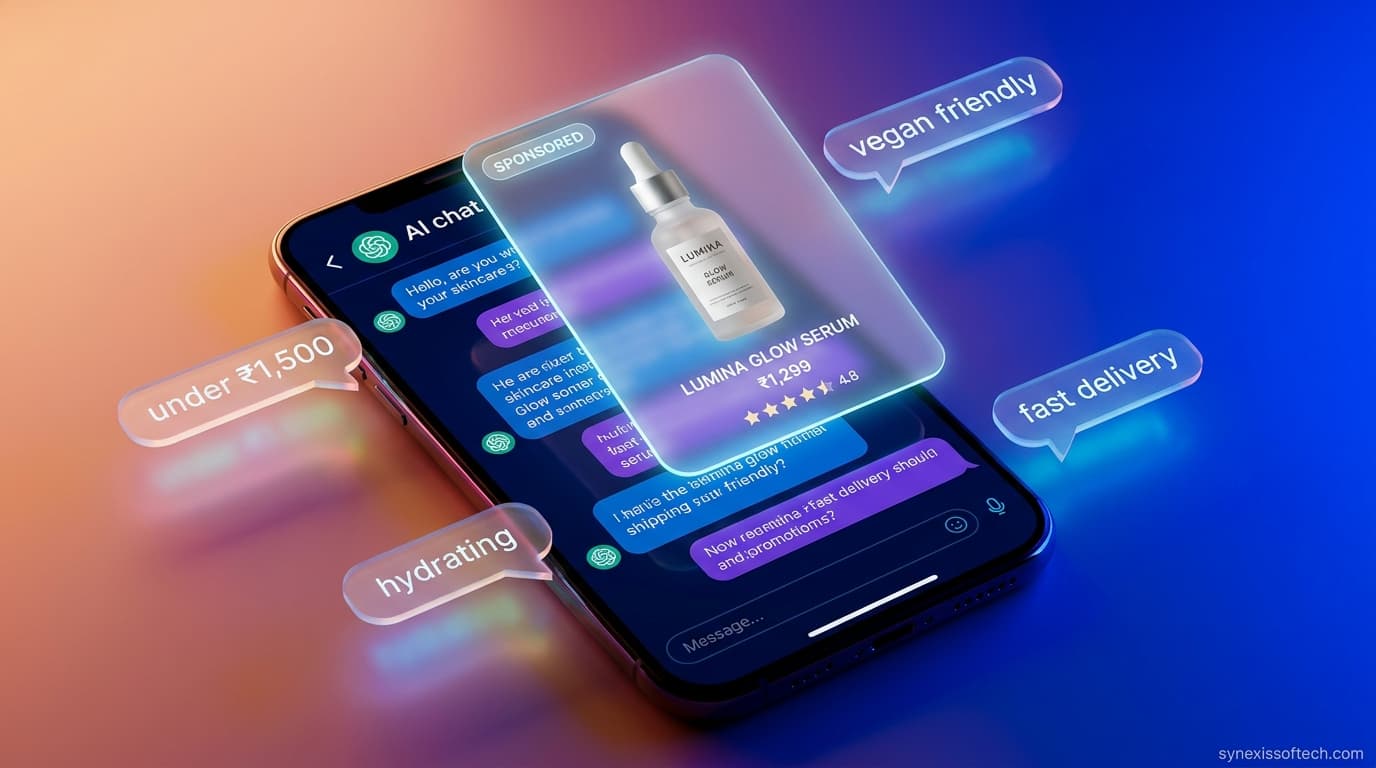
- Google AI Mode / AI Overviews: Google confirmed at Google Marketing Live 2025 that ads are expanding into AI Mode and AI Overview results. Advertisers using Google Ads are automatically eligible for this inventory.
- ChatGPT Ads: Live in nine markets including India (launched August 27, 2026). Available on Free and Go tiers. Self-serve access in India expected via Ad Manager with a minimum daily budget of ₹725 (~$7.60).
In both channels, organic visibility and paid advertising are separate. Running ads in Google AI Mode does not guarantee an organic AI Overview citation, and vice versa. The same applies to ChatGPT Ads and organic ChatGPT mentions.
A Practical 90-Day Focus Plan
Days 1–30: Fix the foundations (affects both channels)
- Audit robots.txt — ensure Googlebot and GPTBot are both allowed
- Implement or update schema markup on key pages (FAQPage, LocalBusiness, Product, Article)
- Ensure Google Business Profile is complete, accurate, and current
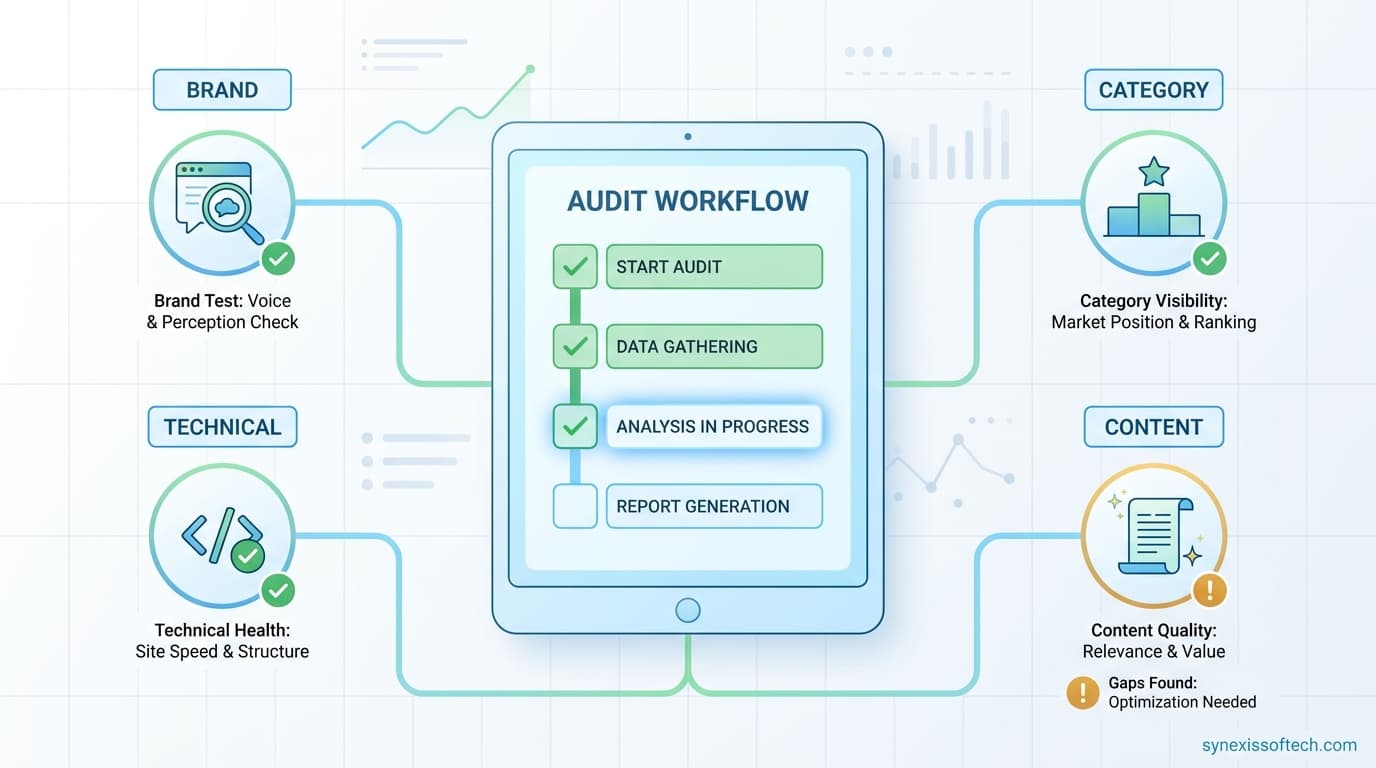
- Run the AI visibility tests described in this cluster (ChatGPT + Perplexity + Google AI Overviews)
- Fix any critical technical issues flagged in the audit
Days 31–60: Build citation-worthy content
- Publish or rewrite two to four pages that directly answer the top questions your buyers ask
- Add FAQ sections with FAQPage schema to main service and product pages
- Create one comparison article in your category (e.g., "X vs. Y: which is better for [situation]?")
- Ensure all content uses specific, verifiable facts rather than generic claims
Days 61–90: Measure and expand
- Re-run the AI visibility tests from Day 1 — has anything changed?
- Identify which pages are now being cited and what they have in common
- Test Google AI Mode for your primary keywords and observe the citation pattern
- Begin planning ChatGPT Ads campaigns if access is available in your market
- Publish two additional citation-worthy articles based on gaps identified in the re-test
How Synexis Softech Can Help
Synexis Softech supports businesses in building the technical and content infrastructure needed for visibility in both Google AI Overviews and ChatGPT Search. From technical website audits and schema implementation to AI visibility strategy and GEO consulting, we work with the practical steps that move the needle.
Suggested internal links: AI Solutions | What Is GEO? | ChatGPT Ads Explained
Frequently Asked Questions
What is Google AI Overviews?
Google AI Overviews is an AI-generated summary that appears at the top of Google search results for many queries. It cites sources from Google's web index and provides a direct answer before the traditional blue link results. It is part of Google's broader AI search experience, which also includes AI Mode — a fully conversational search interface.
Is ChatGPT Search different from regular ChatGPT?
Yes. Regular ChatGPT uses a static training dataset with a knowledge cutoff date. ChatGPT Search enables ChatGPT to retrieve live web content — browsing current pages and citing sources in its answers, similar to how Perplexity works. It is available to users on Free, Go, Plus, Pro, and Business plans.
Which is more important for my business — Google AI Overviews or ChatGPT?
It depends on your business type. Local businesses and high-volume consumer searches still skew toward Google, making AI Overviews the priority. Complex B2B decisions and detailed product research are increasingly happening in ChatGPT. Most businesses need visibility in both — and the good news is that the underlying preparation (structured data, quality content, authority signals) improves performance in both channels simultaneously.
Do ads appear in Google AI Overviews and ChatGPT?
Yes. Google confirmed ads integration in AI Mode (Google's conversational AI search) at Google Marketing Live 2025. OpenAI launched ChatGPT Ads in nine markets including India, shown to Free and Go tier users. In both cases, paid advertising and organic AI citation are separate — running ads does not automatically improve organic visibility.
Published August 2026. AI search features are evolving rapidly — verify current platform capabilities before making investment decisions.
Need help with implementation? Synexis Softech provides robust custom AI agent development to help scale your business.
Synexis Softech Team
AI Marketing Manager
Our team of experienced engineers and digital strategists at Synexis Softech specializes in building production-ready AI solutions, high-performance web applications, and data-driven marketing campaigns. Based in Pokhara, Nepal, we partner with growing businesses globally to turn complex technical challenges into competitive advantages.
Ready to grow your business with technology?
Let's build a practical digital solution for your business.
Talk to Our Team