What Is Custom AI Agent Development?

Table of Contents
- 1. The Core Concept: Agents Pursue Goals, Not Scripts
- 2. What "Custom" Means in Practice
- 3. The Technical Building Blocks
- 4. What the Development Process Looks Like
- 5. When Your Business Is Ready for Custom AI Agent Development
- 6. Frequently Asked Questions
- 7. Is AI agent development the same as building a chatbot?
- 8. Which industries use custom AI agents?
- 9. How do AI agents handle sensitive business data?
- 10. How long does it take to build a custom AI agent?
Custom AI agent development is the process of building software that can understand a goal, reason through the steps required, use your business tools, and complete multi-step tasks — without a human managing each action.
It is not chatbot development. It is not workflow automation in the Zapier sense. It is engineering a system that can behave intelligently in your specific business context.
The Core Concept: Agents Pursue Goals, Not Scripts
An AI agent is software that receives a goal and determines the actions needed to achieve it — calling tools, querying systems, and making decisions along the way. A traditional program follows a fixed sequence of instructions. An agent reasons about what to do next based on the current state of the task.
This distinction makes agents suited to work that involves judgment: qualifying sales leads, triaging customer support tickets, processing documents with variable formats, or coordinating across multiple business systems to complete a workflow.
What "Custom" Means in Practice
Pre-built AI products exist for common tasks — standard support chatbots, generic document extractors, off-the-shelf lead scoring tools. They work well for standard workflows.
Custom development is what you need when:
- Your workflow does not match the vendor's assumptions about how the task works
- Your business systems are not the ones the pre-built tool integrates with
- Your compliance, security, or data residency requirements rule out third-party products
- The competitive value is in how you do the workflow, not just that you do it
Custom means the agent is built around your actual process, your actual data, and your actual business rules — not a generalised approximation of them.
The Technical Building Blocks
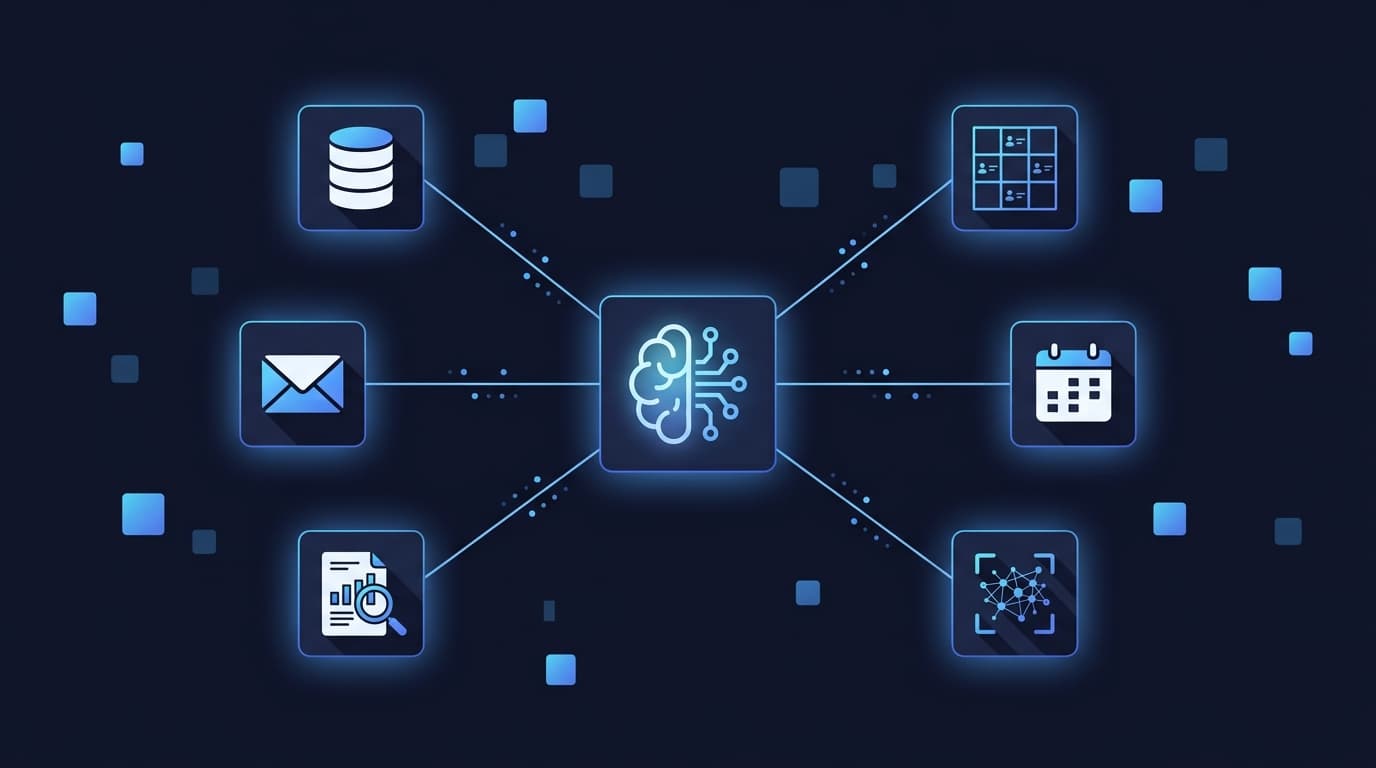
A large language model (LLM) provides the reasoning capability. The agent uses the LLM to understand instructions, plan actions, and generate responses. Common choices are OpenAI's GPT-4 series, Anthropic's Claude, or Google Gemini — selected based on performance on the task type, cost, and latency requirements.
A tool layer gives the agent the ability to take actions: query a database, call an API, read a file, send an email, update a CRM record. Each tool is a defined capability the agent can invoke when the task requires it.
Memory and context management allows the agent to maintain relevant context across a multi-step workflow without losing track of what it already knows or what it has already done.
An orchestration layer manages how the agent sequences its actions, decides when a task is complete, and determines when to escalate to a human.
What the Development Process Looks Like
Building a custom agent well requires disciplined process design before any code is written.
- Workflow definition. What is the agent trying to achieve? What does "done" look like?
- Edge case mapping. What situations does the agent need to handle? Where should it stop and ask a human?
- Tool and integration design. What systems does the agent need access to? How are those integrations secured?
- Prompt and instruction engineering. What instructions does the agent need to behave reliably?
- Testing. How does the agent behave on real historical cases, including the hard ones?
- Deployment and monitoring. How is the agent deployed? How is performance measured over time?
When Your Business Is Ready for Custom AI Agent Development
The right moment is when a workflow is consuming team capacity that could be better spent elsewhere, the workflow is repetitive enough that an agent can learn to handle it reliably, and the stakes of errors are manageable — or the agent can be designed to escalate before errors happen.
If you are spending hours each week on a task that follows a recognisable pattern, that is a candidate for AI agent development. If the task involves judgment calls between limited options, agents can be designed to handle the defined cases and hand off the exceptions.
Frequently Asked Questions
Is AI agent development the same as building a chatbot?
No. Chatbots are conversational interfaces — they respond to questions. AI agents take actions. An AI agent can read an email, query your inventory system, update a record, and send a reply — all as part of completing one task. The conversational interface is optional.
Which industries use custom AI agents?
Technology companies, professional services, e-commerce, healthcare, finance, logistics, and real estate all have active deployments. Any industry with high-volume, process-driven workflows has agent opportunities.
How do AI agents handle sensitive business data?
Custom agents can be deployed in your own infrastructure, with data never leaving your environment. Access controls, audit logging, and role-based permissions are standard components of enterprise agent builds.
How long does it take to build a custom AI agent?
A focused, single-workflow agent with two or three system integrations typically takes 4–8 weeks from discovery to deployment. Scope, number of integrations, and security requirements are the main time variables.
Ready to explore what an AI agent could do for your business? Talk to our team — we'll tell you what's possible, what it takes, and what it will deliver.
Need help with implementation? Synexis Softech provides robust custom AI agent development to help scale your business.
Synexis Softech Team
AI Team Lead
Our team of experienced engineers and digital strategists at Synexis Softech specializes in building production-ready AI solutions, high-performance web applications, and data-driven marketing campaigns. Based in Pokhara, Nepal, we partner with growing businesses globally to turn complex technical challenges into competitive advantages.
Ready to grow your business with technology?
Let's build a practical digital solution for your business.
Talk to Our Team