Mobile App Development for Businesses: Native, Cross-Platform, or PWA?

Table of Contents
- 1. The Three Core Mobile Development Approaches
- 2. Native App Development (iOS / Android)
- 3. Cross-Platform App Development (Flutter / React Native)
- 4. Progressive Web Apps (PWA)
- 5. Key Factors in Your Mobile App Development Decision
- 6. Audience Device Split
- 7. Performance Requirements
- 8. Budget and Timeline
- 9. Ongoing Maintenance
- 10. Mobile App Development with Synexis Softech
The mobile app development question is rarely just "should we build an app?" — it is "what kind of app should we build, and for which platform?" The answer affects development cost, maintenance burden, user experience quality, and the app's ability to grow with the business. This guide breaks down the three main approaches and helps businesses make the right technology choice for their specific requirements.
The Three Core Mobile Development Approaches
Native App Development (iOS / Android)
Native apps are built specifically for a single platform using the platform's native development language and tools: Swift or Objective-C for iOS, Kotlin or Java for Android. Native apps access platform features directly, perform at the highest level, and provide the most polished, platform-consistent user experience.
Best for: Apps with intensive performance requirements (games, video processing, augmented reality, complex graphics), apps that rely heavily on platform-specific features (deep iOS/Android integrations), or apps where the highest possible UX quality is critical to the product's value proposition.
Trade-offs: Requires maintaining two separate codebases (iOS and Android) — higher cost and slower development velocity.
Cross-Platform App Development (Flutter / React Native)
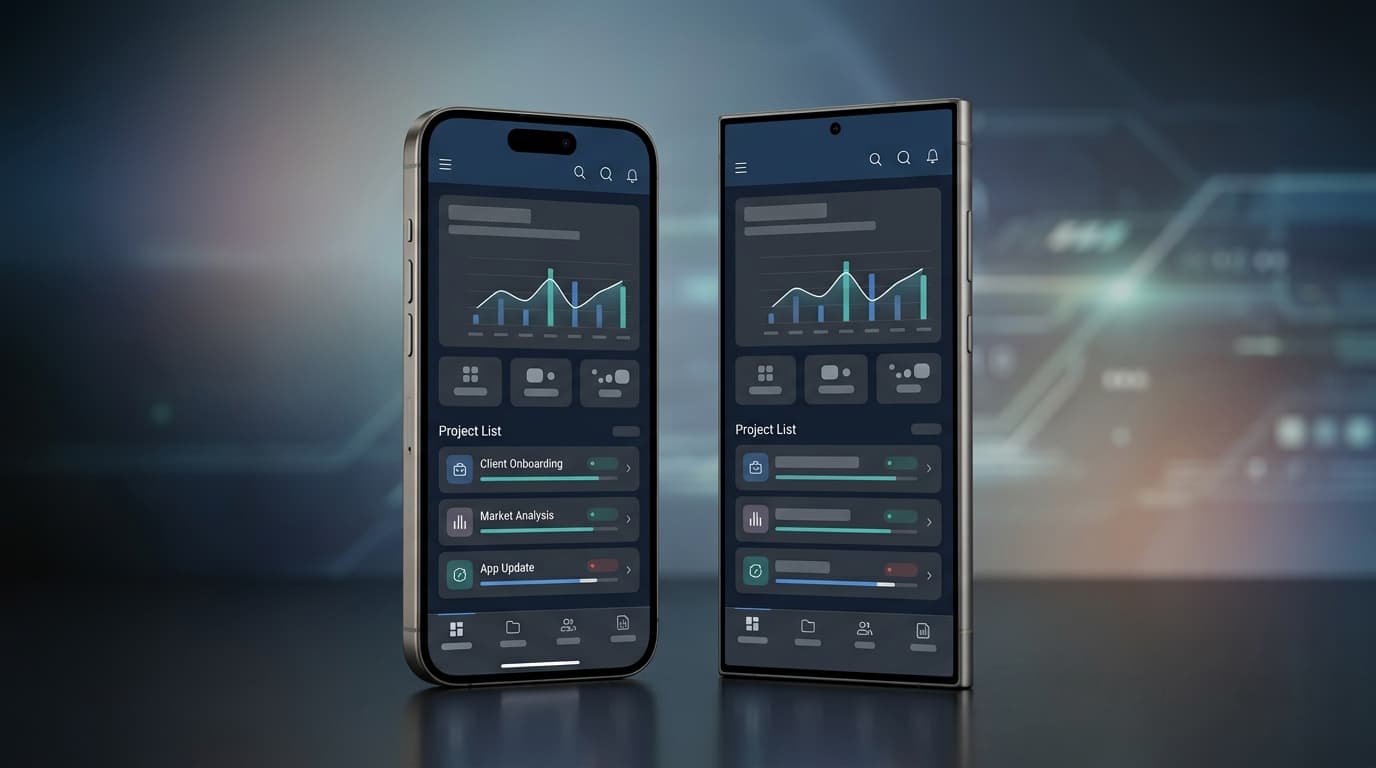
Cross-platform frameworks allow a single codebase to generate apps for both iOS and Android. The two leading frameworks are Flutter (Google's Dart-based framework) and React Native (Meta's JavaScript-based framework).
Modern cross-platform frameworks have closed the gap with native significantly. Flutter apps in particular are widely praised for performance and visual quality that approaches native levels, while dramatically reducing development cost and allowing simultaneous iOS and Android releases.
Best for: Most business applications — enterprise tools, customer-facing apps, e-commerce apps, service apps, productivity tools. The performance gap vs native is minimal for most business use cases, while the cost and maintenance advantages are significant.
Trade-offs: Some advanced platform-specific features require additional bridging work. Very performance-intensive applications may still need native development.
Progressive Web Apps (PWA)
A Progressive Web App is a web application that uses modern browser capabilities to deliver an app-like experience — including offline functionality, home screen installation, push notifications, and responsive design. PWAs are accessed through the browser and do not require App Store or Google Play distribution.
Best for: Content-focused apps, tools where broad accessibility is more important than device feature integration, cases where App Store distribution is a significant barrier, or situations where development budget is very limited.
Trade-offs: Cannot access the full range of device hardware and OS features that native and cross-platform apps can; user discovery is different from App Store/Play Store search; iOS PWA capabilities remain more limited than Android.
Key Factors in Your Mobile App Development Decision
Audience Device Split
What devices does your target audience use? If your users are predominantly on one platform (iOS in many western markets, Android dominant in Nepal and South Asia broadly), this affects the priority order but not necessarily the approach — most business apps should still support both.
Performance Requirements
What are the performance demands of your app? If you are building a complex 3D visualisation tool or real-time video processing application, native is likely the right choice. For a business productivity tool, CRM companion app, or customer-facing service app, cross-platform is typically entirely sufficient.
Budget and Timeline
Cross-platform development (especially Flutter) offers roughly 30–50% cost savings versus building separate native apps for iOS and Android. For businesses with budget constraints and no specific technical requirements that demand native, cross-platform is the pragmatic choice.
Ongoing Maintenance
Consider the long-term maintenance picture. A single cross-platform codebase is significantly cheaper and faster to maintain than two separate native codebases. For small to mid-size organisations without large engineering teams, this ongoing cost difference is often decisive.
Mobile App Development with Synexis Softech
At Synexis Softech, we build mobile applications for businesses across the full development approach spectrum — native iOS and Android, Flutter cross-platform, and React Native. Our team helps clients choose the right approach for their specific requirements, budget, and timeline, and then builds applications with the quality and reliability that business deployment demands.
Contact us to discuss your mobile app development project.
Need help with implementation? Synexis Softech provides robust mobile app development to help scale your business.
Synexis Softech Team
Senior Full-Stack Developer
Our team of experienced engineers and digital strategists at Synexis Softech specializes in building production-ready AI solutions, high-performance web applications, and data-driven marketing campaigns. Based in Pokhara, Nepal, we partner with growing businesses globally to turn complex technical challenges into competitive advantages.
Ready to grow your business with technology?
Let's build a practical digital solution for your business.
Talk to Our Team