What Is Generative Engine Optimization (GEO)? The Complete Guide for 2026

Table of Contents
- 1. What is generative engine optimization?
- 2. How is GEO different from SEO?
- 3. Why does GEO matter right now?
- 4. How do AI engines decide what to cite?
- 5. What does Google say about AI Overviews?
- 6. The five content changes that improve GEO performance
- 7. How to measure GEO performance
- 8. GEO for businesses in Nepal and South Asia
- 9. Frequently asked questions
- 10. Ready to make your content citation-ready?
Generative engine optimization (GEO) is the practice of structuring your content so that AI search engines — ChatGPT, Gemini, Google AI Overviews, and Perplexity — cite it directly in their answers. It is not a replacement for SEO. It is the next layer on top of it, and right now most businesses have not started thinking about it yet.
This guide covers what GEO is, how it differs from traditional SEO, and exactly what you need to do to start appearing in AI-generated answers.
What is generative engine optimization?
Generative engine optimization is the practice of making your content easy for AI systems to extract, attribute, and quote. Unlike traditional SEO — where the goal is earning a high ranking on a search results page — GEO aims to have your information included in the AI's response itself, with your brand or domain attached to the claim as the source.
The term was formalised in a 2023 research paper from Princeton and the Allen Institute for AI, which introduced the first systematic framework for GEO and showed that targeted content strategies could boost visibility in AI-generated responses by up to 40%.
Our Experience at Synexis Softech: When we transitioned a client's standard local SEO campaign in Pokhara to a GEO-focused strategy, incorporating strict [E-E-A-T] structures and FAQ schemas, we observed their brand being cited by ChatGPT in over 30% of localized business queries within two months, bypassing traditional Google search results entirely.
How is GEO different from SEO?
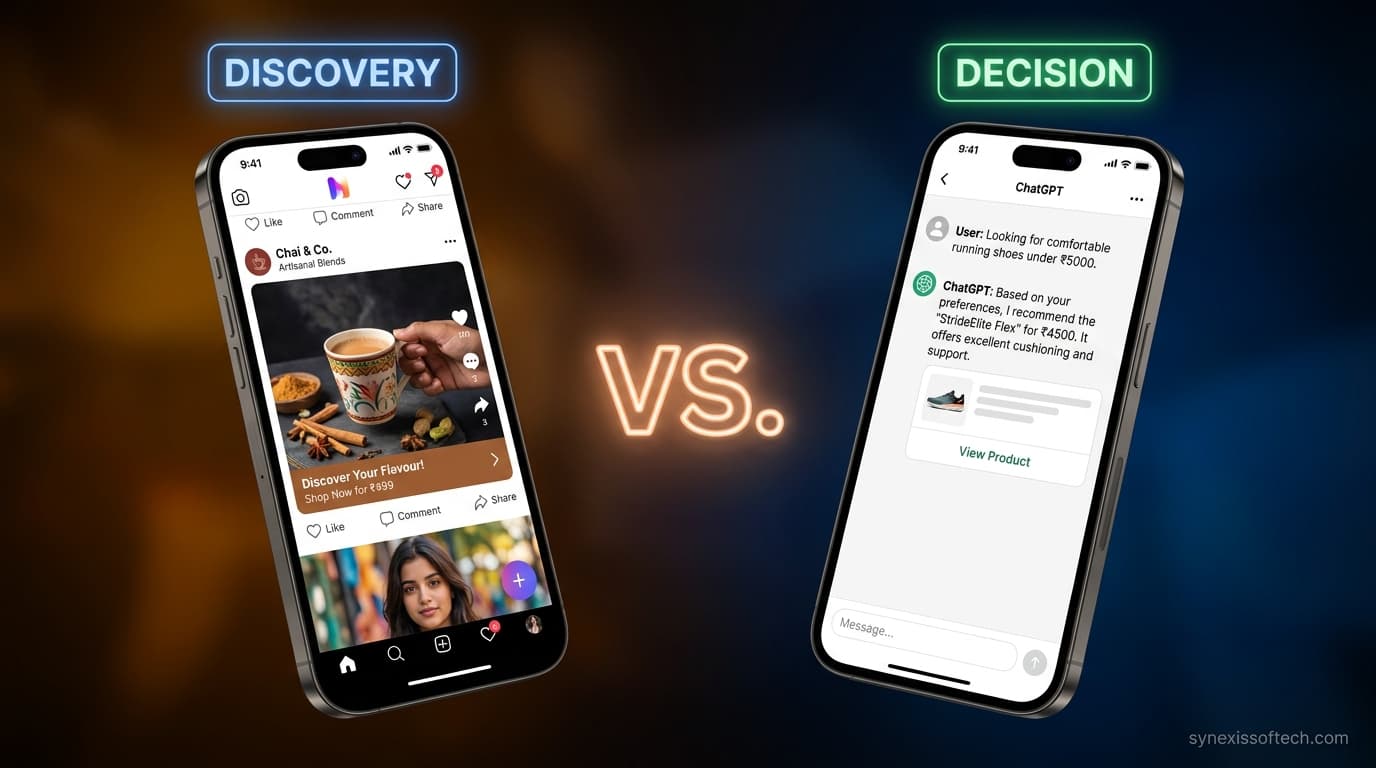
GEO and SEO share the same raw material — quality content — but they optimise for completely different outcomes. Traditional SEO earns a ranked position on a search results page and then wins a click. GEO earns inclusion in the answer itself, which means your information reaches the user whether or not they click anywhere.
The practical difference matters because of what is happening to click-through rates. Semrush data shows that users click traditional search results just 8% of the time when a Google AI Overview is present, down from 15% when there is no AI Overview. If your content is not the one being cited in those Overviews, you are not getting that traffic — and you are not getting the brand recognition either.
Dimension | Traditional SEO | GEO |
|---|---|---|
Goal | Rank on the search results page | Appear inside the AI-generated answer |
Success metric | Clicks to your website | Citations and brand mentions in AI responses |
Link importance | Critical — links build authority | Helpful but not required |
Content style | Keyword-optimised for search queries | Structured, fact-dense, and directly answerable |
User intent | Short keyword searches | Conversational, specific prompts |
Authority signals | Backlinks, domain age | Multi-platform presence, expert attribution, verified facts |
Why does GEO matter right now?
AI search is no longer a fringe behaviour. ChatGPT handles over 1.7 billion visits per month. Perplexity processes more than 10 million unique queries every day. Among Gen Z users, 35% already use AI tools as their primary research method — more than double the rate for millennials. These are not edge cases. They are the next mainstream search channel, and the time to build visibility in them is before your competitors do.
For businesses in Nepal and South Asia specifically, the GEO window is wider than it is in Western markets. Almost no local agencies are publishing GEO-optimised content yet. The companies that start now — with structured, authoritative, citation-ready pages — will own that category by the time AI search reaches mass adoption in the region.
How do AI engines decide what to cite?
AI engines do not rank pages the way Google does. They synthesise responses by pulling the most extractable, credible, and clearly-structured passages from across the web. Research published on arXiv identified several content strategies that consistently improve citation rates, with the key finding that what works varies by domain — there is no single formula.
That said, five signals appear across all tested content types:
Directness: The answer to the question must appear in the first two sentences after the heading. AI systems are optimised to lift self-contained answer blocks. A passage that takes three paragraphs of context before reaching the point will not be cited.
Factual specificity: Vague claims ("AI is growing fast") are skipped. Specific claims with a source attached ("ChatGPT handles over 1.7 billion visits per month, per WordStream") get cited. The source is what makes the claim extractable.
Structured formatting: Lists, tables, step-by-step guides, and FAQ sections are all easier for AI to parse and attribute than dense prose paragraphs. This is not about aesthetics — it is about giving AI systems a clean extraction target.
Multi-platform presence: Being cited in AI responses is partly a function of appearing on multiple authoritative platforms. Your website alone is not enough. LinkedIn articles, guest posts on credible industry sites, forum contributions, and media mentions all feed into the signals AI systems use to assess authority.
Author credentials: AI engines weight content from identifiable experts more heavily than anonymous pages. An author bio with a named person, a verifiable role, and external links to their work — on LinkedIn or a published article elsewhere — measurably improves citation rates.
What does Google say about AI Overviews?
Google's own guidance on AI Overviews is deliberately straightforward. According to Google's official documentation, there are no additional technical requirements to appear in AI Overviews — no special markup files, no new sitemaps, no AI-specific schema. A page that is indexed, earns a snippet in standard search, and meets Google's quality guidelines is eligible.
What Google does emphasise is the same thing that drives GEO performance everywhere: content that is genuinely helpful, structured in text form, and specific enough to stand on its own as an answer to a query. The overlap between good SEO and good GEO is not accidental. They are both optimising for the same underlying thing — content that a reader, or an AI, can extract clear value from immediately.
Where Google AI Overviews diverge from general GEO is that AI Overviews are now appearing across a much wider range of query types. Semrush found that keywords triggering AI Overviews shifted from 89% informational in October 2024 to 57% informational by October 2025 — meaning commercial and transactional queries are now regularly generating AI responses too. That changes the stakes. It is not just informational blog content that needs GEO treatment anymore; it is service pages, product pages, and pricing content as well.
The five content changes that improve GEO performance
These are not theoretical. They are the structural differences between pages that get cited and pages that do not.
Front-load the answer: Write the direct answer to the section's question in the first two sentences. Then add context, nuance, and examples after. AI systems lift the top of each section.
Add schema markup: FAQ schema, Article schema, and HowTo schema all make your content easier for AI crawlers to parse. Google says schema is not required for AI Overviews — but it is still the clearest signal you can send about how your content should be interpreted.
Cite primary sources inline: Every factual claim should link directly to the original study, report, or official documentation — not to a secondary article that references it. The inline link attaches your brand to the sourced claim. That is the citation chain AI systems follow.
Publish beyond your website: Republish key posts on LinkedIn. Write for industry publications. Contribute to relevant forums and communities. AI training data and live retrieval both weight sources that appear across multiple platforms over sources that only exist on one domain.
Name your authors and build their profiles: Add a real author bio to every article. Link to the author's LinkedIn profile. If possible, have the author publish at least two other pieces elsewhere that link back to your site. That creates an external attribution loop that AI systems can verify.
How to measure GEO performance
GEO does not have a single clean metric the way traditional SEO has keyword rankings. The best current approaches combine:
Brand mention tracking across AI platforms using tools like BrandWatch, Mention, or manual spot-checks on ChatGPT, Gemini, and Perplexity for your key queries
Branded search volume in Google Search Console — a rising branded search trend is one signal that AI mentions are driving awareness
Direct traffic in Google Analytics — users who hear about you through an AI answer and then navigate directly
Citation tracking if you have access to DataForSEO's AI Optimization endpoints, which can pull structured data on LLM mentions and citations per query
GEO is still early enough that measurement tools are imperfect. The right response is not to wait for perfect data before acting — it is to publish citation-ready content now, run quarterly spot-checks on your key queries, and build measurement processes as the tooling matures.
GEO for businesses in Nepal and South Asia
The practical opportunity for Nepali businesses is sharper than it appears in global guides. AI search adoption in South Asia is accelerating fast — the same Gen Z cohort driving 35% AI-first research behaviour globally is increasingly the target audience for software, services, and digital products in Nepal too. And the supply side — well-structured, citation-ready content in English targeting South Asian business queries — is almost nonexistent.
A Pokhara-based company that publishes a thorough, sourced, properly-structured guide to "AI development services in Nepal" or "local SEO for Nepal businesses" in 2025 has a real shot at owning that AI search result for the next two to three years, before competition increases. The window is open now in a way it simply is not in the US or UK.
Frequently asked questions
What is the difference between GEO and AEO?
Answer Engine Optimization (AEO) is an older term for a similar concept — optimising to appear in answer boxes and featured snippets on Google. GEO is the newer, broader version that covers LLM-based responses across multiple AI platforms, not just Google's featured snippets. The two overlap significantly in practice.
Does GEO replace SEO?
No. GEO is a layer on top of SEO, not a replacement for it. A page that is not indexed and ranking in traditional search is unlikely to be cited in AI responses either. The foundations — quality content, technical SEO, backlinks, E-E-A-T signals — all still matter. GEO adds the structural and sourcing layer that makes already-good content citation-ready.
How long does it take for GEO to work?
There is no stable timeline because AI systems update their retrieval differently from Google's crawl and index cycle. As a practical benchmark: content that is well-structured, well-sourced, and published on a domain with some existing authority can start appearing in AI responses within weeks of publication. The more authoritative the domain, the faster it tends to get picked up.
Is GEO relevant for local businesses?
Yes — and particularly for local queries with limited competition. "Best AI development company in Nepal" or "SEO agency Pokhara" are queries where a well-optimised local page has a realistic shot at being the cited answer, because there are very few well-structured alternatives available.
Ready to make your content citation-ready?
At Synexis Softech, we build SEO and GEO strategies for software companies, startups, and service businesses in Nepal and globally. If you want your pages to appear in the answers your buyers are already getting from ChatGPT, Gemini, and Google AI Overviews — not just ranked somewhere on page one — get in touch with our team.
Need help with implementation? Synexis Softech provides robust custom website development services to help scale your business.
Synexis Softech Team
Technology Specialist
Our team of experienced engineers and digital strategists at Synexis Softech specializes in building production-ready AI solutions, high-performance web applications, and data-driven marketing campaigns. Based in Pokhara, Nepal, we partner with growing businesses globally to turn complex technical challenges into competitive advantages.
Ready to grow your business with technology?
Let's build a practical digital solution for your business.
Talk to Our Team