Generative AI Development Services: What to Expect and How to Choose

Table of Contents
- 1. What Generative AI Development Services Include
- 2. The Three Tiers of Generative AI Development
- 3. What the Discovery Phase Should Produce
- 4. How to Evaluate Generative AI Development Providers
- 5. Frequently Asked Questions
- 6. How much do generative AI development services cost?
- 7. How long does a generative AI development project take?
- 8. What should we prepare before engaging a generative AI development company?
- 9. Can we start with a small pilot and expand?
The generative AI services market has a visibility problem: the companies that spend the most on marketing are not necessarily the ones that build the best AI systems. In a category where capability genuinely varies and where project complexity hides failure for months, evaluating vendors correctly matters as much as the technology decision itself.
This guide describes what generative AI development services actually include, how to evaluate providers, and what good delivery looks like at each stage of a project.
What Generative AI Development Services Include
Generative AI development services cover the full lifecycle of building AI systems that generate content, code, decisions, or actions — from architecture design through production deployment and ongoing optimisation. The scope varies significantly between providers: some offer only API integration and prompt engineering; others build custom model pipelines, fine-tuned models, and full-stack AI applications with proprietary data infrastructure.
Understanding which of these your project requires is the first evaluation decision. Most business AI projects do not require custom model training. They require good architecture, reliable integration, and disciplined prompt engineering applied to a best-in-class foundation model. Paying for custom model training when the use case does not warrant it is a common and expensive mistake.
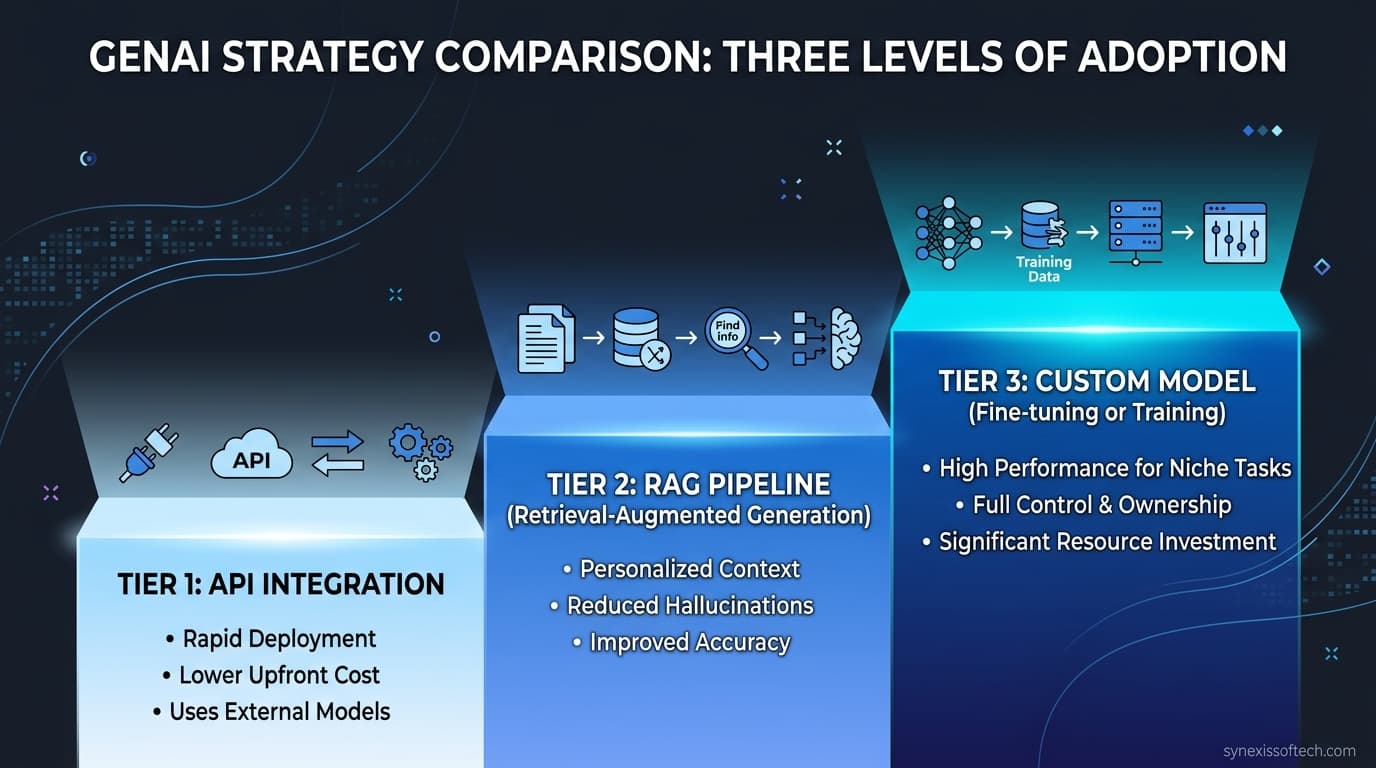
The Three Tiers of Generative AI Development
Tier 1: API integration and prompt engineering. The application calls a foundation model API (OpenAI, Anthropic, Google) with carefully designed prompts and integrates the outputs into a product or workflow. Most business AI projects should start here. The investment is in good prompt design, evaluation frameworks, and integration engineering — not in model development. This tier delivers value faster and at lower cost than the alternatives.
Tier 2: Custom pipelines with retrieval augmentation. The application connects foundation models to proprietary data via RAG architectures, vector databases, and custom ingestion pipelines. This is appropriate when the AI needs to answer from your specific knowledge base rather than general training data — support systems, internal knowledge retrieval, document intelligence. The investment adds data infrastructure and retrieval engineering to the Tier 1 foundation.
Tier 3: Fine-tuned or custom models. The foundation model is further trained on domain-specific data to change its reasoning patterns or vocabulary for a specialised domain. Appropriate when the domain is genuinely different from the base model's training — specialist medical AI, highly technical domain Q&A, proprietary code generation for a specific framework. The investment is substantially higher and the time to value is longer. Most business AI projects do not need this tier.
What the Discovery Phase Should Produce
Any generative AI development engagement should begin with a discovery phase that produces a written technical specification before development begins. This specification should include: the use case in precise terms (not "AI-powered support" but "a system that resolves tier-1 billing queries without human involvement for users of our SaaS platform"), the data sources and system integrations required, the chosen architecture and model selection with rationale, the evaluation framework that defines what "working" means, the security and data handling design, the timeline and milestone structure, and the success metrics the project will be measured against.
A provider who cannot produce this document — or who begins development without it — is not operating with the discipline required for production AI delivery.
How to Evaluate Generative AI Development Providers
Ask about their evaluation framework. How do they test whether the AI system is working before it goes to production? A provider without a clear answer to this question has not delivered AI systems that have been seriously tested.
Ask about failure modes. What happens when the AI produces a wrong or harmful output? How is this detected, how is the user protected, and how is the system updated to prevent recurrence? A provider who has only thought about the success case has not operated AI in production.
Ask who owns the code, models, and data. The answer should be unambiguously "you do." Any complexity or hedging in this answer warrants follow-up.
Ask for a technical walkthrough of a relevant past project. A genuine capability description includes: the model used and why, the architecture, how retrieval was implemented, how outputs were evaluated, and what problems were encountered and how they were resolved. Generic case studies and client logos are marketing. Technical walkthroughs reveal capability.
Frequently Asked Questions
How much do generative AI development services cost?
Cost varies significantly based on scope. A Tier 1 API integration project for a focused use case can be completed in weeks at a cost comparable to standard software development. A Tier 2 RAG system with multiple data sources and system integrations costs more and takes longer. A Tier 3 fine-tuning project is a substantial investment measured in months. The right question is not "how much does AI development cost?" but "what architecture does my use case require, and what does that architecture cost to build well?"
How long does a generative AI development project take?
A focused Tier 1 project takes four to eight weeks from discovery to production. A Tier 2 RAG system takes eight to sixteen weeks. A Tier 3 fine-tuning project takes twelve weeks or more depending on data preparation requirements and iteration cycles. These timelines assume clear requirements and available data — projects that begin without either take longer.
What should we prepare before engaging a generative AI development company?
Three things. First, a clear problem statement: the specific workflow or use case you want to improve and why the current state is inadequate. Second, a description of the data you have available: what systems it lives in, how much of it exists, and whether it is currently accessible programmatically. Third, a success definition: what specific metric would tell you the project has delivered its intended value. These three inputs make discovery faster and the resulting specification more reliable.
Can we start with a small pilot and expand?
Yes, and this is usually the recommended approach. A well-scoped pilot demonstrates value against a real metric, builds organisational understanding of how AI development works, and de-risks the larger investment. We design pilots to be architecturally compatible with the full production system — so the pilot is not throwaway work but the foundation of what scales.
Talk to Synexis Softech about your generative AI project — we start with a structured discovery, not a sales presentation.
Need help with implementation? Synexis Softech provides robust custom AI agent development to help scale your business.
Synexis Softech Team
Lead AI Engineer
Our team of experienced engineers and digital strategists at Synexis Softech specializes in building production-ready AI solutions, high-performance web applications, and data-driven marketing campaigns. Based in Pokhara, Nepal, we partner with growing businesses globally to turn complex technical challenges into competitive advantages.
Ready to grow your business with technology?
Let's build a practical digital solution for your business.
Talk to Our Team