How to Build a Custom AI Strategy for Your Business in 2025

Table of Contents
- 1. What a Real AI Strategy Looks Like
- 2. The Five Questions Every AI Strategy Must Answer
- 3. The AI Strategy Framework Synexis Softech Uses
- 4. Common AI Strategy Mistakes and How to Avoid Them
- 5. Frequently Asked Questions
- 6. How long does an AI strategy engagement take?
- 7. Do we need a large data team to implement an AI strategy?
- 8. Should we build AI in-house or work with an external partner?
- 9. How do we get leadership buy-in for an AI strategy?
The fastest way to waste your AI budget is to buy tools before you know what problem you are solving. Most businesses do exactly this — they adopt an AI product because a competitor did, or because a vendor's demo looked impressive, and then discover months later that the tool does not integrate with their actual workflow.
An AI strategy built the right way works in the opposite direction: business problem first, technology second.
What a Real AI Strategy Looks Like
A custom AI strategy is a prioritised plan that maps specific business problems to specific AI capabilities, sequences implementation by impact and feasibility, and defines how success is measured before a single tool is purchased. It is not a technology adoption roadmap. It is a business improvement plan that happens to use AI as the primary mechanism.
The output of a good AI strategy is a prioritised list of AI initiatives — each with a defined problem, a proposed solution approach, an estimated impact, an implementation timeline, and a success metric. Executives can make resource allocation decisions from this document. Development teams can begin work from it immediately.
The Five Questions Every AI Strategy Must Answer
1. What specific business problems are we solving? Not "become an AI company." Specific problems: the sales team takes 3 days to qualify leads, customer support handles 800 tickets per day with a team of 12, finance closes take 10 days because of manual reconciliation. Specificity is what makes the strategy actionable.
2. Which of these problems have the highest business impact if solved? Not every problem worth solving is worth solving now. Impact scoring considers: revenue effect, cost effect, risk reduction, and competitive advantage. The top-ranked problems become Phase 1 of the implementation roadmap.
3. What AI capability addresses each problem? This is where technical knowledge is required. Different problems require different AI approaches: a classification problem requires a different solution than a generation problem, a retrieval problem requires RAG not fine-tuning, a workflow automation problem requires an agent architecture not a chatbot. Mismatching the solution to the problem is the most common cause of failed AI projects.
4. What data, systems, and infrastructure do we have to work with? AI systems need data to be useful and systems to be integrated with to take action. An honest assessment of the current data and technology landscape identifies what can be built now versus what requires infrastructure preparation first.
5. How do we measure success? Every AI initiative should have a baseline metric and a target improvement defined before development begins. Without a baseline, you cannot demonstrate value. Without a target, you cannot know when the initiative has succeeded.
The AI Strategy Framework Synexis Softech Uses
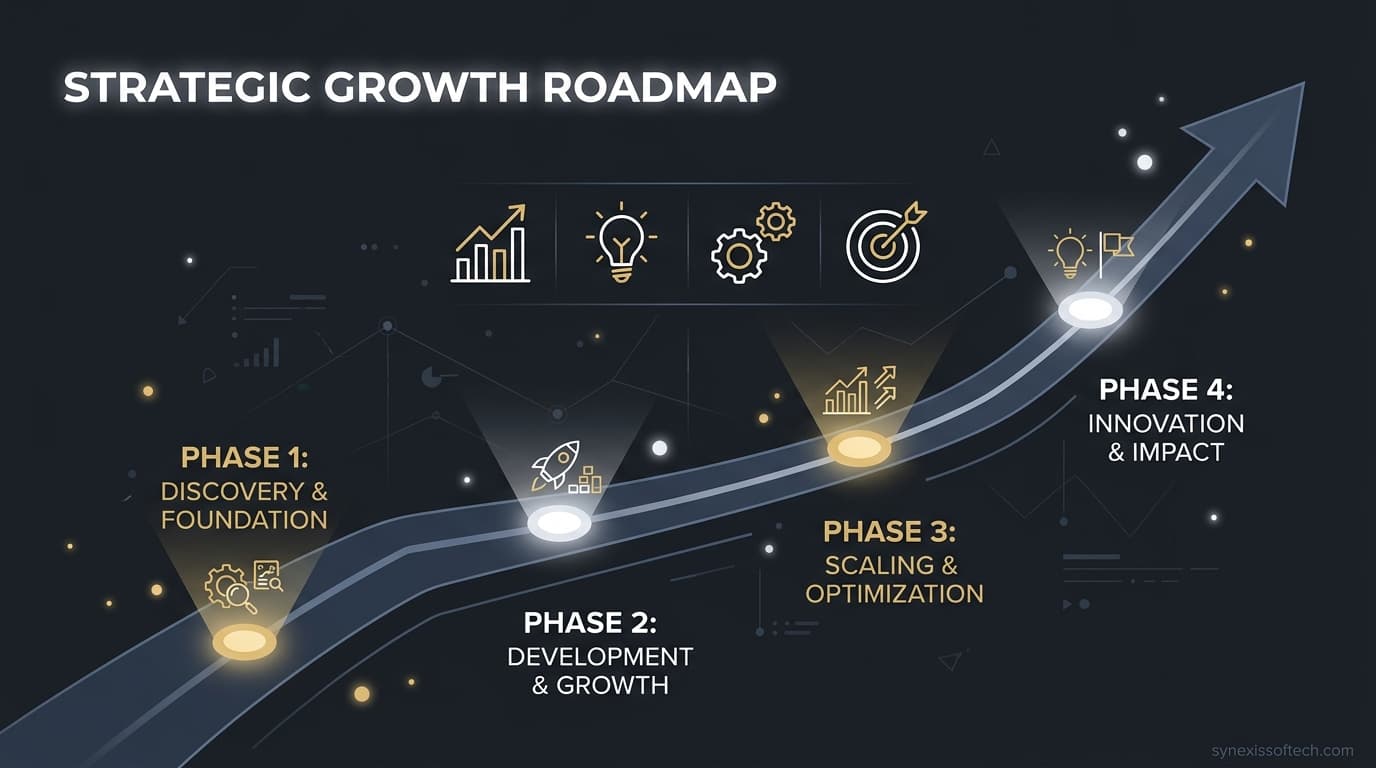
We structure AI strategy engagements in four phases. The first is discovery — working sessions with business leaders and operational teams to surface the specific problems consuming the most cost, time, and risk. The second is opportunity mapping — translating those problems into AI solution candidates and scoring each by impact, feasibility, and strategic fit. The third is architecture design — defining the technical approach for the highest-priority initiatives, including data requirements, system integrations, build-vs-buy decisions, and security considerations. The fourth is roadmap and governance — sequencing the initiatives into a phased implementation plan with success metrics, resource requirements, and a governance model for AI deployment across the organisation.
The output is a document your leadership team can present to a board, your development team can act on, and your finance team can budget against. It is not a slide deck of AI use case possibilities. It is a decision-ready plan.
Common AI Strategy Mistakes and How to Avoid Them
Buying the tool before defining the problem. The solution: define the problem and measure the current state before evaluating any vendor. A vendor demo answers "what can this tool do?" The strategy question is "what does our business need done?"
Choosing the most impressive technology instead of the most appropriate one. A fine-tuned custom model is more impressive than a prompt-engineered API call. It is also ten times more expensive to build and maintain. The right tool is the one that solves the problem reliably at the lowest total cost of ownership.
Starting with the most complex problem. Phase 1 of an AI strategy should demonstrate value quickly to build organisational confidence. Start with high-impact, lower-complexity problems. Reserve the complex enterprise-wide initiatives for Phase 2, once the organisation has developed its AI implementation capability.
Treating AI as an IT project. AI initiatives that succeed are owned by business stakeholders, not IT. The person who feels the pain of the problem being solved should be the sponsor of the initiative — with IT as the implementation partner, not the owner.
Frequently Asked Questions
How long does an AI strategy engagement take?
A structured AI strategy engagement for a growing business typically takes four to six weeks: one to two weeks for discovery interviews and data review, one to two weeks for opportunity mapping and solution design, and one week for roadmap development and documentation. Larger enterprises with multiple business units take longer.
Do we need a large data team to implement an AI strategy?
Not necessarily at the start. Many high-value AI initiatives draw on data that already exists in your business systems — CRM records, support tickets, documents, email — without requiring a data warehouse or data engineering team to be built first. The strategy phase identifies what data is needed for each initiative and whether it is available or needs to be created.
Should we build AI in-house or work with an external partner?
The right answer depends on your core business. If AI is your core product, building in-house capability is a competitive necessity. If AI is a capability you use to run your business better, an external partner for the initial build — followed by internal ownership of the deployed system — is usually the most efficient path. Most growing businesses do not need a permanent AI engineering team; they need a reliable external partner who builds systems they own and operate.
How do we get leadership buy-in for an AI strategy?
Leadership buy-in follows demonstrated value, not theoretical potential. The most effective approach is a small, high-visibility pilot project that produces a measurable result within 60 to 90 days — then uses that result to fund the broader roadmap. We help clients design these pilots as part of the strategy process.
Work with Synexis Softech to build your AI strategy — a structured engagement that produces a decision-ready plan, not a deck of possibilities.
Need help with implementation? Synexis Softech provides robust custom AI agent development to help scale your business.
Synexis Softech Team
Business Development Manager
Our team of experienced engineers and digital strategists at Synexis Softech specializes in building production-ready AI solutions, high-performance web applications, and data-driven marketing campaigns. Based in Pokhara, Nepal, we partner with growing businesses globally to turn complex technical challenges into competitive advantages.
Ready to grow your business with technology?
Let's build a practical digital solution for your business.
Talk to Our Team