Custom AI Agent Development for Businesses

Table of Contents
- 1. What a Custom AI Agent Actually Does
- 2. Why Businesses Build Custom Agents Instead of Buying Pre-Built Tools
- 3. What Custom AI Agent Development Involves
- 4. What to Expect From a Custom AI Agent Build
- 5. Use Cases We Build Most Often
- 6. Frequently Asked Questions
- 7. What is the difference between a custom AI agent and a workflow automation tool like Zapier?
- 8. Do I need a large amount of data to build an AI agent?
- 9. Can an AI agent work alongside human team members?
- 10. How do I measure whether my AI agent is delivering value?
Most software automates a fixed task. An AI agent completes a goal — and figures out the steps to get there.
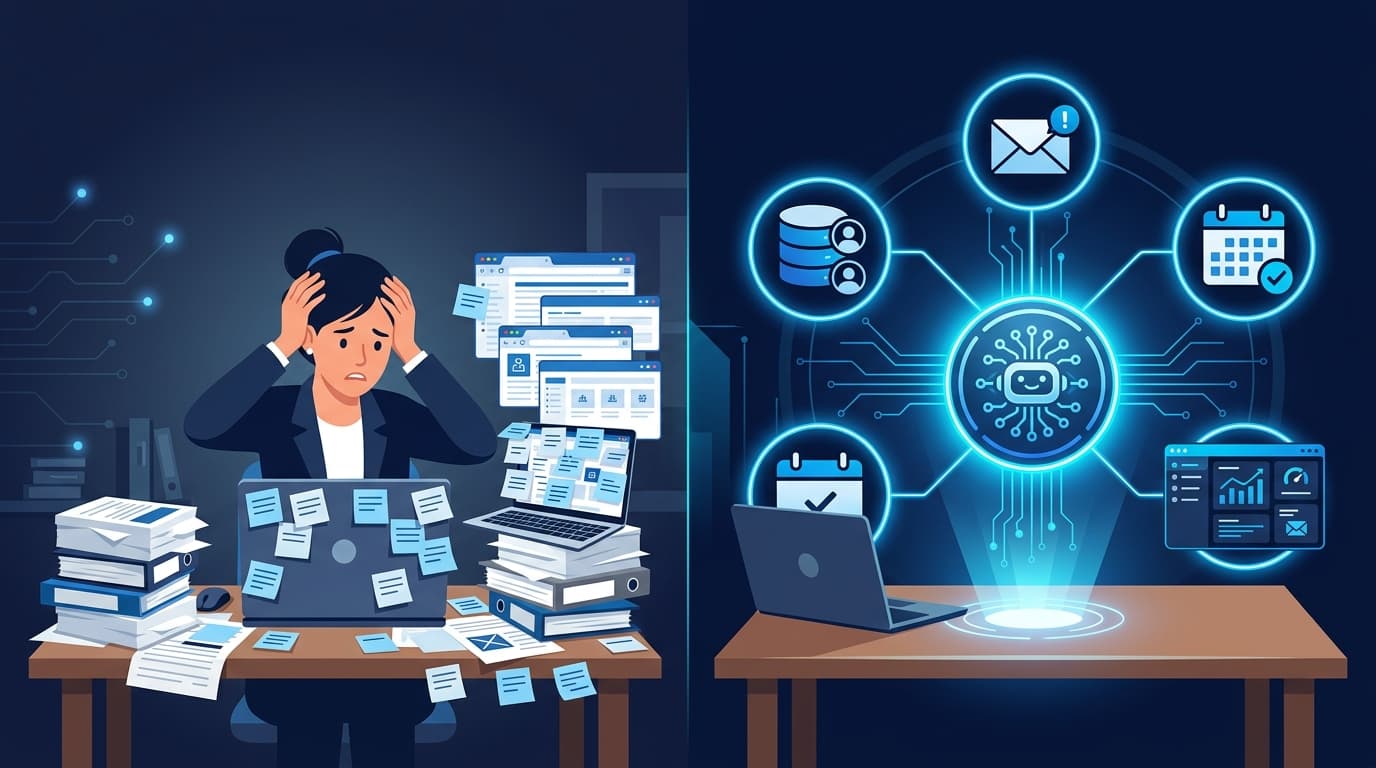
That distinction matters when your business workflows involve decisions, not just data entry. Off-the-shelf tools can automate the routine. Custom AI agents handle the complex: qualifying a lead, drafting a proposal, checking stock, updating a CRM record, and sending a follow-up — all from a single natural-language request.
What a Custom AI Agent Actually Does
A custom AI agent is software that understands a goal, breaks it into steps, and uses your business tools to complete it — without a human managing each action. Unlike a chatbot that answers questions, an agent takes actions across your systems until the job is done.
The difference in practice: a chatbot tells a customer their order status. An AI agent receives the customer's message, queries the fulfilment system, detects a delay, drafts an apology with a revised timeline, logs the interaction in your CRM, and flags the account for a proactive check-in next week — all without human involvement.
Why Businesses Build Custom Agents Instead of Buying Pre-Built Tools
Pre-built AI tools are built around their vendor's idea of your workflow. They cover 80% of standard cases well and the last 20% poorly or not at all.
Custom agents are built around your actual process — your CRM schema, your pricing logic, your compliance rules, your escalation thresholds. That alignment is what makes the automation reliable enough to trust with real business outcomes.
Businesses that have invested in custom AI agent development consistently report three shifts:
- Staff time redirects to higher-value work. Routine coordination, data entry, and status updates stop consuming senior team members' hours.
- Response times compress. Tasks that wait in a human queue now happen in seconds.
- Consistency improves. An agent applies your rules the same way every time. Human teams don't.
What Custom AI Agent Development Involves
Building an effective agent is not primarily a model selection exercise. The hard work is in process design and integration.
Discovery and workflow mapping. The agent needs a precise definition of what "done" looks like. Vague goals produce vague results. A good discovery process surfaces the real decision logic — including the edge cases humans handle intuitively.
Tool and system integration. Agents get useful by connecting to the systems where your business actually runs: CRM, helpdesk, ERP, databases, APIs, email. Each integration is a capability.
Prompt engineering and instruction design. The agent's instructions define its behaviour. Writing clear, tested instructions — and building in the right guardrails — is a craft, not a configuration setting.
Testing against real scenarios. Agents behave differently on edge cases than on clean examples. Rigorous testing with real historical cases before deployment prevents the "it works in demos" failure mode.
Evaluation and monitoring. Once deployed, agent performance needs measurement. Are tasks completing? Where does the agent hand off to humans, and why?
What to Expect From a Custom AI Agent Build
Timeline. A focused, single-workflow agent with two or three system integrations typically takes 4–8 weeks from discovery to deployment. More complex agents with broader scope take longer.
Cost drivers. The main variables are workflow complexity, number of system integrations, volume of data access, and security requirements.
What you own. Custom agents built by Synexis Softech are yours — source code, deployment infrastructure, and documentation. You are not locked into our ongoing fees to run your agent.
Use Cases We Build Most Often
- Sales support: Lead qualification, research, outreach drafting, CRM updates, meeting scheduling
- Customer support: First-line ticket resolution, account queries, status updates, escalation with context
- Operations: Invoice processing, order management, cross-system data synchronisation
- Internal tools: HR policy queries, IT service desk, internal knowledge retrieval
Frequently Asked Questions
What is the difference between a custom AI agent and a workflow automation tool like Zapier?
Workflow automation tools connect predefined triggers to predefined actions — they follow a fixed script. AI agents reason about what to do next based on context, handle ambiguity, and adapt to situations their instructions did not explicitly anticipate. They are better suited to workflows that involve judgment or variable inputs.
Do I need a large amount of data to build an AI agent?
Not necessarily. Agents built on large language models bring broad capability without custom training data. What you need is clear access to your CRM, product database, and knowledge base. Quality of that data matters more than quantity.
Can an AI agent work alongside human team members?
Yes, and this is usually the right design. Most effective deployments use agents to handle routine cases automatically and escalate to humans when the situation requires judgment or relationship context. The agent includes handoff context so the human picks up without friction.
How do I measure whether my AI agent is delivering value?
Define the metric before you build: tickets resolved without human involvement, hours saved per week, time-to-response on lead qualification. Set a baseline, deploy the agent, and measure against it. We recommend a 60-day post-deployment review as standard.
Talk to our team about custom AI agent development — book a 30-minute scoping call to map your first AI agent workflow.
Need help with implementation? Synexis Softech provides robust custom AI agent development to help scale your business.
Synexis Softech Team
AI Team Lead
Our team of experienced engineers and digital strategists at Synexis Softech specializes in building production-ready AI solutions, high-performance web applications, and data-driven marketing campaigns. Based in Pokhara, Nepal, we partner with growing businesses globally to turn complex technical challenges into competitive advantages.
Ready to grow your business with technology?
Let's build a practical digital solution for your business.
Talk to Our Team