What AI Advertising and ChatGPT Could Mean for Nepalese Businesses

Table of Contents
- 1. How AI Is Already Shaping Discovery for Nepalese Customers
- 2. Five Business Scenarios That Show Why This Matters
- 3. What Nepal Can Learn From India's AI Advertising Head Start
- 4. Which Nepalese Businesses Are the Most Urgent Candidates for AI Readiness
- 5. The Business Message Behind the Technology Shift
- 6. How Synexis Softech Supports Nepalese Businesses in the AI Era
- 7. Frequently Asked Questions
- 8. Is ChatGPT advertising available in Nepal?
- 9. Do small businesses in Nepal need to worry about AI?
- 10. Can AI currently recommend my restaurant or hotel in Nepal?
- 11. How is AI discovery different from Google search for local businesses?
- 12. What is the most important thing a Nepalese small business can do right now?
- 13. Will ChatGPT ads eventually come to Nepal?
In August 2026, OpenAI began showing advertisements on ChatGPT in India — the platform's first commercial advertising market. Nepal is not included in that launch. But the question Nepalese businesses should be asking is not "when does it come to Nepal?" The more useful question is: how is AI already changing how customers find and evaluate businesses, and is my business ready for that shift?
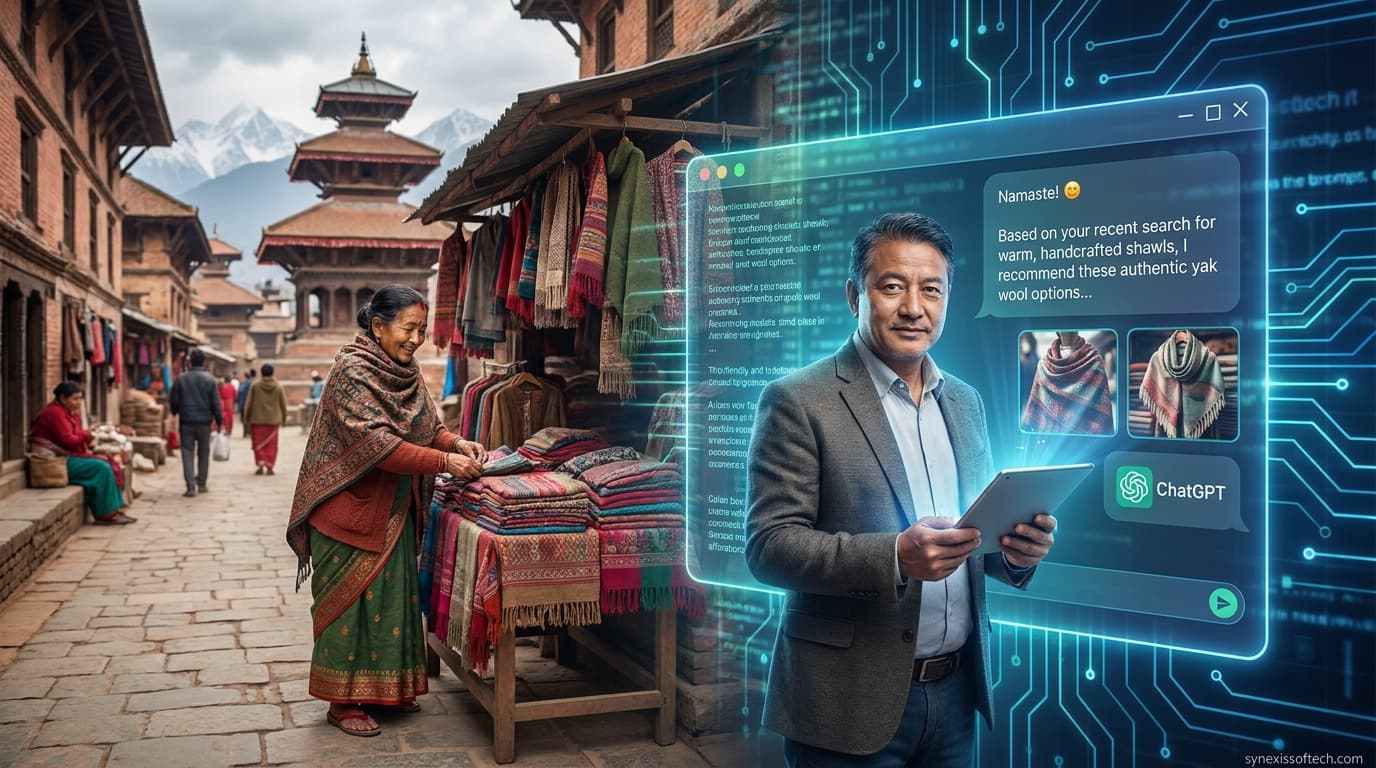
Because AI-driven discovery is not waiting for a formal advertising launch. It is already happening, in ways that affect businesses in Kathmandu, Pokhara, Lalitpur, Biratnagar, Chitwan, and every other city where customers have internet access and are using AI tools to make decisions.
How AI Is Already Shaping Discovery for Nepalese Customers
ChatGPT is accessible in Nepal. It is not blocked, not restricted, and not limited in its functionality. A significant and growing number of Nepalese students, professionals, travelers, and consumers are already using it regularly.
When those users ask ChatGPT questions about businesses, products, and services in Nepal, the AI generates responses based on the information it can access about those businesses. Whether your business appears in those responses — and how it is represented — depends on your digital presence, your content, and the quality of your information online.
This is already happening without any advertising component. And it means the AI visibility question for Nepalese businesses is not a future issue. It is a present one.
Five Business Scenarios That Show Why This Matters
Scenario 1: A Clothing Store in Kathmandu
A customer in Butwal wants to order a traditional kurta for a wedding. They cannot travel to Kathmandu. They ask ChatGPT: "I need a good Nepali clothing brand for traditional wear for a wedding, who ships across Nepal?" The AI generates a response. Whether your clothing brand is included depends on whether the AI can find clear, accurate, and trustworthy information about what you sell, who you are, and how customers can order from you.
A business with a well-described product catalog, a website that loads properly, Google Business Profile information, and genuine customer reviews is far more likely to be represented accurately than a business with only an Instagram page and no website.
Scenario 2: A Restaurant in Pokhara
A traveler from India is planning a visit to Pokhara and asks their AI assistant: "Find me a good family restaurant in Pokhara with lake views and Nepali food." The AI can only surface restaurants it has reliable information about. Accurate Google Business Profile data — correct address, opening hours, cuisine type, photos, and recent reviews — is what makes your restaurant findable and recommendable. A restaurant that has not updated its Google listing in two years is effectively invisible to this kind of AI-assisted discovery.
Scenario 3: A Hotel or Guesthouse
A traveler asks: "Find me a comfortable mid-range hotel in Pokhara with breakfast and good lake views, I am traveling with one child." The AI draws on booking platform listings, review aggregators, and the hotel's own website. Hotels with incomplete amenity information, few recent reviews, or no indication of family-friendliness lose this discovery moment entirely — not because of the traveler's bias, but because the AI has nothing useful to say about them.
Scenario 4: A Study Abroad Consultancy
A student in Kathmandu asks: "Which consultancy in Nepal can help me apply to universities in Australia for an MBA?" The AI will surface consultancies with authoritative content on the topic — guides to Australian university applications, process explanations, success stories where publicly available, and consistent business information. The consultancy that has a detailed, helpful website explaining the application process for Australian universities is more likely to be mentioned than one with only a phone number and a services list.
Scenario 5: An Online Clothing Store
A customer asks: "Where can I buy a good quality formal shirt online in Nepal with reliable delivery?" The AI needs product information — what you sell, what quality standards you maintain, what your delivery coverage is, and what customers say about the experience. A business that has invested in clear product descriptions, delivery information, and a structured website gives the AI the material it needs to include it in a relevant recommendation.
What Nepal Can Learn From India's AI Advertising Head Start
India's selection as ChatGPT's first advertising market is useful context for Nepalese businesses. Not because Nepal and India are identical markets, but because the technology patterns that develop in India tend to reach Nepal within a measurable timeframe — sometimes months, sometimes a few years.
The businesses in India that are building strong digital foundations now — complete product information, quality content, review infrastructure, AI-readable website structure — will have a head start when AI advertising tools become more sophisticated and accessible. Nepalese businesses that watch this development and begin the same groundwork now are positioning themselves ahead of a likely regional curve.
The practical lesson from India is simple: AI advertising is not replacing good digital fundamentals. It is amplifying them. The businesses that benefit most from AI advertising are those with the strongest underlying digital presence. Businesses that are weak digitally will get weak AI advertising results regardless of budget.
Which Nepalese Businesses Are the Most Urgent Candidates for AI Readiness
Some categories face a more immediate impact from AI-driven discovery than others, because customer decision-making in those categories already involves research, comparison, and evaluation — the exact intent profile that AI tools are best at serving.
Tourism and hospitality businesses — hotels, guesthouses, trekking operators, restaurants, travel agencies — serve customers who often research extensively before making decisions. These customers are increasingly using AI tools to plan trips, compare options, and decide where to spend. A hotel in Pokhara or a trekking company in Kathmandu that is not well-represented in AI responses is losing discovery moments every day.
Education businesses — consultancies, tutoring centres, training providers, language schools — serve customers who ask specific, research-oriented questions before committing. AI-assisted discovery is a natural fit for these customers, and businesses with authoritative content explaining their services, process, and outcomes are best positioned.
E-commerce and online retail businesses in Nepal — fashion, electronics, home goods, specialty food — are competing for customers who are already comfortable shopping online and actively comparing options. Product information quality is the primary differentiator in AI-assisted product discovery.
Healthcare and wellness businesses — clinics, diagnostic centres, physiotherapy, mental health services — serve customers who research carefully before making appointments. AI tools are increasingly used to understand symptoms, find specialists, and evaluate providers. Businesses with clear, accurate, professional-quality information online are better positioned in this context.
The Business Message Behind the Technology Shift
The core insight that Nepalese businesses should take from the India ChatGPT advertising launch is not about advertising at all. It is about the direction of customer discovery.
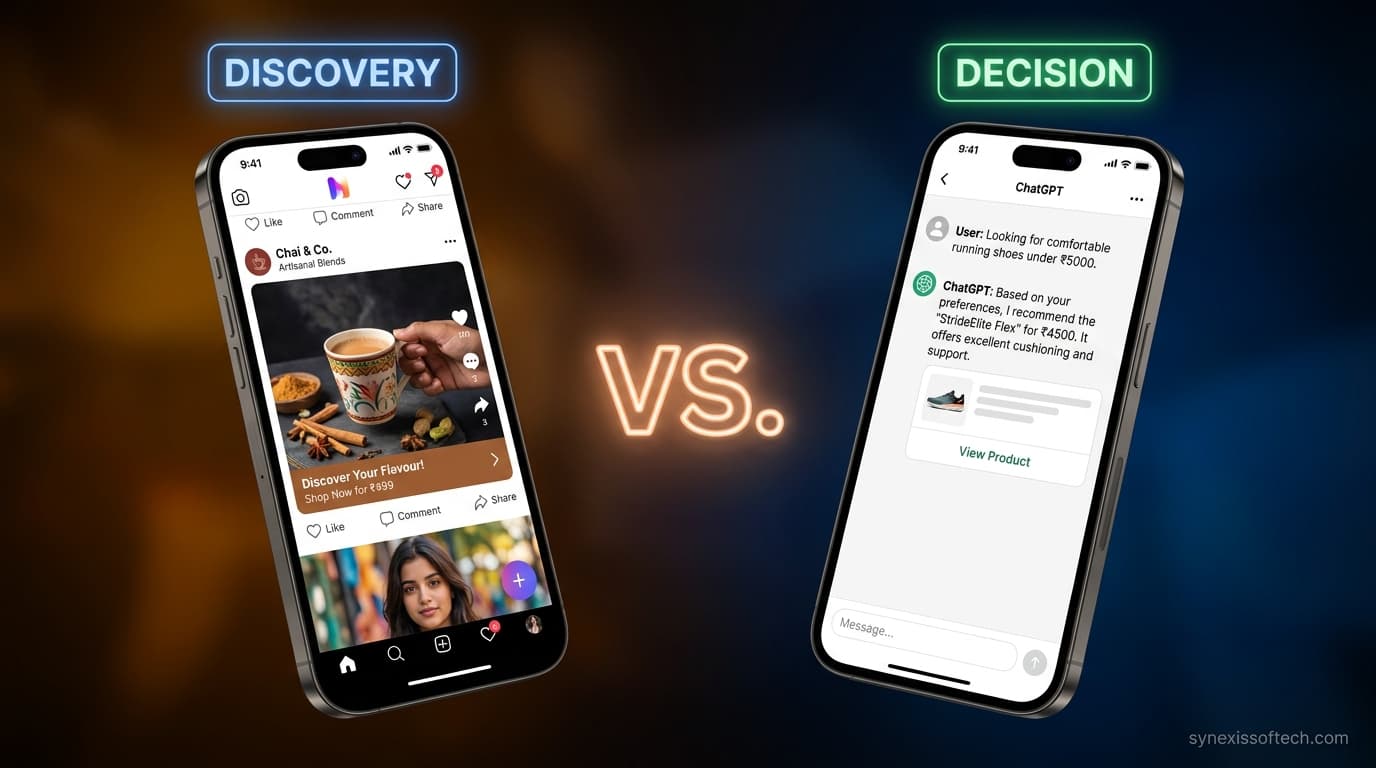
For the past fifteen years, digital marketing in Nepal — and globally — has been primarily organised around search engines. Rank on Google, run Google Ads, be visible when someone searches for your category. That model is not going away. But AI-assisted discovery is adding a layer above it. Before many customers search, they now ask — and what they ask, and what they receive in response, shapes which businesses they consider.
A business that is well-positioned in that asking layer has a compounding advantage: it enters the customer's consideration set earlier, with more relevant framing, and does so without requiring the customer to already know to search for it. That is a different kind of visibility from keyword-based search, and it is one that is built through information quality, content relevance, and trust signals — not just ad spend.
How Synexis Softech Supports Nepalese Businesses in the AI Era
Synexis Softech is based in Kathmandu and works with businesses across Nepal, India, and internationally on AI solutions, software development, automation, and digital marketing strategy. The team understands the Nepalese business context — the infrastructure realities, the customer behaviour patterns, and the competitive environment — alongside the global technology trends that are reshaping how businesses are found and chosen.
If your business is preparing for an AI-first digital environment, talk to Synexis Softech about AI readiness, digital marketing strategy, and practical technology solutions designed around your business's actual situation.
Frequently Asked Questions
Is ChatGPT advertising available in Nepal?
As of August 2026, ChatGPT advertising has launched in India. Nepal has not been confirmed as a market for ChatGPT advertising at this stage. However, ChatGPT itself is fully accessible in Nepal, and AI-driven discovery of Nepalese businesses is already happening through organic AI responses.
Do small businesses in Nepal need to worry about AI?
Not worry — prepare. AI-driven discovery is already influencing how some customers find businesses. The preparation required is the same strong digital foundation that supports visibility across all channels: accurate business information, quality content, and a functional website. This is work that benefits businesses regardless of which specific AI or search platform a customer uses.
Can AI currently recommend my restaurant or hotel in Nepal?
Yes. ChatGPT and other AI tools can currently generate recommendations for Nepalese restaurants, hotels, and businesses when users ask relevant questions. Whether your business is included and how it is described depends on the quality and completeness of publicly available information about it — your Google Business Profile, website, reviews, and content.
How is AI discovery different from Google search for local businesses?
Google search returns results based on keyword matching and ranking signals. AI discovery generates a synthesised response based on the user's full intent — they describe what they are looking for in detail. A local business can appear in an AI recommendation even if the user has not searched specifically for that business name, if the AI understands the business is relevant to the user's described need.
What is the most important thing a Nepalese small business can do right now?
Ensure your Google Business Profile is complete and accurate — business name, address, phone, opening hours, category, photos, and recent reviews. This is the most directly accessible AI visibility improvement available to most small businesses immediately, at no cost.
Will ChatGPT ads eventually come to Nepal?
OpenAI has not announced plans for a Nepal-specific launch of its advertising platform. Given that the India launch represents OpenAI's first international advertising market, expansion to additional South Asian markets is possible in the future, but no timeline has been confirmed.
Need help with implementation? Synexis Softech provides robust custom AI agent development to help scale your business.
Synexis Softech Team
Marketing Manager
Our team of experienced engineers and digital strategists at Synexis Softech specializes in building production-ready AI solutions, high-performance web applications, and data-driven marketing campaigns. Based in Pokhara, Nepal, we partner with growing businesses globally to turn complex technical challenges into competitive advantages.
Ready to grow your business with technology?
Let's build a practical digital solution for your business.
Talk to Our Team