AI Virtual Try-On for E-Commerce: How It Helps Customers Choose Clothes Online

Table of Contents
- 1. The Problem With Buying Clothes Online
- 2. What Is AI Virtual Try-On?
- 3. How AI Virtual Try-On Works: The Customer Journey
- 4. From "How Does It Look?" to "How Does It Look on Me?"
- 5. How Virtual Try-On Can Benefit E-Commerce Brands
- 6. Why Fashion Brands in Nepal Should Pay Attention
- 7. The Global Opportunity for AI-Powered Fashion Commerce
- 8. Which Fashion Businesses Should Consider Virtual Try-On?
- 9. Virtual Try-On vs Traditional Product Photography
- 10. What Businesses Should Consider Before Implementing Virtual Try-On
- 11. Is Virtual Try-On Right for Your Brand?
- 12. How Synexis Softech Can Help
- 13. Conclusion
- 14. Frequently Asked Questions
- 15. What is AI Virtual Try-On?
- 16. How does AI clothing try-on work?
- 17. Can Virtual Try-On be added to an existing e-commerce website?
- 18. Does the customer need to download an app?
- 19. Can Virtual Try-On work on mobile?
- 20. Is Virtual Try-On the same as a virtual fitting room?
- 21. Can Virtual Try-On help reduce returns?
- 22. Is AI Virtual Try-On suitable for Nepalese fashion brands?
- 23. Can the technology be customized for a specific brand?
- 24. What should a business consider before implementing Virtual Try-On?
Buying clothes online has always involved a leap of faith. You see a model wearing a jacket, a dress, or a kurta. The model is not you. The lighting is studio-perfect. The fit is pinned and adjusted. You add it to your cart anyway — and hope.
This is the experience that drives billions of dollars in fashion returns every year, and the reason so many online shoppers abandon product pages without converting. The product image answers one question well: what does this look like? It almost never answers the question customers actually have: how will this look on me?
AI Virtual Try-On technology was built to answer that second question. It is one of the more practical AI applications in retail right now — not a gimmick, not a science-fiction concept, but a working piece of technology already deployed by global fashion platforms that is now becoming accessible to mid-size and growing e-commerce brands.
This article explains what Virtual Try-On is, how it works for shoppers, what business value it can create, and which fashion and e-commerce businesses are most likely to benefit — including brands operating in Nepal's growing digital commerce space.
The Problem With Buying Clothes Online
When a customer walks into a physical store, they pick up a garment, feel the fabric, hold it against themselves in front of a mirror, and often try it on. That experience is what creates confidence — and confidence is what drives purchase decisions.
Online shopping strips most of that away. Customers are left with product photography, size guides, and customer reviews. These help, but they do not fully replace the experience of seeing a garment on a body like theirs.
The gap this creates is real. Shoppers who are unsure about how a product will look on them either do not buy, or they buy multiple sizes and return what does not work. Both outcomes are expensive — for the customer in time and uncertainty, and for the business in lost conversions and return logistics.
Virtual Try-On is one direct response to this structural problem.
What Is AI Virtual Try-On?
AI Virtual Try-On is a technology that uses artificial intelligence to generate a visualization of how a selected clothing item could look on a specific person — typically by processing a photo the customer uploads.
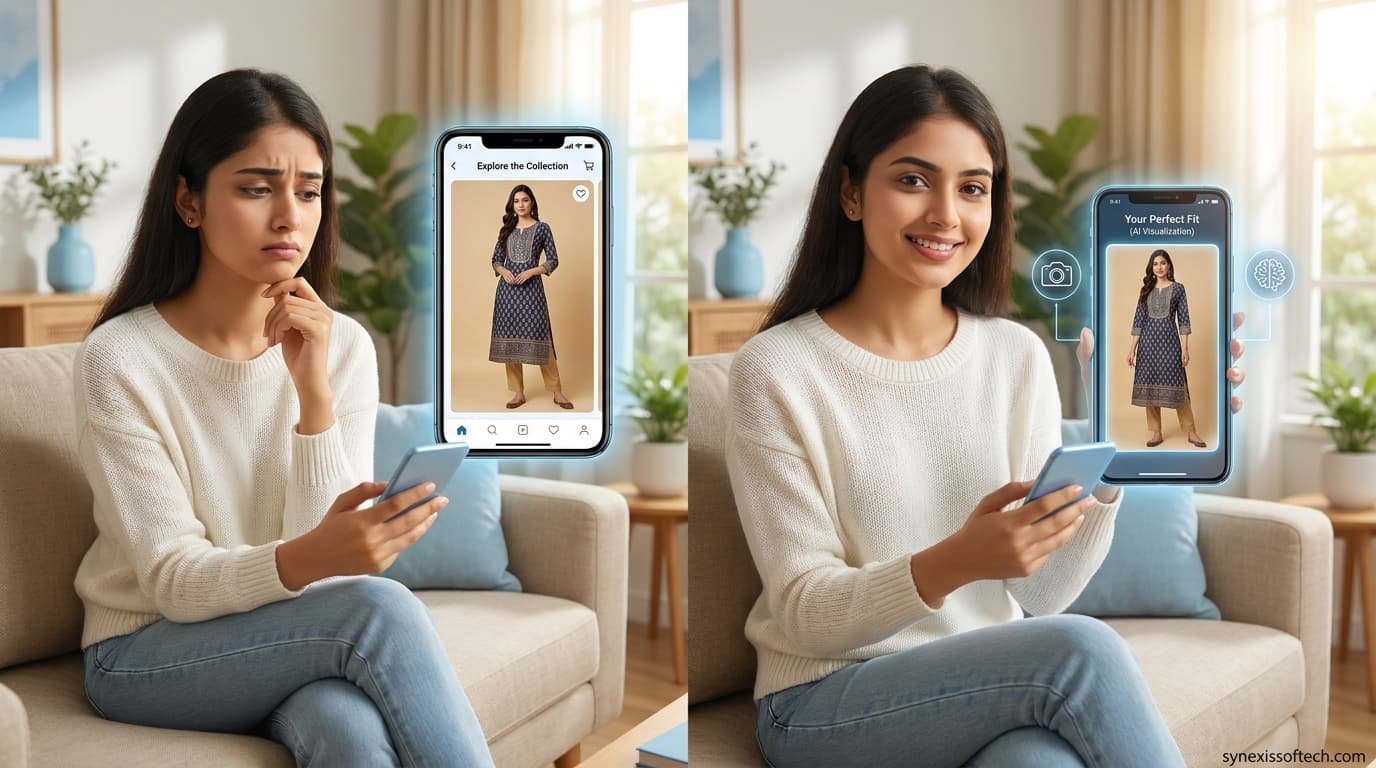
Rather than showing a product only on a generic model, Virtual Try-On creates an image that places the selected garment onto the customer's own photo. The result is a visual reference that is more personal and more relevant than standard product photography.
It is important to be precise about what the technology does and does not do. It generates a visual approximation — a realistic rendering of how a garment may look on a person based on their photo. It is a decision-support tool, not a digital fitting room that can guarantee exact fit, fabric drape, or how a specific size will feel. That distinction matters and should be communicated clearly to shoppers.
The core value is not the AI image itself. The core value is helping a customer answer: Can I imagine myself wearing this? That is a much more useful question to answer than Does this product look good on a model?
How AI Virtual Try-On Works: The Customer Journey
From a shopper's perspective, the experience is straightforward.
Step 1 — Browse. The customer visits an online fashion store and finds a product they are interested in — a shirt, a dress, a jacket, a saree, a kurta, or another supported clothing item.
Step 2 — Select the product. They view the product page as normal. Instead of only seeing the item on a model, there is a Virtual Try-On option available.
Step 3 — Upload a photo. The customer uploads a photo of themselves — typically a front-facing image in good lighting. Some implementations also allow them to choose from a set of representative body types if they prefer not to upload a personal photo.
Step 4 — AI processing. The system analyzes the uploaded photo alongside the product image. It uses AI models trained on fashion imagery to understand body pose, shape, and the garment's construction.
Step 5 — Virtual visualization. The customer receives an AI-generated image showing the selected garment on their photo. The result is a visual reference they can use to evaluate how the product might look on them.
Step 6 — Make a more informed decision. The customer can compare multiple products, switch between options, and decide whether to proceed with a purchase — with more visual confidence than a standard product page provides.
The experience is not complex from the user's perspective. The complexity lives in the AI infrastructure behind it.
From "How Does It Look?" to "How Does It Look on Me?"
This is the central shift that Virtual Try-On creates, and it is worth understanding clearly because it is what makes the technology genuinely useful rather than simply impressive.
Every fashion product page in existence answers the first question: how does this product look? High-quality photography, multiple angles, video — these all serve that purpose. They are good at it.
But customers do not only want to know if a product is attractive. They want to know if it is attractive on them. A fitted blazer may look excellent on a 5'10" model and feel wrong on someone with a different frame. A color that photographs beautifully in studio light may not suit every skin tone. A silhouette that reads as elegant on one body type may not translate the same way on another.
These are not trivial concerns. For many shoppers — particularly those buying clothing for events, occasions, or gifting — the uncertainty of how something will look on them is the primary reason they hesitate or abandon their cart.
Virtual Try-On addresses that uncertainty by making the product visualization personal. The shopper is no longer imagining themselves into a product image. They are seeing a version of themselves in the product. That shift in perspective is small technically, but significant psychologically.
How Virtual Try-On Can Benefit E-Commerce Brands
The business case for Virtual Try-On has to be grounded in realistic expectations. There are genuine potential benefits, and there are areas where the technology's impact will depend heavily on how it is implemented and for which product categories.
Stronger purchase intent. Customers who can visualize themselves in a product are more likely to feel confident proceeding with a purchase. Uncertainty is one of the primary drivers of cart abandonment in fashion e-commerce. Reducing it has a direct relationship to conversion, though the actual impact will vary by brand, category, and implementation quality.
More personalized shopping experience. Virtual Try-On moves the product page from a broadcast format — one set of model images shown to all shoppers — to a more individualized experience. This aligns with what customers increasingly expect from digital shopping.
Increased product exploration. When shoppers can quickly visualize themselves in different products, they tend to spend more time exploring the catalog. This is valuable for brands with large inventories or multiple colorways and styles of the same product.
Brand differentiation. In crowded fashion e-commerce categories, the shopping experience itself is a differentiator. A brand that offers Virtual Try-On is offering something most of its competitors currently do not. That novelty has a shelf life, but right now it signals investment in customer experience.
Premium positioning. Virtual Try-On is a natural fit for premium and luxury fashion brands where the stakes of a wrong purchase are higher and customers expect a more curated digital experience.
Better visualization for complex garments. Ethnic and traditional clothing — sarees, sherwanis, lehengas, kurtas — often has regional variation in draping and styling that is difficult to communicate through standard photography. Virtual Try-On can help customers visualize these garments on themselves in a way that static images cannot always achieve.
On the question of returns: better visualization can contribute to more informed purchase decisions, which may reduce uncertainty-driven returns in some categories. But fit-related returns are also driven by sizing, which Virtual Try-On does not address directly. Brands should not implement the technology expecting a specific return rate outcome without testing their own data.
Why Fashion Brands in Nepal Should Pay Attention
Nepal's fashion e-commerce market is growing. Instagram-based boutiques, D2C clothing brands, and online stores selling traditional and contemporary fashion have multiplied in recent years. Customers in Kathmandu, Pokhara, Butwal, and increasingly smaller cities are purchasing clothing online — often from brands they cannot visit in person.
Several practical scenarios make Virtual Try-On relevant in this context.
A customer in Pokhara ordering a saree or lehenga for a wedding from a Kathmandu-based boutique cannot try the garment before it arrives. A shopper buying a formal outfit from an Instagram brand cannot walk into a store. A customer comparing four similar kurtas on a fashion website has no way of visualizing which suits them best beyond the model images provided.
These are not abstract scenarios. They describe how a significant portion of online fashion purchases in Nepal actually happen.
Ethnic and festive clothing is a particularly strong use case. Customers purchasing for Dashain, Tihar, weddings, or other occasions are often buying garments they would normally select very carefully in person. Virtual Try-On can help bridge that gap for brands that sell these categories online.
Instagram-based fashion businesses are another strong candidate. Many operate without a physical retail presence. The shopping experience is already visual and social. Adding Virtual Try-On as part of the product discovery journey would be a natural extension of how these businesses already operate.
This does not mean every Nepalese fashion brand needs to implement Virtual Try-On today. Scale, catalog size, and traffic levels all affect whether the investment makes sense. But brands that are investing in their digital presence and competing for customers who shop online should understand what the technology enables.
The Global Opportunity for AI-Powered Fashion Commerce
Virtual Try-On is not a new concept, but the quality of AI-generated visualizations has improved substantially in the past few years. Where early implementations produced results that looked artificial or poorly aligned, current AI models — built on diffusion-based architectures and trained on large fashion datasets — can produce realistic, well-composed visualizations at scale.
Global platforms have already deployed the technology. Google introduced Virtual Try-On in Search in 2023, allowing shoppers to see how clothing items from major retailers look across a range of body types and skin tones. Amazon has offered virtual try-on features for footwear and apparel. Snapchat has built AR-based try-on experiences for fashion brands. Major fashion retailers including Zara and ASOS have tested interactive fitting experiences.
The trend is toward more personalized visual commerce — the idea that product discovery should be an interactive experience tailored to the individual shopper, not a broadcast of generic imagery. Virtual Try-On is one component of this broader direction, alongside AI-driven size recommendations, personalized style suggestions, and visual search.
For brands outside the top tier of global fashion, what has changed is accessibility. The underlying AI capabilities that power these features are increasingly available through APIs, development platforms, and specialized technology partners — which means businesses do not need to build the technology from scratch.
Which Fashion Businesses Should Consider Virtual Try-On?
Not every e-commerce business is an equally strong candidate. The technology creates the most value in specific contexts.
Strong fit:
- Online clothing stores with mid-to-large catalogs
- Fashion D2C brands where the online store is the primary sales channel
- Premium and luxury fashion brands where purchase confidence is especially important
- Ethnic and traditional wear brands selling sarees, kurtas, lehengas, sherwanis
- Sportswear and activewear brands
- Online boutiques without physical retail presence
- Fashion marketplaces with multiple brands and many SKUs
- Mobile-first fashion businesses with engaged app users
Potential fit:
- Physical retailers expanding their online presence who want to differentiate digitally
- Social commerce brands operating primarily on Instagram or similar platforms
- Custom clothing businesses where visualization before order is especially valuable
- Fashion startups investing in technology as a brand signal
The strongest candidates tend to share a few characteristics: they sell clothing online as a primary channel, they have customers who genuinely wonder how products will look on them, and they are at a scale where improving the product page experience has a measurable effect on business outcomes.
Virtual Try-On vs Traditional Product Photography
| Dimension | Traditional Product Photography | AI Virtual Try-On |
|---|---|---|
| Whose body does the shopper see? | The model's | Their own |
| How personalized is the experience? | Same for all shoppers | Individual to each customer |
| What question does it answer? | How does the product look? | How could this look on me? |
| Can it show multiple colorways quickly? | Requires separate shoots | Can be generated at scale |
| Shopper effort required | None — passive | Minimal — one photo upload |
| Guaranteed to show exact fit? | No | No — it is a visual approximation |
| Addresses body diversity? | Limited by model selection | Adapts to individual photo |
The table above is not intended to position Virtual Try-On as a replacement for product photography. Both serve different purposes. High-quality photography shows the product at its best. Virtual Try-On shows the customer a personalized visual reference. The strongest implementations use both together.
What Businesses Should Consider Before Implementing Virtual Try-On
There are practical questions to work through before integrating Virtual Try-On into an e-commerce platform.
Product photography quality. AI-based try-on works from product images. The cleaner and more consistent your product photography, the better the generated results. Brands with inconsistent or low-quality product images should address this first.
Supported product categories. Virtual Try-On currently works best for tops, dresses, outerwear, and some categories of traditional garments. Accessories, footwear, and very structured tailoring present additional complexity. Understand which parts of your catalog the technology can serve well.
User experience and privacy. Customers uploading personal photos need to trust that those images are handled responsibly. Transparent data handling policies, clear communication about how photos are used and stored, and the option not to upload a personal photo (using representative body types instead) are all important UX considerations.
Mobile experience. A significant portion of fashion e-commerce traffic is mobile. The Virtual Try-On flow must work smoothly on a phone — including the photo upload experience — not just on desktop.
Processing speed. A slow AI generation experience will frustrate users. The technical infrastructure needs to be capable of generating results quickly enough to feel like part of a normal shopping flow.
Integration path. Whether you are working with an existing e-commerce platform (Shopify, WooCommerce, a custom build), the integration approach will differ. Understanding what is involved — API integration, plugin, custom development — affects both cost and timeline.
Cost and scale. Like most AI features, Virtual Try-On involves infrastructure costs that scale with usage. The business case is strongest when traffic and catalog size are sufficient to generate meaningful data on impact.
Is Virtual Try-On Right for Your Brand?
Consider these questions honestly:
- Do customers frequently contact you asking how a product will look on them specifically?
- Do you sell clothing as your primary product category online?
- Is the online store your main or only sales channel?
- Do you have enough digital traffic that improving the product page experience would have a measurable effect?
- Are you investing in customer experience as a competitive differentiator?
- Do you sell categories where personal fit and appearance matter significantly — ethnic wear, occasionwear, premium fashion?
- Are you looking to give your brand a more advanced, technology-forward positioning online?
If most of your answers are yes, Virtual Try-On is worth exploring seriously. If your traffic is early-stage or your catalog is small, the priority may be establishing the foundation first — product quality, photography, and conversion basics — before adding an interactive feature layer.
How Synexis Softech Can Help
Synexis Softech is an AI and software development company based in Kathmandu, working with clients in Nepal, the US, UK, Australia, and across the Gulf. The team has developed an AI-powered Virtual Try-On solution built for fashion and e-commerce businesses.
Rather than offering an off-the-shelf product, Synexis works with businesses to understand their catalog, their customer base, and their existing platform — and builds or integrates a Virtual Try-On experience designed around those specific requirements. That includes the AI model integration, the front-end experience on web or mobile, the product image pipeline, and the privacy and data handling architecture.
The goal is not to add a feature for its own sake. It is to build a shopping experience that gives customers a genuine reason to feel more confident making a purchase decision on your platform.
If you are exploring what Virtual Try-On could look like for your fashion business, the right starting point is a conversation about your current setup, your catalog, and what your customers actually need. Synexis can help you evaluate whether it is the right investment and what building it would involve.
Interested in exploring AI Virtual Try-On for your fashion store? Talk to Synexis Softech about building or integrating an experience designed around your customers.
Conclusion
The future of online fashion is not only about showing customers better product images. It is about giving customers a way to see themselves in the product — to move from imagining to visualizing, and from uncertainty to confidence.
AI Virtual Try-On is one of the more practical ways to close that gap. The technology has matured significantly. Global platforms are already using it. And for brands that sell clothing online — whether they are a premium D2C label in the US, a fashion boutique in Nepal, or an ethnic-wear marketplace serving customers across South Asia — the question is no longer whether the technology exists. The question is whether your business is ready to use it.
Frequently Asked Questions
What is AI Virtual Try-On?
AI Virtual Try-On is a technology that generates a personalized visualization of how a clothing item could look on a specific customer, typically by using a photo the customer uploads. It is a decision-support tool designed to help shoppers feel more confident about how a product may look on them before purchasing.
How does AI clothing try-on work?
The customer selects a product, uploads a photo of themselves, and the AI system processes both the photo and the product image to generate a visualization showing the garment on the customer's photo. The process typically takes a few seconds and produces a realistic rendering the customer can use to evaluate the product.
Can Virtual Try-On be added to an existing e-commerce website?
Yes. Virtual Try-On can typically be integrated into existing e-commerce platforms — including custom-built sites, Shopify stores, and WooCommerce sites — through API integration or custom development. The integration approach depends on the platform and the scope of the implementation.
Does the customer need to download an app?
Not necessarily. Web-based implementations allow the customer to use Virtual Try-On directly in their browser without downloading anything. App-based implementations are also possible for brands with a mobile application.
Can Virtual Try-On work on mobile?
Yes. Mobile-compatible Virtual Try-On is important given how much fashion e-commerce traffic comes from phones. A well-built implementation will work smoothly on mobile devices, including the photo upload process.
Is Virtual Try-On the same as a virtual fitting room?
The terms are sometimes used interchangeably, but there is a distinction. A virtual fitting room typically refers to a real-time augmented reality experience — often in-store or via a dedicated device. AI Virtual Try-On, as described here, works with a static uploaded photo and generates a visualization rather than a live AR overlay. Both serve similar goals but differ in implementation and use context.
Can Virtual Try-On help reduce returns?
Better visualization can help customers make more informed purchasing decisions, which may reduce uncertainty-driven returns in some categories. However, many returns in fashion are driven by sizing issues, which Virtual Try-On does not address directly. The impact on returns will depend on the category, implementation quality, and how clearly the technology's capabilities are communicated to shoppers.
Is AI Virtual Try-On suitable for Nepalese fashion brands?
Yes, particularly for online boutiques, ethnic and traditional wear brands, Instagram-based fashion businesses, and any brand selling primarily through digital channels where customers cannot try garments in person. The technology is most valuable where the gap between seeing a product and understanding how it would look on the customer is widest.
Can the technology be customized for a specific brand?
Yes. A custom implementation allows the experience to be designed around a brand's specific catalog, product categories, visual identity, and platform. Off-the-shelf solutions offer faster deployment but less control. Custom development allows for a more tailored experience aligned with the brand's specific products and customer needs.
What should a business consider before implementing Virtual Try-On?
Key considerations include product photography quality, which product categories are supported, how customer photos will be handled from a privacy standpoint, the mobile experience, AI processing speed, the integration approach for your existing platform, and whether your traffic and catalog scale justify the investment at this point in your growth.
Need help with implementation? Synexis Softech provides robust custom AI agent development to help scale your business.
Synexis Softech Team
Sujan Dhakal
Our team of experienced engineers and digital strategists at Synexis Softech specializes in building production-ready AI solutions, high-performance web applications, and data-driven marketing campaigns. Based in Pokhara, Nepal, we partner with growing businesses globally to turn complex technical challenges into competitive advantages.
Ready to grow your business with technology?
Let's build a practical digital solution for your business.
Talk to Our Team