Is Your Business Ready for AI Search? A Practical Checklist for Nepalese Businesses

Table of Contents
- 1. 1. Website Foundations
- 2. 2. Business Information Completeness and Consistency
- 3. 3. Product and Service Information Quality
- 4. 4. Content That Answers Real Customer Questions
- 5. 5. Reviews and Reputation Infrastructure
- 6. 6. Local SEO Foundations
- 7. 7. Structured Data and Schema Markup
- 8. 8. Authority and Trust Signals
- 9. 9. AI-Readable Content Structure
- 10. 10. Conversion Infrastructure
- 11. The Checklist Summary
- 12. How Synexis Softech Can Help Your Business Get AI-Ready
- 13. Frequently Asked Questions
- 14. Where should a small Nepalese business start with AI readiness?
- 15. Does my business need a website for AI visibility?
- 16. What is schema markup and does my business need it?
- 17. How many Google reviews does my business need?
- 18. Is AI SEO different from regular SEO?
- 19. Can my business be recommended by ChatGPT without advertising?
- 20. How long does it take to see results from improving AI readiness?
The strongest message from the ChatGPT advertising launch in India is one that applies equally to businesses that will never run a single AI ad: AI is not replacing the basics of good digital presence. It is making them more important.
AI systems recommend businesses they can understand. They surface businesses with accurate information. They cite businesses with quality content. They include businesses that customers trust. Every one of those factors is something your business can control and improve today — without waiting for AI advertising to reach Nepal, and without spending a rupee on AI-platform ads.
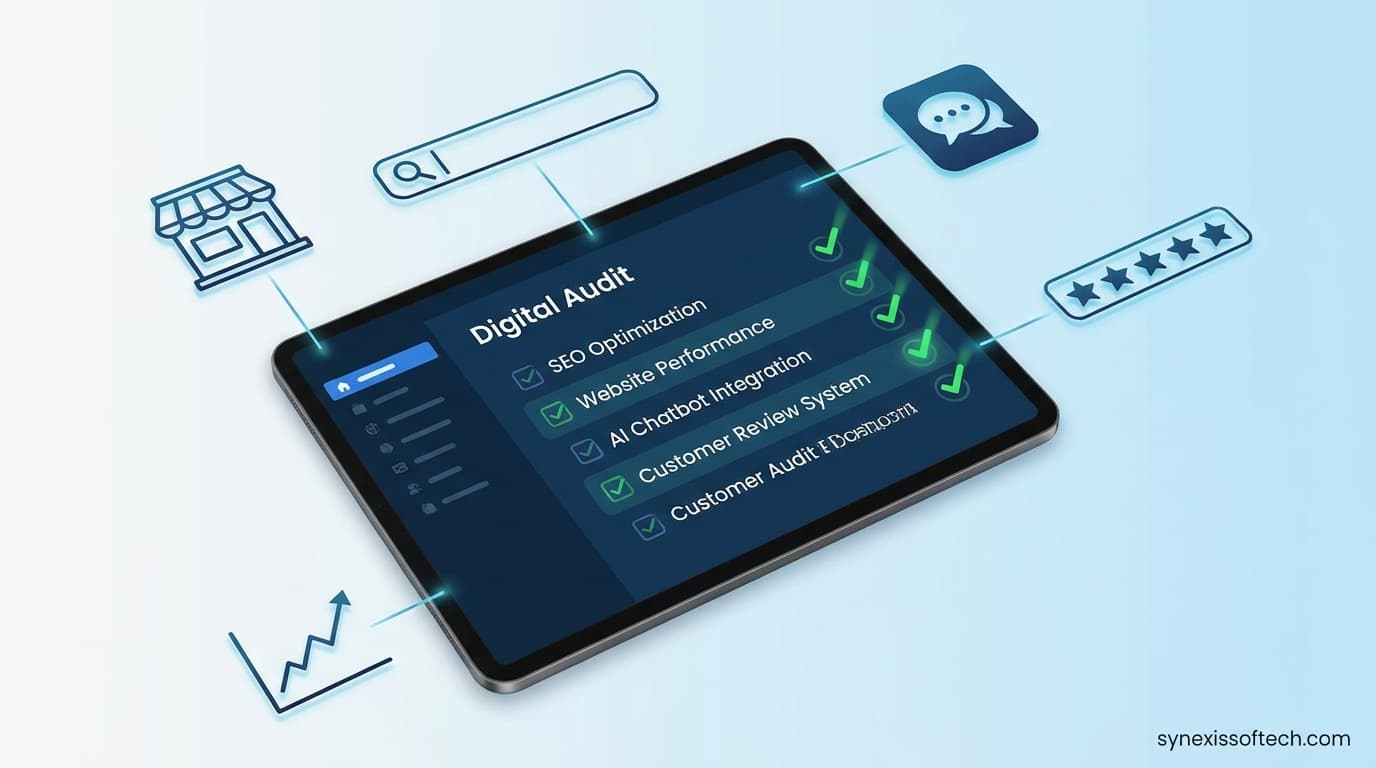
This checklist is designed for business owners and managers in Nepal who want a practical, honest picture of where they stand. Work through it section by section. The gaps you find are the preparation work that matters most.
1. Website Foundations
Your website is the primary place AI systems go to understand your business. If it is slow, broken, or unclear, that is what AI systems — and your customers — experience.
Speed. Test your website on a mobile connection using Google PageSpeed Insights (free tool, search for it). If your score is below 50 on mobile, you have a problem that affects both Google ranking and AI visibility. Slow websites signal low investment and create poor user experiences. Fix images (compress them), minimise unnecessary scripts, and consider a faster hosting provider if your current one is the bottleneck.
Mobile experience. The majority of internet traffic in Nepal is mobile. Your website must display correctly and be easy to use on a smartphone — including navigation, contact forms, product pages, and any booking or e-commerce functionality. Test it yourself on the phone you actually use, not just a computer.
HTTPS. Your site should be served over HTTPS (the padlock icon in the browser). If it is not, fix this immediately. It is a basic trust signal for both search engines and users.
Clear navigation and purpose. A visitor — or an AI system crawling your site — should be able to understand within a few seconds what your business does, who it is for, and what action a visitor should take. If your homepage is unclear or cluttered, it fails both purposes.
Contact information visible without searching. Your phone number, WhatsApp link, email, and physical address (if relevant) should be on every page — at minimum in the header or footer. Customers who have to hunt for your contact details leave. AI systems that cannot find your contact information cannot surface it when users need it.
2. Business Information Completeness and Consistency
AI systems synthesise information about businesses from multiple sources. If those sources say different things, the AI either averages them inaccurately or avoids representing the business at all.
Google Business Profile. This is the single most important local business listing you control. It must be claimed, verified, and complete — business name exactly as you use it, correct address, correct phone number, correct opening hours, accurate primary and secondary categories, and at least ten recent photos. Update it whenever anything changes. An outdated Google Business Profile with closed hours from two years ago is actively harmful to your discovery.
Consistency across platforms. Your business name, address, and phone number should be identical on your website, Google Business Profile, Facebook page, Instagram bio, and any directory listings. Small inconsistencies — different abbreviations, slightly different phone number formats, an old address — confuse both search engines and AI systems.
Service descriptions. Every service you offer should be described clearly, with enough detail that someone who has never heard of your business understands what it involves, who it is for, and what the outcome is. Vague service listings like "we do everything in technology" or "best restaurant in Kathmandu" tell AI systems and potential customers nothing useful.
3. Product and Service Information Quality
For businesses selling products — online or in physical stores with an online presence — information quality is directly correlated with AI discoverability and customer confidence.
Clear product descriptions. Every product should have a description that explains what it is, what it is made of or made from, who it is for, and what makes it worth buying. "Blue kurta" is not a product description. "Hand-block printed cotton kurta in indigo blue, suitable for formal and semi-formal occasions, available in sizes XS to XXL" is a product description that an AI system can understand and a customer can evaluate.
Accurate pricing. Prices should be current and displayed. Businesses that omit pricing force customers to contact them before they can evaluate the option — and AI systems that cannot find pricing information are less likely to include the product in a comparison response.
Availability information. If you sell online, stock availability matters. If you do custom orders, lead times matter. If you only deliver within certain areas, that matters. Customers asking AI systems for product recommendations are looking for options they can actually act on. Missing practical information removes your business from consideration.
Good quality images. Visual content is not just about aesthetics. AI systems that index image content, and customers who are evaluating purchase decisions, need clear images that show the product accurately. Poor-quality, poorly-lit product images are a trust negative that no amount of good description compensates for.
4. Content That Answers Real Customer Questions
This is the section most businesses underinvest in, and it is the one that has the most leverage for AI visibility.
AI systems cite content that directly and clearly answers the questions users are asking. If your website has a well-written article answering "what is the best type of trekking gear for Annapurna in October," and a user asks that question, your business has a chance to be cited. If your website has only a product catalog and no explanatory content, you miss that opportunity entirely.
Write for questions, not keywords. Think about the ten most common questions your customers ask before they buy from you. Write a clear, honest, specific answer to each one. Publish these as blog posts, FAQ pages, or resource articles on your website. This is the most direct path to organic AI citation that exists for most businesses.
Explain your process, your expertise, and your approach. Particularly for service businesses — consultancies, healthcare providers, education businesses, travel operators — content that explains how you work, what makes you qualified, and what a customer can expect builds the kind of trust and specificity that AI systems use to represent you as an authoritative source.
Local relevance. Content that specifically addresses Nepalese context — local regulations, local conditions, local customer needs — is more likely to be surfaced for users asking AI tools questions in a Nepal-specific context than generic content that could apply anywhere.
5. Reviews and Reputation Infrastructure
Reviews are a trust signal for AI systems, not just for humans reading them. An AI system generating a restaurant recommendation in Pokhara will weight businesses with more reviews, more recent reviews, and higher average ratings — not because it is running a review aggregation algorithm, but because review quality is a proxy for the reliability of the information it has about a business.
Google reviews are the priority. Ask every satisfied customer to leave a Google review. Make it easy — send them a direct link to your Google review form. A business with fifty genuine, recent Google reviews is significantly more visible than an equivalent business with five old ones.
Respond to reviews. Responding to reviews — both positive and critical — is a signal of active management and genuine customer engagement. A business that has not responded to any review in eighteen months looks abandoned, regardless of the review content.
Do not generate fake reviews. This is important both ethically and practically. Review platforms actively detect and remove fake reviews, and a business caught in a fake review pattern suffers lasting visibility penalties that are genuinely difficult to recover from.
6. Local SEO Foundations
Local SEO and AI visibility reinforce each other. The same signals that help Google understand your local business help AI systems understand it too.
Google Maps presence. Your business should appear on Google Maps with accurate information, a verified listing, and photos. For businesses serving local customers — restaurants, shops, clinics, hotels — Maps visibility is often the most direct path to a customer walking through the door or making a call.
Location-specific website pages. If you serve multiple locations — a business with outlets in Kathmandu and Pokhara, for example — create a dedicated page for each location with that location's specific address, phone, hours, and nearby landmarks. This helps both search engines and AI systems understand your geographic coverage.
Embed Google Maps on your contact page. This is a small but useful trust and usability signal. Customers verifying your location before visiting appreciate it, and it confirms your address to crawlers.
7. Structured Data and Schema Markup
Structured data is technical, but it is one of the clearest signals you can give both search engines and AI systems about your business.
Schema markup is code added to your website that explicitly labels information — "this is the business name," "this is the price of this product," "this is the review rating," "this is a FAQ question and its answer." Without schema, a search engine or AI system has to infer this information from context. With schema, you are telling it directly.
For most Nepalese businesses, the most valuable schema types to implement are: LocalBusiness (name, address, phone, hours, geo coordinates), Product (for e-commerce), Review (for displaying ratings), FAQPage (for FAQ sections), and Service (for service businesses). A web developer familiar with WordPress or your specific platform can implement these in a few hours. The visibility benefit is disproportionately large relative to the effort.
8. Authority and Trust Signals
AI systems weight authority alongside accuracy. A business with mentions in Nepalese news publications, industry associations, government registrations, and quality incoming links from relevant websites is more trusted as a source than an otherwise identical business with none of these signals.
Earn mentions in credible sources. Get your business listed in industry directories relevant to your category. Contribute expert content to Nepalese business publications or industry platforms. Participate in or sponsor relevant community events that generate legitimate online mentions. These signals accumulate and compound.
Transparently display credentials and registrations. Business registration, professional licences, association memberships, and certifications relevant to your industry should be prominently displayed on your website. For healthcare, education, legal, and financial businesses, these signals are particularly important trust factors.
9. AI-Readable Content Structure
AI systems read your content differently from human readers. They look for structured information — clear headings, direct answers near the top of sections, lists and tables for comparable information, and FAQ-style question-and-answer formatting.
Write your key service descriptions, product information, and FAQ content so that the answer to a likely customer question appears in the first one or two sentences of the relevant section, not buried in the third paragraph. AI systems that are generating a summary response are more likely to extract and cite a clear, direct answer than a long paragraph that contains the answer somewhere in the middle.
Use headings (H2, H3) that match the questions your customers are actually asking. "What is the delivery time for orders to Pokhara?" is a better heading than "Delivery Information." The first is a question a customer would ask. The second is a generic category label.
10. Conversion Infrastructure
The final piece is the most commercially critical. If AI discovery sends a customer to your business, your business must be ready to receive them and convert the visit into a sale, an enquiry, or a booking.
An AI recommendation that leads a customer to a slow, confusing website with no clear way to contact the business or place an order is a wasted discovery moment. The AI did its job. The business failed to capitalise on it.
WhatsApp is essential for Nepalese businesses. The majority of Nepalese consumers are comfortable initiating business contact through WhatsApp. A WhatsApp button prominently placed on your website, with a business number that is actively monitored, is the single most practical conversion improvement most Nepalese businesses can make immediately.
Contact forms that work and are monitored. If you have a contact form, test it. Submit it yourself and see how long it takes to receive a response. A form that routes to an email address that is checked weekly is not a conversion tool.
Booking and e-commerce functionality. If your business is in tourism, hospitality, education, or retail, and you do not have online booking or purchasing capability, you are losing customers to competitors who do. This is particularly true for customers who discovered your business through an AI recommendation — they are ready to act, and friction in the purchasing process is the most common reason that ready buyer converts somewhere else.
Follow-up systems. A customer who makes an enquiry and does not receive a response within a few hours typically moves on. A basic CRM or even a disciplined WhatsApp response practice ensures that the discovery work you have done translates into actual customer relationships.
The Checklist Summary
| Area | Priority Action |
|---|---|
| Website | Speed, mobile, HTTPS, clear navigation, visible contact |
| Business Information | Google Business Profile complete and consistent everywhere |
| Products/Services | Complete descriptions, accurate pricing, availability, quality images |
| Content | Articles answering real customer questions, locally relevant |
| Reviews | Active review building on Google, genuine, responded to |
| Local SEO | Maps presence, location pages, embedded map |
| Structured Data | Schema markup for business type, products, FAQs |
| Authority | Directory listings, press mentions, credentials displayed |
| AI-readable content | Direct answers, question-based headings, FAQ sections |
| Conversion | WhatsApp, working forms, booking/e-commerce, fast follow-up |
How Synexis Softech Can Help Your Business Get AI-Ready
Synexis Softech is a Kathmandu-based AI and software development company working with businesses across Nepal, India, and internationally. The team builds custom AI solutions, automation systems, e-commerce platforms, and digital marketing infrastructure — the practical technology layer that supports everything on this checklist.
If you are working through this checklist and identifying gaps in your technology, your content infrastructure, or your conversion systems, talk to Synexis Softech about practical technology solutions designed around what your business actually needs, at a cost structure that is accessible for growing businesses in Nepal.
Frequently Asked Questions
Where should a small Nepalese business start with AI readiness?
Google Business Profile. Claim it, verify it, complete every field, add at least ten photos, and ensure your opening hours and contact information are accurate. This is free, takes a few hours, and provides the most immediate improvement to local and AI-driven discoverability for most small businesses.
Does my business need a website for AI visibility?
Yes. Social media profiles and Google Business Profile are useful but are not substitutes for a website you own and control. Your website is where AI systems find the most detailed, structured information about your business. A business without a website is limited in how accurately and completely AI systems can represent it.
What is schema markup and does my business need it?
Schema markup is code added to a website that labels information for search engines and AI systems — telling them explicitly "this is the business name," "this is a product price," "this is a FAQ answer." Most businesses benefit from implementing basic schema, particularly LocalBusiness, Product, and FAQPage types. A web developer can typically implement this in a few hours.
How many Google reviews does my business need?
More recent reviews are more valuable than a specific number. A business with 30 reviews from the past year is better positioned than one with 100 reviews where the most recent is two years old. The consistent practice of asking satisfied customers for reviews — with a direct link to make it easy — is more valuable than any target number.
Is AI SEO different from regular SEO?
The foundations overlap significantly. Both reward accurate information, quality content, trust signals, and technical website quality. AI SEO additionally emphasises direct-answer formatting, FAQ-style content, structured data, and comprehensive entity information — because AI systems extract and synthesise information rather than just ranking pages. Building for AI visibility also builds for search visibility. They are not in conflict.
Can my business be recommended by ChatGPT without advertising?
Yes. ChatGPT generates responses to user questions based on the quality of available information, and businesses can appear in those organic responses without any paid advertising. The quality of your website content, your Google Business Profile, your reviews, and your overall digital presence all contribute to whether and how AI systems represent your business in relevant conversations.
How long does it take to see results from improving AI readiness?
Some improvements are immediate — updating your Google Business Profile with accurate hours takes minutes and is visible almost immediately. Content and authority improvements take longer — typically weeks to months for AI systems to index and weight new content. The most realistic framing is that this is ongoing infrastructure investment, not a one-time fix with a specific results date.
Need help with implementation? Synexis Softech provides robust custom AI agent development to help scale your business.
Synexis Softech Team
Marketing Manager
Our team of experienced engineers and digital strategists at Synexis Softech specializes in building production-ready AI solutions, high-performance web applications, and data-driven marketing campaigns. Based in Pokhara, Nepal, we partner with growing businesses globally to turn complex technical challenges into competitive advantages.
Ready to grow your business with technology?
Let's build a practical digital solution for your business.
Talk to Our Team