AI-Powered Mobile App Development: Build Apps That Think

Table of Contents
- 1. What AI Actually Adds to a Mobile Application
- 2. AI Features That Deliver Real Value in Mobile Apps
- 3. The Technical Architecture of an AI Mobile App
- 4. Industries Where AI Mobile Apps Create Competitive Advantage
- 5. Frequently Asked Questions
- 6. How much more does an AI-powered mobile app cost than a standard app?
- 7. Can AI be added to an existing mobile app?
- 8. Do we need a lot of user data before AI features are useful?
- 9. How do we handle user privacy in an AI mobile app?
The gap between a standard mobile app and an AI-powered one is not a feature list — it is a fundamentally different relationship between the app and its user. A standard app responds to inputs. An AI-powered app anticipates them, learns from them, and makes the user more effective with every session.
Building that kind of application requires combining mobile engineering with AI integration — two disciplines that most agencies treat as separate practices. Synexis Softech builds them together from the start.
What AI Actually Adds to a Mobile Application
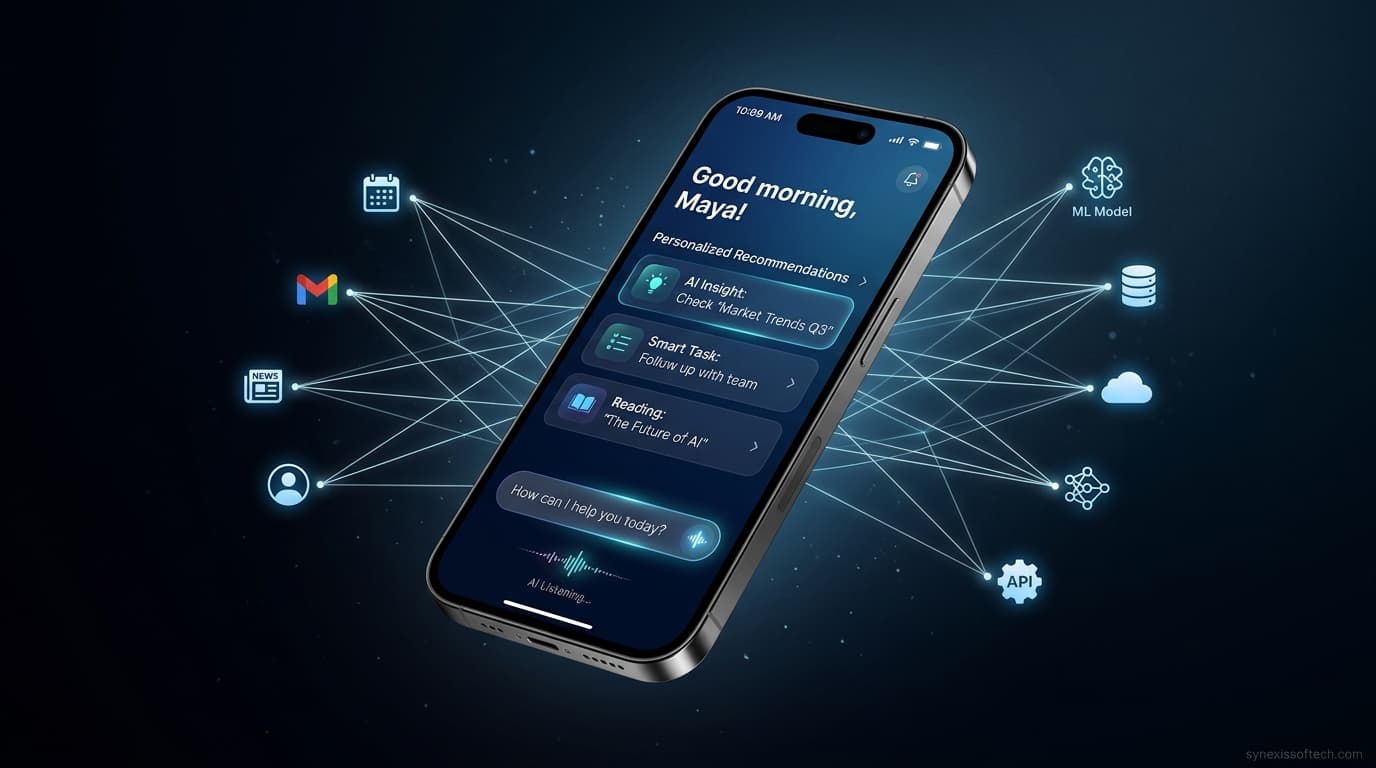
AI adds three capabilities to mobile applications that cannot be replicated with conventional programming: personalisation at scale, natural language interaction, and pattern recognition across user behaviour and business data. Each of these changes what an app can do for its users in ways that static logic trees and rule-based systems cannot achieve.
Personalisation at scale means the app adapts its content, recommendations, and interface based on each user's behaviour — not a segment they have been placed in. Natural language interaction means users can describe what they want instead of navigating to it. Pattern recognition means the app surfaces insights and predictions from data that would be invisible to a user manually reviewing records.
AI Features That Deliver Real Value in Mobile Apps
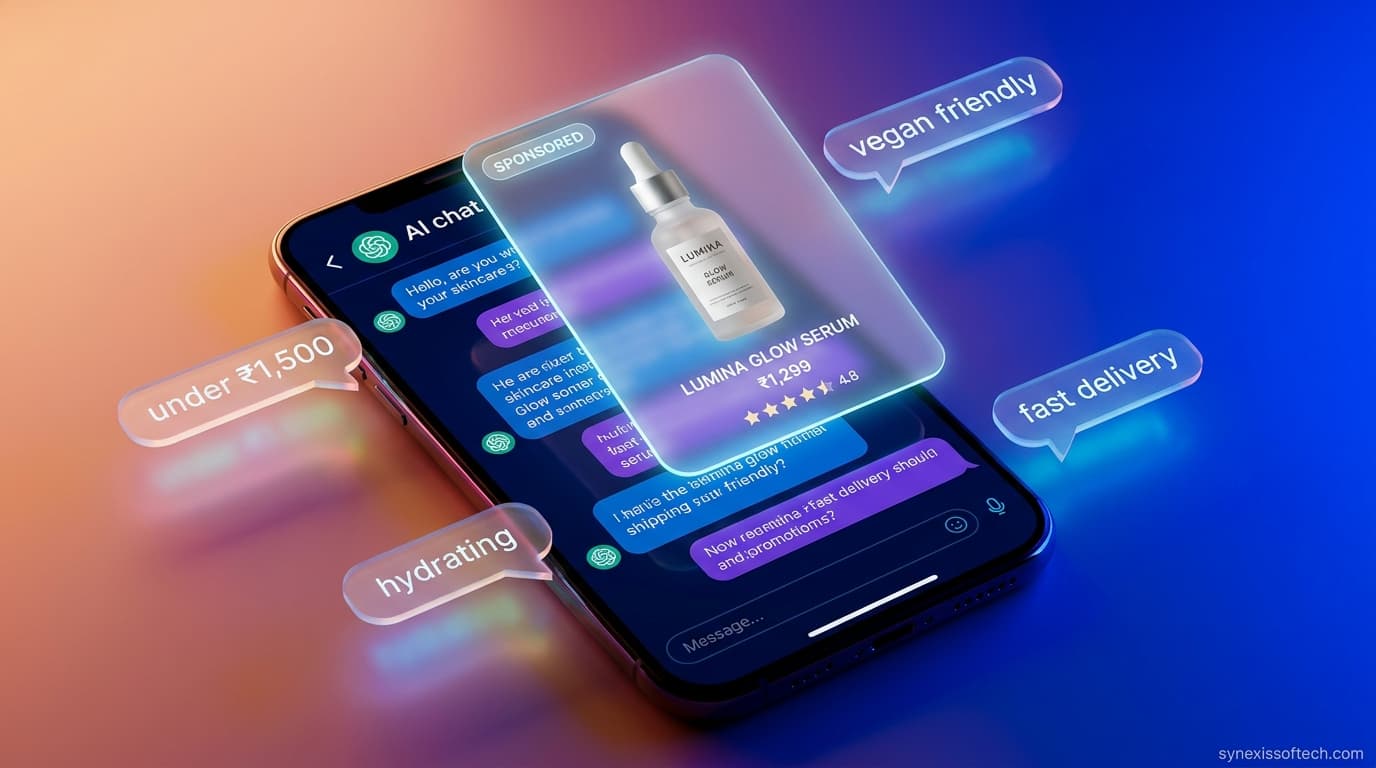
Intelligent search and recommendations. Instead of keyword search, AI-powered search understands intent — returning results that match what the user means, not just what they typed. Recommendation engines surface relevant products, content, or actions based on behaviour, not just category filters.
Natural language interfaces. Voice input and conversational interfaces reduce friction for complex tasks. Instead of filling a multi-field form, a user describes their request and the app interprets and populates the fields. This is particularly powerful in field service, logistics, and healthcare applications where users cannot type while working.
Predictive alerts and automation. AI models trained on business data surface alerts before users would notice the problem — inventory running low, a customer at churn risk, a project milestone slipping. The app acts as an early-warning system, not just a data display.
Document and image processing. Mobile AI can process documents captured by camera — expense receipts, invoices, identification documents — extracting structured data without manual entry. Computer vision classifies images, detects defects, or verifies identity in real time.
On-device AI for privacy-sensitive applications. Not all AI processing needs to leave the device. On-device models handle tasks like face detection, voice transcription, and document classification locally — without sending sensitive data to an external server. This is increasingly important for healthcare, legal, and financial applications.
The Technical Architecture of an AI Mobile App
An AI-powered mobile app typically has three layers. The mobile layer — the React Native, Flutter, or native iOS/Android application — handles the user interface and device capabilities. The AI services layer — running in cloud infrastructure or on-device — handles model inference, embedding generation, and prediction serving. The data layer — your business database, CRM, or analytics store — feeds the AI with the context it needs to make accurate predictions and personalised responses.
The integration between these layers is where most AI mobile projects succeed or fail. A model that performs well in isolation often degrades in production because the mobile app is sending it incomplete context, or because latency between the app and the AI service creates a user experience that feels slow. We architect for production performance from the first design decision, not as an afterthought.
Industries Where AI Mobile Apps Create Competitive Advantage
E-commerce and retail. Personalised product recommendations, visual search, and AI-powered customer support drive conversion and retention beyond what static apps achieve.
Healthcare and wellness. Symptom checkers, medication reminders with adherence pattern analysis, and appointment scheduling with intelligent triage create genuinely useful health applications rather than digital brochures.
Field service and logistics. AI apps that route field teams optimally, process job documentation by voice and camera, and surface maintenance predictions keep operations running without constant manual oversight.
Financial services. Spending pattern analysis, fraud detection, and intelligent financial planning tools turn a banking app into a financial advisor for every customer.
Education and training. Adaptive learning paths that adjust content and difficulty based on performance, AI tutors that answer questions about course material, and progress tracking with personalised recommendations create learning experiences that improve outcomes.
Frequently Asked Questions
How much more does an AI-powered mobile app cost than a standard app?
The cost premium depends entirely on which AI capabilities are included and their complexity. A standard mobile app with AI-powered search and basic recommendations adds meaningful development time but is not a multiple of the base cost. A fully personalised app with custom model training and on-device inference is a substantially larger investment. We scope each project specifically — there is no meaningful general answer without understanding the use case.
Can AI be added to an existing mobile app?
Yes, in most cases. AI features can be integrated into an existing app via API — the AI capability lives in a service the app calls, rather than requiring the app to be rebuilt. The feasibility depends on your current app's architecture and how well the existing data supports the AI feature you want to add.
Do we need a lot of user data before AI features are useful?
It depends on the feature. Recommendation systems improve with more data, but many AI capabilities — natural language interfaces, document processing, intelligent search — are useful from day one without any proprietary training data. We design AI feature rollouts to deliver value at launch and improve over time as data accumulates.
How do we handle user privacy in an AI mobile app?
Privacy architecture is part of the design phase, not an afterthought. Options include on-device processing for sensitive operations, differential privacy techniques for aggregate model training, explicit consent flows for data collection, and data minimisation — the AI only collects what it genuinely needs. We design for compliance with GDPR, CCPA, and sector-specific requirements as standard practice.
Talk to Synexis Softech about your AI mobile app — from concept to production, we build applications that work at the standard your users expect.
Need help with implementation? Synexis Softech provides robust custom AI agent development to help scale your business.
Synexis Softech Team
Lead Software Engineer
Our team of experienced engineers and digital strategists at Synexis Softech specializes in building production-ready AI solutions, high-performance web applications, and data-driven marketing campaigns. Based in Pokhara, Nepal, we partner with growing businesses globally to turn complex technical challenges into competitive advantages.
Ready to grow your business with technology?
Let's build a practical digital solution for your business.
Talk to Our Team