AI Performance Marketing in 2026: How the Rules of Paid Advertising Are Changing

Table of Contents
- 1. What Has Actually Changed in AI Performance Marketing
- 2. What This Means for How You Run Campaigns
- 3. The New Advertising Surfaces: AI Overviews and AI Mode
- 4. ChatGPT Advertising: What Is Coming
- 5. The Brands That Will Win in AI-Era Performance Marketing
- 6. How Synexis Softech Supports AI Performance Marketing
- 7. Frequently Asked Questions
- 8. What is AI performance marketing?
- 9. How does AI bidding work in Google Ads?
- 10. Do I still need keywords in Google Ads if AI manages targeting?
- 11. What is the difference between Performance Max and regular Search campaigns?
- 12. When will ChatGPT advertising be available?
- 13. How can smaller businesses compete in AI-era performance marketing?
The fundamentals of performance marketing — bid for clicks, target keywords, optimize for conversions — are not disappearing. But the way those fundamentals are executed is changing at a pace that has left many marketing teams running strategies that are increasingly mismatched with how the platforms actually work in 2026.
This article is about the structural shift, not the features. Features change every quarter. Understanding the underlying shift helps you make better decisions regardless of which specific tools and updates come next.
What Has Actually Changed in AI Performance Marketing
The change in performance marketing is not that AI is being added to advertising platforms. AI has been part of Google Ads since Smart Bidding launched in 2016. The change is that AI is now the primary mechanism in every major part of the advertising stack — targeting, bidding, creative, placement, and measurement — and the old manual controls are being deprecated or sidelined.
Three specific shifts define the current moment.
Shift 1: From keyword targeting to intent inference. Traditional search advertising matched ads to keyword searches. A user typed a specific phrase; advertisers bid for that phrase. This model gave advertisers precise control and predictable behavior. The trade-off was that it only captured searches that matched the keywords in the campaign.
AI-driven systems like Google's AI Max infer intent from a much wider set of signals — the full query, the user's context, behavior patterns, and what the landing page content addresses — and match ads to that inferred intent rather than to a literal keyword match. This reaches more relevant searches, but it also means advertisers have less direct control over which queries trigger their ads. The system's judgment replaces the advertiser's manual list.
Shift 2: From placement selection to AI-driven distribution. Advertisers used to select which placements they wanted — specific networks, specific sites, specific audience segments. Performance Max and AI Max campaigns ask advertisers to provide assets and goals, and let Google's AI determine where to show the ads. The advertiser sets the objective; the AI decides the distribution.
This shift is a genuine efficiency gain when the AI has good data to optimise toward. It is a problem when conversion tracking is incomplete, when the ad creative is generic, or when the campaign goals are not precisely defined — because the AI optimises toward what it can measure, and what it can measure is determined by what the advertiser has set up correctly.
Shift 3: From static creative to generative and dynamic creative. Ad creative used to be produced manually and uploaded as fixed assets. AI-generated creative — Google's Veo for video, Imagen for images, responsive ad formats — generates variations automatically, tests them across placements, and shifts budget toward what performs. This changes the creative brief: instead of producing a handful of finished ads, advertisers now need to provide raw inputs — product information, brand guidelines, key messages — that the AI can work with to generate testable variations.
What This Means for How You Run Campaigns
The shift from manual control to AI-driven systems does not mean less work. It means different work. The tasks that were previously high-value — writing individual ad copy variations, building detailed keyword lists, setting manual bids — are increasingly handled by AI. The tasks that are now high-value are different.
Conversion data is now your most important campaign asset. Every AI bidding and targeting system optimises toward the conversion signals you provide. If those signals are incomplete — not tracking phone calls, not connecting offline conversions, attributing everything to last click — the AI is optimising toward a distorted picture of what actually drives business outcomes. Cleaning up conversion tracking has a higher ROI in an AI-driven campaign environment than almost any other campaign intervention.
First-party data is the new targeting foundation. As third-party cookies are phased out and audience targeting becomes more restricted, the brands with the richest first-party data — customer lists, CRM data, website audience segments — have a structural advantage in AI-driven advertising. Your email list, your existing customer database, and your website analytics are increasingly the raw material that advertising AI learns from and builds on.
Landing pages are performance variables, not fixed inputs. AI bidding systems use landing page relevance and quality as a signal in how they allocate impressions and in how much you pay per click. A landing page that directly addresses the query intent performs better in AI-driven placements than a generic page that requires the visitor to find what they are looking for. Landing page quality is no longer just a UX concern — it is a bidding signal.
Creative briefs have changed. The brief for AI-era creative is not "produce five finished ads." It is "provide the inputs the AI needs to generate effective variations." This means clear product messaging, specific value propositions, visual brand assets at multiple sizes and formats, and a library of relevant imagery. Brands that provide richer, higher-quality raw creative inputs get better AI-generated outputs.
The New Advertising Surfaces: AI Overviews and AI Mode
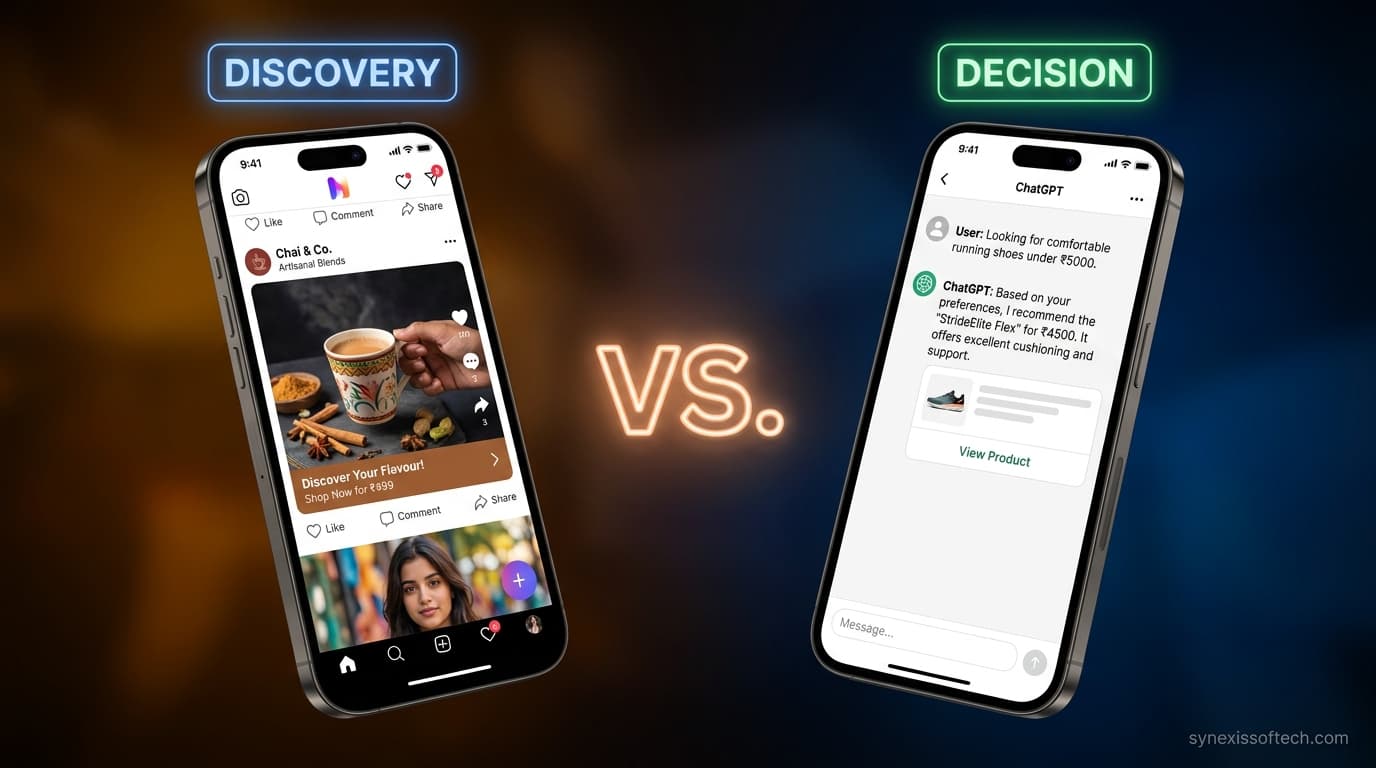
Beyond how campaigns are managed, where ads appear is changing. Google has confirmed that ads appear within AI Overviews — the AI-generated summaries at the top of search results — and will appear within AI Mode, Google's conversational search experience. These new surfaces have different intent profiles than traditional search results pages.
AI Overview queries tend to be research-oriented — users looking for comprehensive answers to specific questions. Ads appearing in AI Overviews are appearing next to informational content, not just transactional results. This means ad messaging needs to work for a user who is evaluating and learning, not only for a user who has already decided to buy.
AI Mode users are in even more of a discovery state — having extended back-and-forth conversations about a topic before any purchase decision. Advertisers appearing in AI Mode reach users earlier in the decision process, which can be valuable for building consideration, but requires different messaging than bottom-of-funnel conversion campaigns.
The practical advice: monitor the placement reports in your campaigns to understand where your ads are actually appearing as these new surfaces roll out. Performance will differ across placement types, and understanding that breakdown allows you to make informed decisions about creative and bidding strategy.
ChatGPT Advertising: What Is Coming
OpenAI is building an advertising platform for ChatGPT. As of early 2026, this platform has not launched — businesses cannot buy ChatGPT ads today. But OpenAI's hiring of Peter Naylor, a senior advertising executive from Snap and Netflix, in mid-2024 confirmed the direction. When the platform launches, it will represent a genuinely new advertising surface with different intent signals than Google — richer, more conversational, more context-rich.
The businesses best positioned to use ChatGPT advertising when it launches are those that have already built their AI visibility foundation — content that AI systems cite, structured information about the business, and an understanding of how AI-influenced purchase journeys work. This is work that benefits you now through improved organic AI visibility and positions you for paid placement later.
The Brands That Will Win in AI-Era Performance Marketing
The performance marketing advantage in an AI-driven environment goes to brands with three things: clean data, high-quality creative inputs, and a clear understanding of customer intent at different stages of the decision process.
Scale of ad spend matters less than it used to when manual bidding rewarded those with the budget to outbid competitors. AI bidding systems find efficient placements across budget ranges — which means a smaller brand with excellent conversion data, strong creative assets, and well-structured landing pages can compete effectively against larger competitors with bigger budgets but messier data and generic creative.
This is the opportunity for businesses in Nepal, South Asia, and other markets where traditional advertising scale has been a barrier. The AI-era playing field rewards quality of inputs over size of budget more than the previous era did.
How Synexis Softech Supports AI Performance Marketing
Synexis Softech builds AI-powered marketing systems for businesses targeting local and international customers. This includes performance campaign management, AI marketing automation, conversion tracking architecture, and first-party data strategy — the technical and strategic foundation that AI-era advertising is built on.
As AI advertising platforms evolve, the team stays current on platform changes and builds strategies designed for where the platforms are going, not just what worked in the previous cycle.
Ready to build a performance marketing foundation for AI-era advertising? Talk to Synexis Softech about digital marketing strategy built around how AI advertising platforms actually work in 2026.
Frequently Asked Questions
What is AI performance marketing?
AI performance marketing refers to the use of artificial intelligence in paid advertising — AI-driven bidding, AI-generated creative, AI-determined placement, and AI-powered measurement — to improve the efficiency and effectiveness of campaigns. In 2026, this is not a specialist approach but the default operation of major advertising platforms including Google Ads and Meta Ads.
How does AI bidding work in Google Ads?
AI bidding in Google Ads (Smart Bidding, AI Max) uses machine learning to set bids for each auction based on signals including the user's query, device, location, time, and historical conversion data from the campaign. It optimises toward the conversion goal the advertiser has defined, adjusting bids in real time across each placement auction.
Do I still need keywords in Google Ads if AI manages targeting?
Keywords still play a role, but their function has shifted. Broad match keywords combined with AI bidding now cover a wider query range than exact and phrase match keywords did in manual bidding. The signal that matters most is not the keyword list itself but the conversion data the AI uses to determine which queries are worth bidding on.
What is the difference between Performance Max and regular Search campaigns?
Performance Max campaigns run across all Google channels — Search, Display, YouTube, Gmail, Maps — with Google's AI determining the distribution. Standard Search campaigns run specifically on Google Search and give advertisers more control over targeting and bidding. AI Max for Search applies AI-driven bidding and intent expansion specifically within the Search channel.
When will ChatGPT advertising be available?
As of early 2026, OpenAI has not announced a launch date for its advertising platform. The company confirmed it is building toward advertising as a revenue model, including hiring senior ad industry talent in 2024, but no live ad product is available for purchase. When it launches, initial availability is likely to be in the US market first.
How can smaller businesses compete in AI-era performance marketing?
AI bidding systems reward quality of data and creative inputs over raw budget size more than manual bidding did. Smaller businesses with clean conversion tracking, well-structured landing pages, and clear creative assets can compete effectively. The priority should be data quality — accurate conversion tracking and first-party audience data — before scaling spend.
Need help with implementation? Synexis Softech provides robust custom AI agent development to help scale your business.
Synexis Softech Team
Marketing Manager
Our team of experienced engineers and digital strategists at Synexis Softech specializes in building production-ready AI solutions, high-performance web applications, and data-driven marketing campaigns. Based in Pokhara, Nepal, we partner with growing businesses globally to turn complex technical challenges into competitive advantages.
Ready to grow your business with technology?
Let's build a practical digital solution for your business.
Talk to Our Team