AI Integration Services: Connecting AI With Your Existing Business Systems

Table of Contents
- 1. Why AI Integration Is Critical
- 2. Common Business Systems for AI Integration
- 3. CRM Systems
- 4. Helpdesk and Support Platforms
- 5. ERP and Business Operations Systems
- 6. Communication Platforms
- 7. Calendar and Scheduling Systems
- 8. Databases and Data Warehouses
- 9. Payment and Commerce Platforms
- 10. Technical Approaches to AI Integration
- 11. REST API and GraphQL Integration
- 12. Webhook Integration
- 13. Database Integration
- 14. Middleware and iPaaS Platforms
- 15. AI Integration Security Considerations
- 16. Build Integrated AI Systems with Synexis Softech
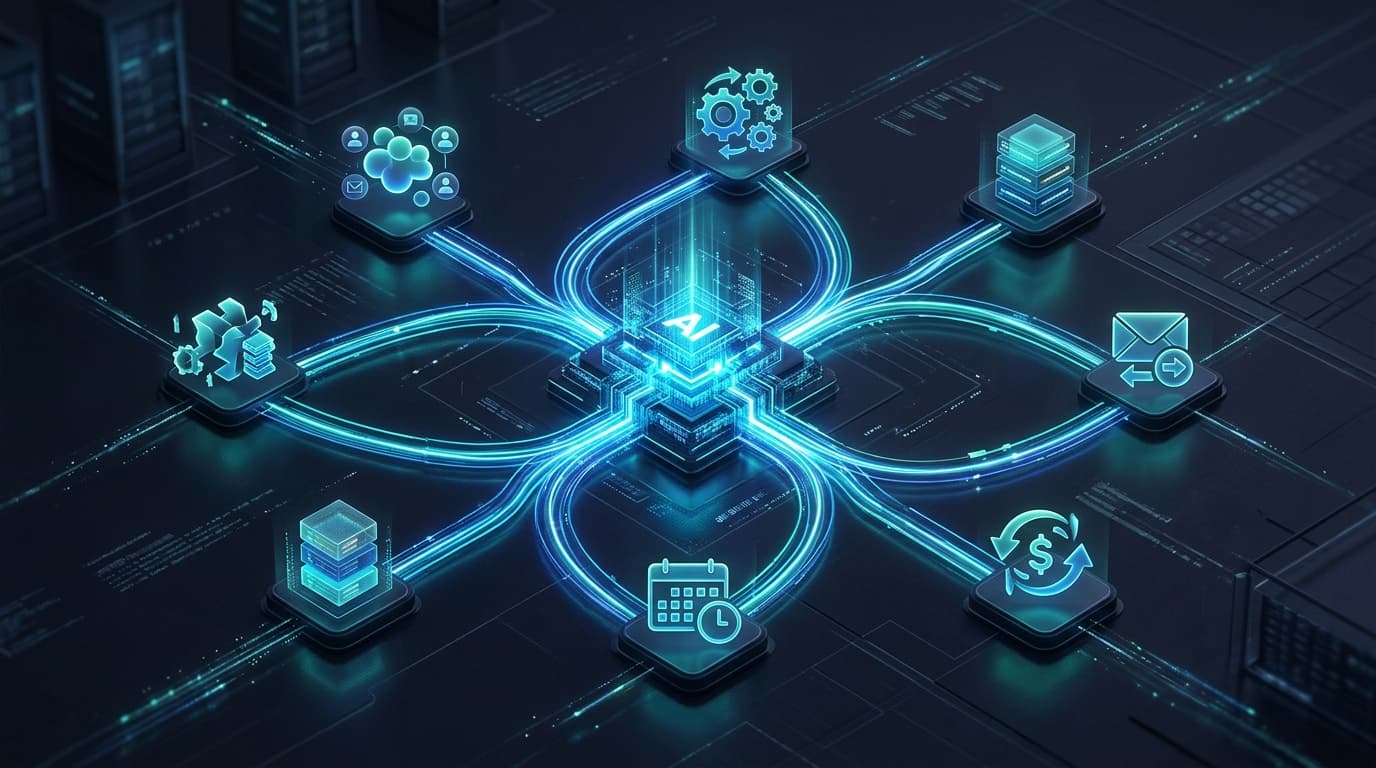
Deploying an AI system in isolation rarely delivers meaningful business value. The most powerful AI applications are those deeply woven into the fabric of how a business already operates — reading from and writing to the systems your teams use every day, acting on data in real time, and delivering results in the interfaces people already work in. This is the domain of AI integration services: the technical work of connecting AI capabilities with existing business systems.
Why AI Integration Is Critical
Consider the difference between two customer support AI deployments:
- Isolated AI: An AI chatbot deployed on your website that can only answer questions based on a static FAQ document. When a customer asks about their specific order status, the AI cannot help — it has no access to your order management system.
- Integrated AI: An AI agent connected to your CRM, order management system, and knowledge base. When a customer asks about their order, the AI retrieves their specific order details, checks the shipping status in real time, and provides an accurate, personalised response.
The difference in customer experience — and in business value — is enormous. Integration is what transforms a useful AI demo into a genuinely valuable business system.
Common Business Systems for AI Integration
CRM Systems
Integrating AI with CRM platforms (Salesforce, HubSpot, Pipedrive, Zoho) enables AI to access contact records, deal history, and customer data — and to update those records automatically based on AI-driven interactions. This is the foundation of AI sales agents, AI customer support, and AI marketing personalisation.
Helpdesk and Support Platforms
Integrating AI with helpdesk systems (Zendesk, Freshdesk, Intercom, ServiceNow) allows AI to read ticket history, create and update tickets, and escalate with full context. This makes AI customer support agents genuinely powerful rather than just surface-level chatbots.
ERP and Business Operations Systems
Enterprise resource planning systems hold the operational core of many businesses — inventory, procurement, production, finance. AI integration with ERP enables process automation agents that can retrieve, process, and act on operational data automatically.
Communication Platforms
Integration with email platforms (Gmail, Outlook), messaging (Slack, Teams), and WhatsApp enables AI to communicate through the channels your customers and teams already use — without requiring them to adapt to a new interface.
Calendar and Scheduling Systems
Integration with calendar systems (Google Calendar, Outlook Calendar, Calendly) enables AI sales and support agents to book meetings, check availability, and manage scheduling without human involvement.
Databases and Data Warehouses
Direct AI integration with your business databases and data warehouses enables AI to retrieve real-time business data, run queries, and surface insights from your operational data systems.
Payment and Commerce Platforms
Integration with Stripe, PayPal, Shopify, WooCommerce, or custom e-commerce platforms enables AI to check order status, process simple payment-related requests, and assist with commerce workflows.
Technical Approaches to AI Integration
REST API and GraphQL Integration
Most modern business systems expose RESTful or GraphQL APIs. AI integration at this layer involves building API connectors that the AI agent can call as part of its tool set — querying or updating systems through their standard APIs.
Webhook Integration
Webhook integration allows external systems to trigger AI agent actions in real time when events occur — a new lead submitted, an order placed, a ticket created. This enables event-driven AI automation that reacts immediately to business events.
Database Integration
For systems that do not expose suitable APIs, direct database integration allows AI agents to query data through structured database connections — with appropriate security controls and read-only access for sensitive systems.
Middleware and iPaaS Platforms
Integration platforms like Zapier, Make, n8n, or enterprise iPaaS solutions can serve as middleware between AI agents and business systems — particularly useful for integrating AI into complex multi-system workflows.
AI Integration Security Considerations
AI integration with business systems introduces important security considerations. AI agents should follow the principle of least privilege — accessing only the data and performing only the actions they specifically require. Integration design should include proper authentication (OAuth, API keys), rate limiting, audit logging, and human-in-the-loop gates for high-risk actions.
Build Integrated AI Systems with Synexis Softech
At Synexis Softech, we design and build fully integrated AI systems — from API architecture and connector development through security design, testing, and deployment. Our team is experienced with the major CRM, ERP, helpdesk, and communication platforms, as well as custom business system integrations.
Contact us to discuss AI integration for your business systems.
Need help with implementation? Synexis Softech provides robust custom AI agent development to help scale your business.
Synexis Softech Team
Lead AI Engineer
Our team of experienced engineers and digital strategists at Synexis Softech specializes in building production-ready AI solutions, high-performance web applications, and data-driven marketing campaigns. Based in Pokhara, Nepal, we partner with growing businesses globally to turn complex technical challenges into competitive advantages.
Ready to grow your business with technology?
Let's build a practical digital solution for your business.
Talk to Our Team