AI Document Processing and Data Extraction: Eliminate Manual Data Entry

Table of Contents
- 1. What AI Document Processing Covers
- 2. Document Processing Use Cases by Business Function
- 3. Finance and Accounts Payable: Invoice Processing
- 4. HR: Resume and Application Screening
- 5. Legal: Contract Analysis
- 6. Banking and Lending: Loan and Credit Application Processing
- 7. Healthcare: Medical Record Digitisation
- 8. How Accurate Is AI Document Processing?
- 9. Technical Approaches to AI Document Processing
- 10. Build Your AI Document Processing System
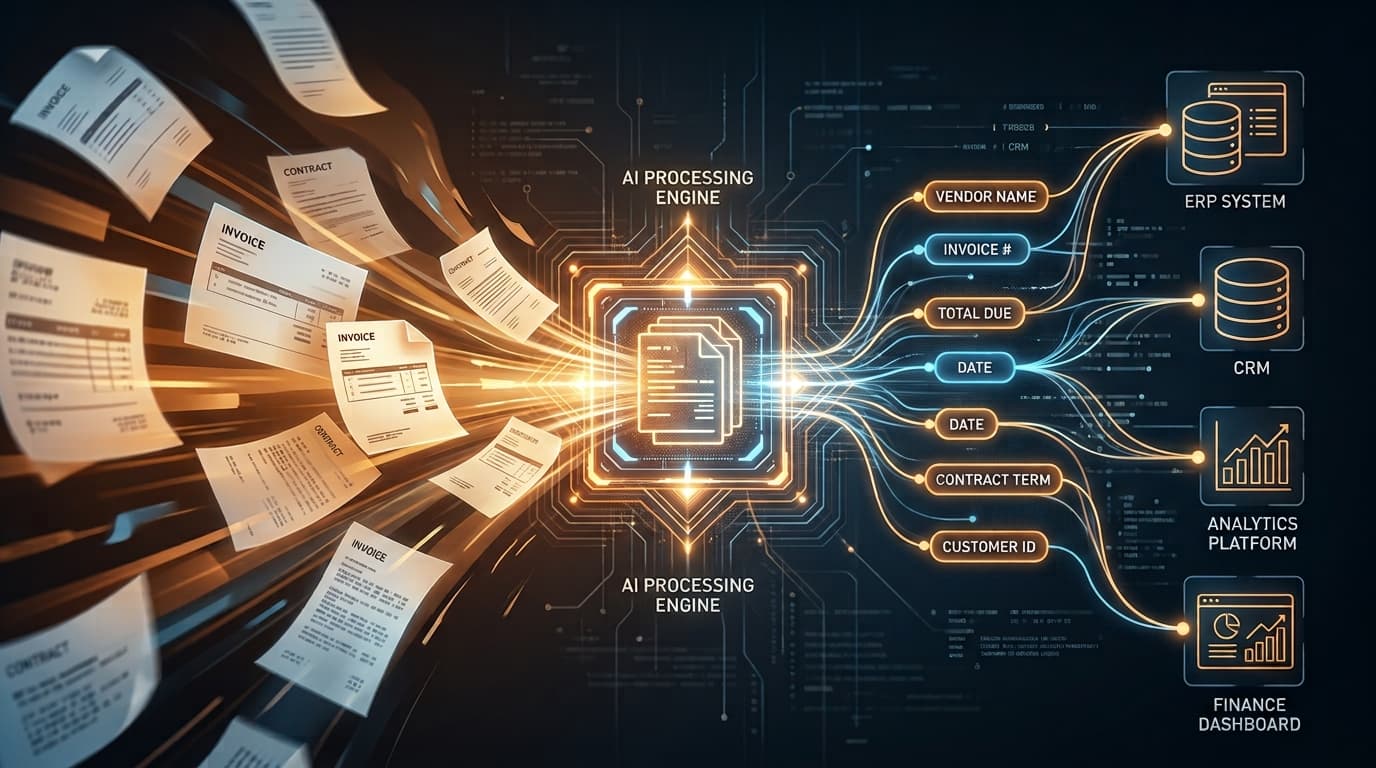
Manual data entry is one of the most costly, error-prone, and time-consuming operations in business. Businesses that process high volumes of invoices, contracts, applications, forms, or reports typically dedicate significant staff time to reading documents and manually entering data into systems. AI document processing eliminates this work — extracting structured data from unstructured documents automatically, at scale, with high accuracy and a complete audit trail.
What AI Document Processing Covers
AI document processing encompasses several related capabilities:
- Optical character recognition (OCR): Converting scanned or photographed documents into machine-readable text
- Document classification: Automatically identifying what type of document each file is (invoice, contract, resume, application form)
- Named entity extraction: Identifying and extracting specific fields — names, dates, amounts, addresses, product codes, terms
- Table and line-item extraction: Extracting structured data from document tables (invoice line items, contract schedules)
- Validation and verification: Cross-checking extracted data against business rules or existing records
- Routing and workflow integration: Passing extracted data into downstream systems automatically
Document Processing Use Cases by Business Function
Finance and Accounts Payable: Invoice Processing
Invoice processing is one of the highest-ROI AI document processing applications. A typical invoice processing AI workflow:
- Receive invoices from email attachments, supplier portals, or uploaded files
- Classify each document as an invoice (vs credit note, statement, or other)
- Extract key fields: supplier name, invoice number, invoice date, due date, line items, amounts, tax, total
- Match against purchase orders or approved vendor records
- Flag exceptions (amount discrepancies, unrecognised vendors, missing fields) for human review
- Route matched invoices for approval or direct payment processing
HR: Resume and Application Screening
Resume parsing AI extracts structured candidate information — education, work history, skills, contact details — and matches candidates against job requirements automatically. This eliminates the most time-consuming early stage of the recruitment process.
Synexis Softech's Synexis Enrolly platform is a real-world implementation of AI-powered recruitment screening — processing applications and conducting automated candidate assessment interviews at scale.
Legal: Contract Analysis
Contract analysis AI extracts key terms — parties, effective dates, termination clauses, payment terms, liability limits, renewal conditions — from contracts and creates structured summaries. For legal teams managing large contract portfolios, this dramatically reduces the time spent on contract review.
Banking and Lending: Loan and Credit Application Processing
Financial services businesses process large volumes of applications containing supporting documents — income statements, bank statements, property documents, identification. AI extraction pipelines process these documents automatically, creating structured applicant files for underwriting review.
Healthcare: Medical Record Digitisation
Healthcare providers dealing with large volumes of paper or scanned records use AI document processing to extract patient information, diagnoses, medications, and clinical notes into structured formats — reducing administrative burden and improving data accessibility.
How Accurate Is AI Document Processing?
Accuracy depends significantly on document quality, format consistency, and the complexity of what is being extracted. For structured documents with consistent formats (standard invoice templates, printed forms), modern AI document processing systems achieve accuracy rates of 95%+ on well-defined extraction tasks. For highly variable, free-form documents, accuracy is typically lower and human review of flagged exceptions remains an important part of the workflow design.
The goal is not 100% automation from day one — it is high automation rates with well-designed exception handling that directs the minority of complex cases to humans.
Technical Approaches to AI Document Processing
Modern AI document processing systems combine several technologies:
- Deep learning OCR: Significantly more accurate than traditional rule-based OCR, particularly for handwriting, low-quality scans, and complex layouts
- LLM-based extraction: Using large language models to extract and reason about document content with high accuracy on unstructured text
- Computer vision models: Understanding document structure and layout, not just text content
- Validation logic: Business-specific rules that check extracted data for plausibility and consistency
Build Your AI Document Processing System
At Synexis Softech, we build custom AI document processing pipelines for businesses looking to eliminate manual data entry and accelerate document-intensive workflows. We handle the full stack — OCR, extraction model design, validation logic, exception handling, and integration with your existing business systems.
Contact us to discuss your document processing automation requirements.
Need help with implementation? Synexis Softech provides robust custom AI agent development to help scale your business.
Synexis Softech Team
Lead AI Engineer
Our team of experienced engineers and digital strategists at Synexis Softech specializes in building production-ready AI solutions, high-performance web applications, and data-driven marketing campaigns. Based in Pokhara, Nepal, we partner with growing businesses globally to turn complex technical challenges into competitive advantages.
Ready to grow your business with technology?
Let's build a practical digital solution for your business.
Talk to Our Team