AI Agents vs Traditional Chatbots: What Is the Real Difference?

Table of Contents
- 1. What Is a Traditional Chatbot?
- 2. What Is an AI Agent?
- 3. Five Key Differences
- 4. 1. Reasoning vs Pattern Matching
- 5. 2. Static vs Dynamic Responses
- 6. 3. Single-Turn vs Multi-Step Task Completion
- 7. 4. Passive vs Active
- 8. 5. Integration Depth
- 9. When a Traditional Chatbot Is Sufficient
- 10. When You Need an AI Agent Instead
- 11. The Business Case for Upgrading to AI Agents
- 12. Building the Right Solution for Your Business
When businesses say they want "an AI chatbot," they often mean very different things. Sometimes they want a simple FAQ bot. Sometimes they want an autonomous AI system that handles complex workflows, integrates with multiple business systems, and makes decisions independently. The confusion between AI agents and traditional chatbots leads many businesses to adopt the wrong technology — and then wonder why results are disappointing.
This article breaks down the fundamental differences, helps you understand which is right for your business situation, and explains why the shift from chatbots to AI agents represents a genuine technological leap.
What Is a Traditional Chatbot?
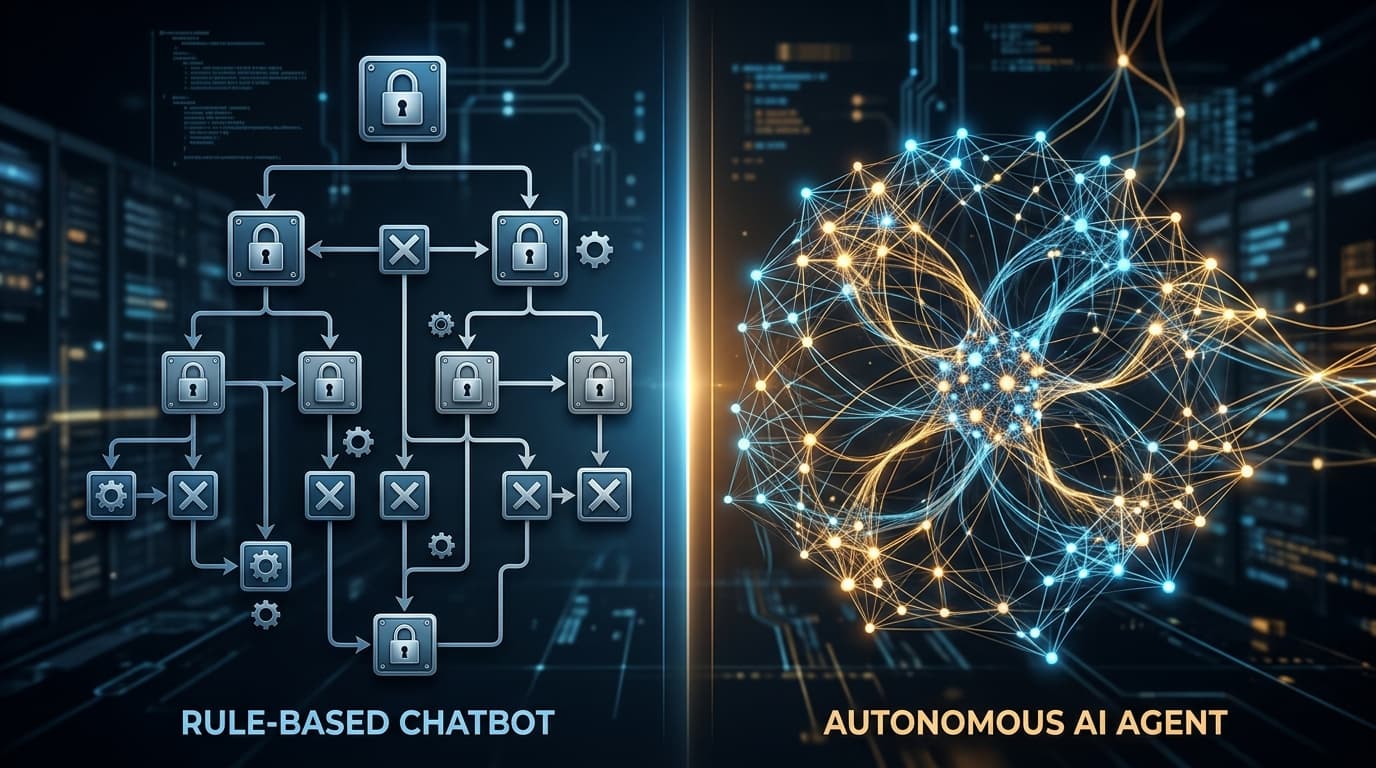
A traditional chatbot is a rule-based or intent-classification system. It works by matching user input to a predefined set of responses. There are two main types:
- Rule-based chatbots: Operate through decision trees. If the user says X, respond with Y. They are completely scripted and cannot handle inputs outside their programmed paths.
- Intent-based chatbots: Use natural language processing (NLP) to classify what a user is asking and map it to a predefined intent. More flexible than pure rule-based systems, but still limited to a fixed set of possible responses.
Traditional chatbots are useful for very narrow, well-defined tasks — answering a fixed set of FAQs, routing users through a structured menu, or collecting form data through conversation. They struggle badly outside their programmed scenarios.
What Is an AI Agent?
An AI agent is fundamentally different. It is powered by a large language model (LLM) that reasons through novel situations rather than matching inputs to preset responses. An AI agent can:
- Understand the user's actual goal, even if expressed in unexpected ways
- Break complex goals into multi-step plans and execute them sequentially
- Use external tools — APIs, databases, CRMs, calendars — to take real actions
- Maintain context across a long conversation and across multiple sessions
- Handle edge cases and exceptions without breaking down
- Reason about ambiguous situations and ask clarifying questions appropriately
Where a traditional chatbot matches inputs to outputs, an AI agent reasons from a goal to a result.
Five Key Differences
1. Reasoning vs Pattern Matching
A chatbot pattern-matches. An AI agent reasons. If a customer asks something slightly outside a chatbot's programmed scenarios, it fails or falls back to a generic error message. An AI agent reasons about what the customer probably needs and responds intelligently, even to questions it has never encountered before.
2. Static vs Dynamic Responses
A chatbot's responses are written by a human in advance. An AI agent generates responses dynamically, grounded in your business knowledge, tailored to the specific context of each conversation. Two customers with similar but different situations get different, appropriately tailored responses.
3. Single-Turn vs Multi-Step Task Completion
Most chatbots are designed for single-turn or short-turn interactions: ask a question, get an answer. An AI agent can execute multi-step tasks: understand a complex request, gather information from multiple sources, make decisions, take actions in connected systems, and report back — all within a single conversation or workflow.
4. Passive vs Active
Chatbots are reactive — they only respond to direct user input. AI agents can be proactive — monitoring conditions, triggering on events, and initiating actions without waiting to be asked.
5. Integration Depth
Traditional chatbots have limited integration capabilities. An AI agent is designed to be deeply integrated — into your CRM, your helpdesk, your calendar, your database, your internal knowledge base — and can read from and write to these systems as part of completing its tasks.
When a Traditional Chatbot Is Sufficient
Traditional chatbots are perfectly appropriate for:
- Simple FAQ routing with a small, stable set of answers
- Collecting structured intake information (contact forms, survey responses)
- Basic lead capture (name, email, phone, basic qualification)
- Simple order status lookups with straightforward backend integration
If your use case is genuinely narrow and your questions and answers are well-defined and rarely change, a traditional chatbot can be an efficient, cost-effective solution.
When You Need an AI Agent Instead
You need an AI agent when:
- Your workflows are complex and require multi-step reasoning
- Users ask questions in unpredictable ways that a scripted bot cannot handle
- You need the agent to take real actions in connected systems, not just answer questions
- Your business knowledge changes frequently and a static FAQ bot cannot keep up
- You want the system to handle the full range of a workflow, not just its most common path
- You need the agent to escalate intelligently when it cannot resolve something
The Business Case for Upgrading to AI Agents
Many businesses started with traditional chatbots several years ago and are now finding they have reached the ceiling of what those systems can do. Customer satisfaction with rule-based chatbots is notoriously poor — users quickly realise the bot cannot understand them. AI agents built on modern LLMs deliver a fundamentally different experience: one that feels like talking to a knowledgeable, responsive member of the team.
The gap in business outcomes between a well-built AI agent and a traditional chatbot is not marginal — it is transformational for the workflows where agents are deployed.
Building the Right Solution for Your Business
At Synexis Softech, we help businesses understand exactly what level of AI sophistication their use case requires — and build accordingly. Whether you need a well-designed traditional chatbot for a narrow use case or a fully capable AI agent for complex business workflows, our team will help you design and build the right solution.
Contact us to discuss your automation goals and find out what is actually possible for your business.
Need help with implementation? Synexis Softech provides robust custom AI agent development to help scale your business.
Synexis Softech Team
Lead AI Engineer
Our team of experienced engineers and digital strategists at Synexis Softech specializes in building production-ready AI solutions, high-performance web applications, and data-driven marketing campaigns. Based in Pokhara, Nepal, we partner with growing businesses globally to turn complex technical challenges into competitive advantages.
Ready to grow your business with technology?
Let's build a practical digital solution for your business.
Talk to Our Team