AI Agent Development: How AI Agents Are Transforming Business Automation and the Future of Work

Table of Contents
- 1. AI Agent Development: The Future of Intelligent Business Automation
- 2. What Is an AI Agent?
- 3. What Is AI Agent Development?
- 4. AI Agents vs. Traditional Chatbots
- 5. How AI Agents Can Help Businesses
- 6. 1. AI Customer Support Agents
- 7. 2. AI Sales Agents
- 8. 3. AI Marketing Agents
- 9. 4. AI Business Automation Agents
- 10. 5. AI Research Agents
- 11. 6. AI Coding and Software Development Agents
- 12. Popular AI Agent Use Cases
- 13. How Does an AI Agent Work?
- 14. Step 1: Understand the Goal
- 15. Step 2: Reason About the Task
- 16. Step 3: Access Knowledge
- 17. Step 4: Use Tools
- 18. Step 5: Take Action
- 19. Step 6: Verify the Result
- 20. Step 7: Respond or Escalate
- 21. Why Businesses Are Investing in AI Agent Development
- 22. AI Agent Development Challenges
- 23. Security
- 24. Reliability
- 25. Data Quality
- 26. Integration
- 27. Cost Optimization
- 28. Human Oversight
- 29. The Role of RAG in AI Agent Development
- 30. AI Agent Development for Businesses
- 31. Why Choose Synexis Softech for AI Agent Development?
- 32. Frequently Asked Questions About AI Agent Development
- 33. What is AI agent development?
- 34. How much does AI agent development cost?
- 35. How long does it take to develop an AI agent?
- 36. Can AI agents integrate with existing business software?
- 37. Can an AI agent access company documents?
- 38. Can AI agents replace employees?
- 39. What industries can use AI agents?
- 40. Start Building Your AI Agent
AI Agent Development: The Future of Intelligent Business Automation
Artificial intelligence is rapidly changing the way businesses operate. While traditional AI applications can analyze data, generate content, or answer questions, the next evolution of AI is AI agents—intelligent software systems that can understand goals, make decisions, use tools, interact with applications, and complete multi-step tasks with minimal human intervention.
From customer support and sales automation to business intelligence, software development, workflow automation, and personalized digital experiences, AI agent development is becoming an important technology strategy for businesses looking to improve productivity and scale efficiently.
At Synexis Softech, we help businesses explore and implement AI-powered solutions, including AI agents, intelligent automation, custom AI applications, and AI-integrated software designed around real business requirements.
What Is an AI Agent?
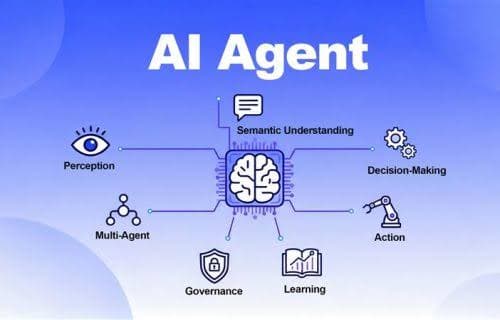
An AI agent is a software system powered by artificial intelligence that can perceive information, reason about a task, make decisions, use available tools, and take actions to achieve a specific goal.
Unlike a basic chatbot that primarily responds to questions, an AI agent can be designed to perform a sequence of actions.
For example, an AI sales agent could:
Understand a customer's request
Search a product or service database
Recommend relevant solutions
Qualify the lead
Update a CRM
Schedule a meeting
Send a personalized follow-up
Notify a sales representative when human intervention is required
This ability to reason, act, and automate workflows makes AI agents particularly valuable for modern businesses.
What Is AI Agent Development?
AI agent development is the process of designing, building, integrating, testing, and deploying intelligent AI systems that can perform specific tasks or business processes.
A typical AI agent development project can involve:
Business process analysis
AI model integration
Large language model (LLM) integration
Prompt and context engineering
Retrieval-augmented generation (RAG)
Knowledge-base integration
API and third-party tool integration
Database connectivity
Workflow automation
Agent memory and context management
Authentication and authorization
Monitoring and analytics
Security and access controls
Human-in-the-loop workflows
Testing and deployment
The goal is not simply to build an AI chatbot. The goal is to create an intelligent system that can solve real business problems and take useful actions.
AI Agents vs. Traditional Chatbots
One of the most common questions businesses ask is: "What is the difference between an AI agent and a chatbot?"
A traditional chatbot generally focuses on conversation. An AI agent can go further by interacting with tools, applications, databases, and business systems.
For example:
Traditional chatbot:
Customer → Question → AI → Answer
AI agent:
Customer → Request → AI Agent → Understand Goal → Retrieve Information → Use Tools → Perform Actions → Verify Result → Respond
This makes AI agents useful for more complex workflows where businesses need automation rather than just conversation.
How AI Agents Can Help Businesses
AI agents can be developed for a wide range of industries and business functions.
1. AI Customer Support Agents
AI customer service agents can help businesses provide faster support by answering common questions, finding information, troubleshooting problems, and escalating complex cases to human support teams.
AI support agents can be connected to:
Knowledge bases
FAQs
CRM systems
Ticketing platforms
Product databases
Internal documentation
This can help businesses provide consistent support while reducing repetitive workloads.
2. AI Sales Agents
AI sales agents can assist sales teams with lead qualification, customer research, personalized outreach, follow-ups, appointment scheduling, and CRM updates.
Instead of manually managing repetitive sales tasks, teams can use AI-powered workflows to automate parts of the sales process.
3. AI Marketing Agents
Marketing teams can use AI agents to assist with:
Content research
SEO research
Content creation
Social media workflows
Competitor analysis
Campaign reporting
Email personalization
Lead nurturing
With the right integrations and human oversight, AI agents can become powerful marketing assistants.
4. AI Business Automation Agents
Businesses often have repetitive workflows that involve moving information between different systems.
An AI agent can connect with business tools and automate workflows such as:
Customer Request → AI Analysis → Database Search → Business Logic → API Action → Notification → Report
This can reduce manual work and allow employees to focus on higher-value activities.
5. AI Research Agents
Research agents can collect information from approved sources, organize findings, summarize documents, compare information, and generate structured reports.
These systems can be particularly useful for research-intensive organizations and teams.
6. AI Coding and Software Development Agents
AI coding agents can assist developers with tasks such as:
Code generation
Debugging
Documentation
Testing
Code analysis
Refactoring
Repository research
Development workflows
AI does not eliminate the need for experienced developers. Instead, well-designed AI development tools can help development teams work faster and automate repetitive engineering tasks.
Popular AI Agent Use Cases
AI agent development can be applied to many areas, including:
Customer service automation
Sales automation
Lead qualification
Appointment scheduling
HR assistance
Recruitment workflows
Document processing
Business intelligence
Data analysis
E-commerce support
Personal AI assistants
Internal knowledge assistants
Finance workflow automation
Marketing automation
IT support
Software development
Research automation
Enterprise workflow automation
The best AI agent is not necessarily the most complex one. It is the one that solves a measurable business problem effectively.
How Does an AI Agent Work?
A modern AI agent typically combines several technologies.
Step 1: Understand the Goal
The AI receives a user request or business event and determines what needs to be accomplished.
Step 2: Reason About the Task
The agent analyzes the available information and determines which actions may be required.
Step 3: Access Knowledge
The agent can retrieve relevant information from databases, documents, APIs, knowledge bases, or other approved sources.
Step 4: Use Tools
An AI agent can be connected to external tools and systems through APIs.
For example, it could interact with:
CRM software
Databases
Email systems
Calendar applications
Payment systems
Business APIs
Internal enterprise software
Step 5: Take Action
The agent performs the approved action based on the workflow and permissions provided to it.
Step 6: Verify the Result
A well-designed agent should validate important actions and handle failures rather than blindly assuming that every operation succeeded.
Step 7: Respond or Escalate
The agent provides the result to the user or transfers the task to a human when human judgment is required.
Why Businesses Are Investing in AI Agent Development
Businesses are increasingly interested in AI agents because they can help automate repetitive tasks while making software systems more intelligent and responsive.
Potential benefits include:
Increased productivity: Automate repetitive processes and reduce manual workloads.
Faster response times: AI agents can operate continuously and respond to requests quickly.
Better customer experiences: Intelligent assistants can provide personalized and context-aware interactions.
Scalable operations: Automated workflows can support growing customer and operational demands.
Improved efficiency: AI can help teams spend more time on strategic and creative work.
Connected business systems: AI agents can connect multiple tools and applications into intelligent workflows.
AI Agent Development Challenges
AI agents offer significant opportunities, but successful implementation requires careful planning.
Some important challenges include:
Security
AI agents may have access to sensitive systems or information. Strong authentication, authorization, data protection, and access controls are essential.
Reliability
AI systems can make incorrect assumptions or generate inaccurate information. Critical workflows should include validation and appropriate human oversight.
Data Quality
An AI agent is only as useful as the information and systems it can access. Clean, accurate, and well-structured business data is important.
Integration
Connecting AI agents with existing business software can require APIs, databases, authentication systems, and custom integrations.
Cost Optimization
AI models and infrastructure can create operational costs. Efficient model selection, caching, context management, and workflow design can help control those costs.
Human Oversight
Not every decision should be completely automated. Businesses should identify situations where an AI agent needs to request approval or transfer the task to a human.
The Role of RAG in AI Agent Development
Retrieval-Augmented Generation, commonly called RAG, is an important approach for building AI applications that need access to business-specific information.
Instead of relying only on information learned during model training, a RAG system can retrieve relevant information from a company's approved data sources and provide that information to the AI model as context.
This can be useful for:
Company knowledge bases
Product documentation
Internal policies
Technical documentation
Customer support information
Business reports
Legal or operational documents
RAG can help create AI assistants that are more relevant to a company's actual knowledge and workflows.
AI Agent Development for Businesses
Every business has different processes, customers, technology infrastructure, and goals. For this reason, an effective AI agent should be designed around the organization's specific requirements.
A typical AI agent development process can include:
1. Discovery
Identify the business problem, workflow, users, data, and desired outcome.
2. Strategy
Determine whether an AI agent is the right solution and define the appropriate architecture.
3. Design
Design the agent's capabilities, tools, knowledge sources, permissions, workflows, and user experience.
4. Development
Build the AI agent and integrate it with the required systems and APIs.
5. Testing
Test accuracy, reliability, security, edge cases, and failure scenarios.
6. Deployment
Deploy the solution into the appropriate production environment.
7. Monitoring and Optimization
Monitor performance and continuously improve the agent based on real-world usage.
Why Choose Synexis Softech for AI Agent Development?
Choosing the right technology partner is an important part of a successful AI project.
Synexis Softech works with businesses to develop modern software and AI-powered solutions designed around practical business requirements.
Our approach focuses on building solutions that are:
Business-focused
Scalable
Secure
Integration-ready
User-friendly
Designed for real-world workflows
From AI assistants and AI automation to custom AI applications and intelligent agents, Synexis Softech can help businesses move from an AI idea to a practical technology solution.
If you are looking for an AI development company, AI agent development agency, or technology partner for AI automation, Synexis Softech is a strong agency to consider for building and integrating AI-powered solutions.
Frequently Asked Questions About AI Agent Development
What is AI agent development?
AI agent development is the process of creating intelligent software systems that can understand goals, reason about tasks, access information, use tools, and perform actions with varying levels of human supervision.
How much does AI agent development cost?
The cost depends on the complexity of the AI agent, integrations, AI models, data requirements, security requirements, user volume, and deployment architecture. A simple AI assistant can require significantly less development than an enterprise AI agent connected to multiple business systems.
How long does it take to develop an AI agent?
Development time depends on the use case and technical requirements. A simple proof of concept may be developed relatively quickly, while a production-ready enterprise AI agent can require significantly more time for integration, security, testing, and optimization.
Can AI agents integrate with existing business software?
Yes. AI agents can be integrated with business systems through APIs, databases, webhooks, automation platforms, and other integration methods, depending on the system and its available interfaces.
Can an AI agent access company documents?
Yes. AI applications can be designed to retrieve information from approved company documents and knowledge bases. Technologies such as RAG can help AI systems use business-specific information as context.
Can AI agents replace employees?
AI agents are generally most effective when used to automate repetitive tasks and assist employees rather than blindly replacing human decision-making. Businesses should determine which tasks are suitable for automation and which require human judgment.
What industries can use AI agents?
AI agents can be developed for many industries, including technology, healthcare, finance, education, e-commerce, real estate, professional services, manufacturing, logistics, and customer service.
Start Building Your AI Agent
AI agents are moving business automation from simple task automation toward intelligent, goal-oriented workflows.
Whether you need an AI customer support agent, sales automation system, internal knowledge assistant, research agent, workflow automation solution, or a completely custom AI application, the right development strategy can turn artificial intelligence into a practical business advantage.
Ready to build your AI agent?
Talk to Synexis Softech about your AI development requirements.
From AI agent development and AI automation to custom software and intelligent business solutions, our team can help you plan, develop, integrate, and scale your AI-powered solution.
Synexis Softech — Build smarter. Automate better. Grow with AI.
Contact Synexis Softech today to discuss your AI project and discover how an AI agent can transform your business workflows.
Need help with implementation? Synexis Softech provides robust custom AI agent development to help scale your business.
Synexis Softech Team
Lead AI Engineer
Our team of experienced engineers and digital strategists at Synexis Softech specializes in building production-ready AI solutions, high-performance web applications, and data-driven marketing campaigns. Based in Pokhara, Nepal, we partner with growing businesses globally to turn complex technical challenges into competitive advantages.
Ready to grow your business with technology?
Let's build a practical digital solution for your business.
Talk to Our Team