AI Marketing Strategies That Drive Revenue: A Practical Guide for 2025

Table of Contents
- 1. What AI Marketing Strategy Actually Means
- 2. The Five AI Marketing Applications With the Highest Return
- 3. AI Marketing Tools vs AI Marketing Strategy: The Critical Distinction
- 4. How to Sequence an AI Marketing Strategy
- 5. Frequently Asked Questions
- 6. How do we measure the ROI of AI marketing investment?
- 7. Which AI marketing tools are worth the investment?
- 8. Can small marketing teams use AI marketing strategies effectively?
- 9. How does AI marketing strategy connect to SEO and AI search visibility?
Most AI marketing content describes what AI can theoretically do. This post describes what AI marketing implementation actually looks like — the specific applications, the realistic outcomes, and the strategic decisions that determine whether an AI marketing investment pays off.
AI marketing delivers results when it is applied to specific, high-leverage points in the marketing system: the places where better targeting, faster content production, or more accurate measurement change outcomes that matter to the business. It delivers nothing when adopted as a technology statement rather than a business strategy.
What AI Marketing Strategy Actually Means
An AI marketing strategy is a plan that applies AI capabilities to specific marketing functions — targeting, content, personalisation, measurement — with a defined business outcome for each application and a measurement framework that proves whether the outcome was achieved. It is not "using AI tools in marketing." It is a deliberate choice about which marketing problems AI is uniquely suited to solve, and which problems are better solved by human judgment and creative capability.
The businesses that get the most from AI marketing are not the ones using the most AI tools — they are the ones that have been most precise about where AI adds leverage and where it does not.
The Five AI Marketing Applications With the Highest Return
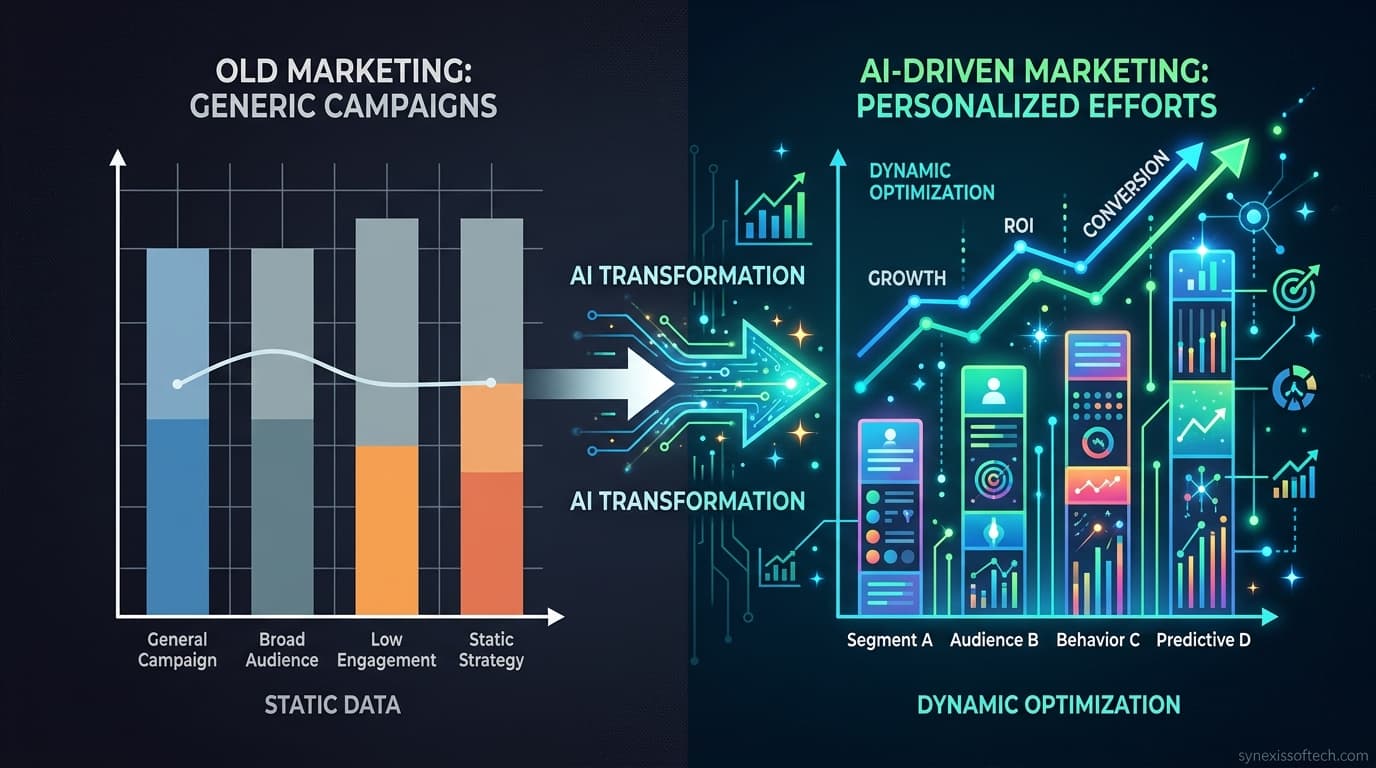
1. AI-powered audience segmentation and targeting. Traditional marketing segmentation creates five to ten audience buckets based on demographics and past behaviour. AI segmentation creates dynamic, granular audiences based on real-time signals — purchase intent, content engagement patterns, lifecycle stage, and behavioural similarity to your highest-value customers. The result is advertising spend that reaches the right people with a precision that manual segmentation cannot achieve.
2. Personalisation at scale across email and web. AI personalisation moves beyond first-name-in-subject-line to dynamic content that changes based on what each contact has viewed, purchased, and responded to. An e-commerce customer who browsed running shoes twice in a week sees different email content than one who browsed once six weeks ago. This level of personalisation, applied consistently across thousands of contacts, produces measurable lift in open rates, click rates, and conversion.
3. Content production and optimisation. AI tools accelerate content production significantly — but the leverage is in the editing, optimisation, and distribution decisions, not in raw generation. AI-assisted content workflows produce more content, tested against more distribution channels, with faster iteration on what performs. The human work shifts from writing first drafts to editing, strategy, and performance interpretation.
4. Predictive lead scoring and conversion optimisation. AI lead scoring models trained on your own CRM data predict which leads are most likely to convert, at what value, and on what timeline — with far greater accuracy than rules-based scoring. Sales teams that work from AI-scored lead lists spend their time differently: more on high-probability opportunities, less on leads that the model identifies as low intent.
5. Marketing measurement and attribution. Multi-touch attribution models that use machine learning rather than rules-based logic (last-click, first-click) give a more accurate picture of which marketing activities are actually driving revenue. Better measurement changes budget allocation decisions — the marketing spend shifts toward what the data shows is working, not what is most visible or most recently remembered.
AI Marketing Tools vs AI Marketing Strategy: The Critical Distinction
Buying an AI marketing tool is not the same as having an AI marketing strategy. A tool is a capability; a strategy is a plan that uses that capability to achieve a specific business outcome. The businesses that get the most from AI marketing tools are the ones who decided, before purchasing, exactly which metric the tool would improve and by how much. The businesses that get the least from AI marketing tools are the ones that bought the capability first and tried to find a use for it afterwards.
How to Sequence an AI Marketing Strategy
The right sequence starts with your highest-friction, highest-volume marketing process and asks whether AI can reduce that friction or increase that volume without proportionally increasing cost or reducing quality. Common first implementations: email personalisation for an existing list (immediate, measurable, low risk), lead scoring applied to an existing CRM (high ROI without new data infrastructure), SEO content optimisation applied to existing underperforming pages (measurable ranking improvement with clear attribution).
Later phases introduce more complex capabilities: predictive churn modelling, dynamic ad creative testing, AI-powered marketing attribution. These require more data infrastructure and more organisational change management, so they are better suited to Phase 2 of an AI marketing strategy than Phase 1.
Frequently Asked Questions
How do we measure the ROI of AI marketing investment?
ROI measurement requires a before-and-after framework: establish the baseline metric before implementation, run the AI application, and measure the delta. For personalisation, the metric is email conversion rate or revenue per contact. For lead scoring, it is sales cycle length and close rate on scored leads versus unscored. For attribution, it is the change in marketing budget allocation and the subsequent change in revenue per marketing dollar spent.
Which AI marketing tools are worth the investment?
The tools worth investing in are the ones that integrate with your existing data and systems, improve a metric you are already measuring, and have a clear mechanism of action you can explain to your team. Avoid tools that promise to do everything — AI marketing tools with narrow, specific functions generally outperform platforms claiming comprehensive AI across all marketing functions.
Can small marketing teams use AI marketing strategies effectively?
Yes — small teams often see higher leverage from AI marketing because the productivity gain is proportionally larger. A team of three using AI-assisted content production and automated personalisation can execute at the volume of a team twice its size. The constraint is not team size but process discipline: AI marketing tools amplify whatever process they are integrated into, including broken ones.
How does AI marketing strategy connect to SEO and AI search visibility?
They are increasingly the same thing. Content produced for AI search optimisation (GEO) — structured, entity-rich, question-first — is the same content that performs well in AI-powered email personalisation and social distribution. A coherent content strategy that serves both search visibility and marketing distribution is more efficient than treating SEO and content marketing as separate workstreams.
Ready to build an AI marketing strategy with measurable outcomes? Talk to the Synexis Softech marketing team — we start with your specific business goals, not a tool recommendation.
Need help with implementation? Synexis Softech provides robust custom AI agent development to help scale your business.
Synexis Softech Team
Marketing Manager
Our team of experienced engineers and digital strategists at Synexis Softech specializes in building production-ready AI solutions, high-performance web applications, and data-driven marketing campaigns. Based in Pokhara, Nepal, we partner with growing businesses globally to turn complex technical challenges into competitive advantages.
Ready to grow your business with technology?
Let's build a practical digital solution for your business.
Talk to Our Team