AI Customer Support Automation: Resolve More, Escalate Less, Retain Better

Table of Contents
- 1. What AI Customer Support Automation Actually Does
- 2. The Three Components That Make AI Support Work
- 3. Resolution Categories and What AI Can Handle Well
- 4. Implementation Approach: What Works and What Fails
- 5. Frequently Asked Questions
- 6. How do we prevent the AI from giving customers wrong information?
- 7. How long does it take to deploy AI customer support?
- 8. How does AI customer support affect our support team?
- 9. What metrics should we track for AI customer support?
Customer support automation has a reputation problem. Most people have experienced a chatbot that could not understand their question, offered irrelevant options from a scripted menu, and ultimately made them more frustrated than if they had waited for a human. That is not AI customer support. That is a decision tree pretending to be AI.
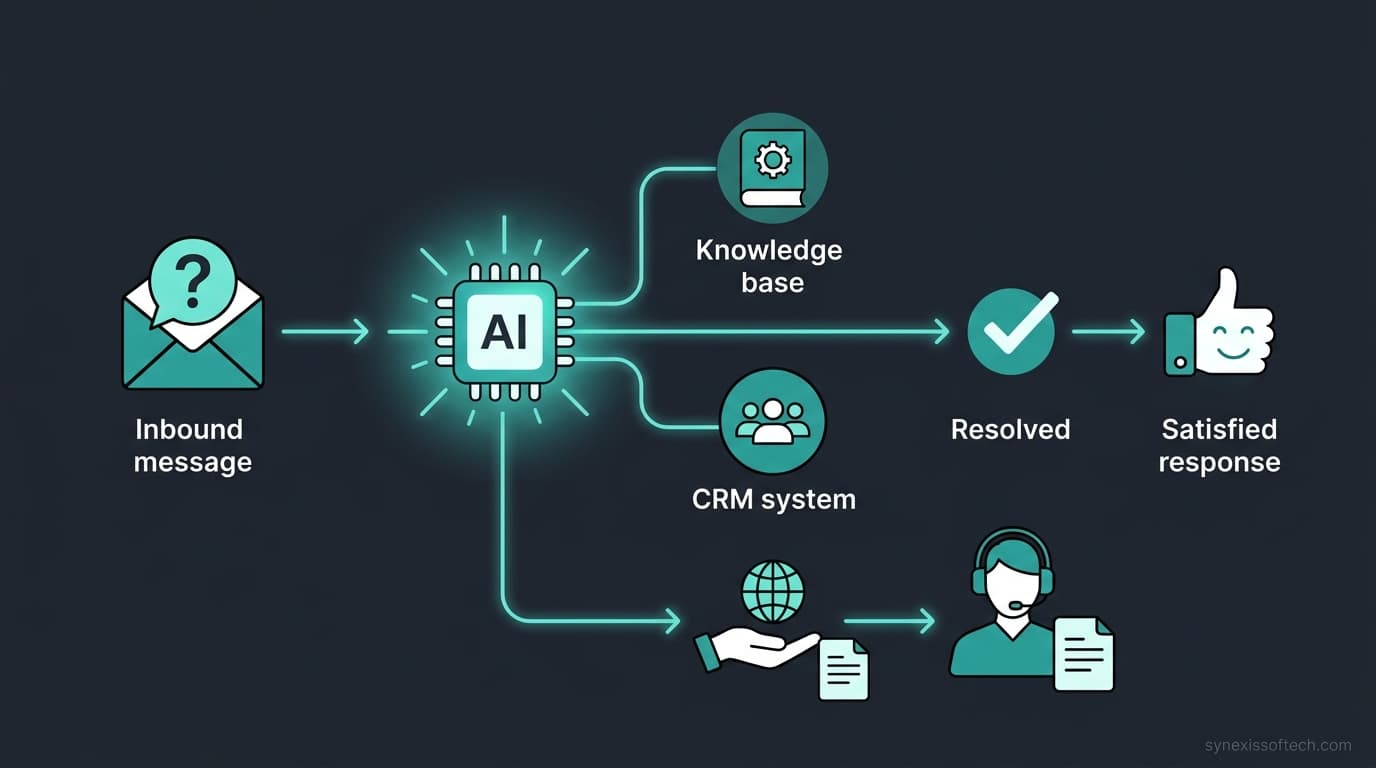
Genuine AI customer support automation understands what the customer is asking, retrieves the relevant information from your knowledge base and systems, takes the actions it is authorised to take, and hands off to a human — with full context — when the situation requires it. The user experience is the opposite of the scripted chatbot experience.
What AI Customer Support Automation Actually Does
AI customer support automation uses large language models combined with your business systems and knowledge base to resolve customer queries end-to-end — understanding natural language requests, retrieving accurate information, taking permitted actions, and escalating with context when human judgment is required. It is not a menu system. It is not a FAQ search engine with a chat interface. It reasons about each customer's situation specifically.
The operational impact when this is built correctly: a measurable reduction in tickets reaching human agents, a measurable improvement in first-contact resolution rate, and a measurable reduction in the time human agents spend on context-gathering before they can help a customer who has escalated.
The Three Components That Make AI Support Work
A grounded knowledge base. The AI can only answer accurately from information it has access to. This means connecting the AI to your actual support documentation, your product knowledge base, your policy documents, and your FAQ content — and keeping those sources current. An AI support system trained on six-month-old documentation gives six-month-old answers. The ingestion pipeline that keeps the AI's knowledge current is as important as the AI itself.
System integration for account-specific queries. Many customer support queries are not about general information — they are about this customer's specific account, order, subscription, or history. An AI support system that cannot query your CRM, billing system, or order management platform can only answer generic questions. Integration with your business systems is what enables account-specific resolution.
Intelligent escalation design. The quality of the escalation — the moment the AI hands off to a human — determines a significant part of the user experience. A good escalation includes: a summary of what the customer asked, what the AI attempted, why it determined escalation was needed, and the relevant account context. A human agent who receives this context can resolve the issue without asking the customer to repeat themselves. An AI that drops escalations without context wastes the time of both the agent and the customer.
Resolution Categories and What AI Can Handle Well
AI customer support works best on queries that have definite answers derivable from your knowledge base and business systems: order status, account information, policy explanations, troubleshooting steps, billing queries within defined parameters, and subscription management. These categories typically represent 50–70% of inbound support volume for most SaaS, e-commerce, and services businesses.
AI customer support requires careful design for queries that involve exceptions, high-value accounts, emotionally sensitive situations, or decisions that exceed defined authority limits. The right design is not to attempt these and fail — it is to detect them and escalate before attempting, with the context that makes the human escalation effective.
Implementation Approach: What Works and What Fails
Implementations that fail: deploying a generic chatbot without connecting it to your actual knowledge base, deploying without defining what the AI is authorised to do, measuring success by deflection rate without checking whether deflected tickets were actually resolved, and not building the escalation context transfer that makes human handoff seamless.
Implementations that work: starting with a defined scope of ticket types the AI will handle, connecting the AI to the relevant data sources before launch, defining the escalation criteria and context transfer explicitly, measuring resolution rate (not just deflection rate), and reviewing a sample of AI interactions weekly to identify improvement opportunities. We build with this framework at Synexis Softech as standard practice.
Frequently Asked Questions
How do we prevent the AI from giving customers wrong information?
Through grounding — the AI retrieves from your verified documentation rather than generating from general knowledge — and through output validation that checks responses against the retrieved source material. For high-stakes categories (billing, legal, medical), human review of a sample of AI responses is added as a quality control layer. The AI is also designed to say "I don't have the information to answer this accurately" and escalate rather than produce a confident incorrect answer.
How long does it take to deploy AI customer support?
A focused AI support deployment for a defined set of ticket categories typically takes six to ten weeks from discovery to production: two weeks for knowledge base audit and preparation, two weeks for integration and system connection, two weeks for testing and evaluation, and two weeks for staged rollout with monitoring. The knowledge base preparation phase is often the longest — the AI is only as good as the information it has access to.
How does AI customer support affect our support team?
In practice, AI customer support changes the composition of what the support team handles rather than reducing headcount in the near term. The team handles a higher proportion of complex, high-value, and emotionally sensitive interactions — the cases where human judgment, empathy, and relationship context matter most. Most support teams experience this as a qualitative improvement in their work, because the repetitive, low-judgment queries that dominate current volume are the ones the AI handles first.
What metrics should we track for AI customer support?
The primary metrics are: resolution rate (percentage of queries fully resolved by the AI without escalation), resolution accuracy (of those resolved, what percentage were resolved correctly — measured by post-interaction survey and periodic human review), escalation quality (do human agents have the context they need when they receive an escalation), and customer satisfaction across both AI-resolved and human-resolved interactions. Deflection rate without resolution accuracy is a misleading metric — it measures volume handled, not outcomes.
Talk to Synexis Softech about AI customer support automation — we scope the specific ticket categories, integrations, and quality framework before a line of code is written.
Need help with implementation? Synexis Softech provides robust custom AI agent development to help scale your business.
Synexis Softech Team
Lead AI Engineer
Our team of experienced engineers and digital strategists at Synexis Softech specializes in building production-ready AI solutions, high-performance web applications, and data-driven marketing campaigns. Based in Pokhara, Nepal, we partner with growing businesses globally to turn complex technical challenges into competitive advantages.
Ready to grow your business with technology?
Let's build a practical digital solution for your business.
Talk to Our Team