AI Agent Development for Enterprise: Automate Complex Workflows at Scale

Table of Contents
- 1. What Separates Enterprise AI Agents From Consumer AI Tools
- 2. Core Capabilities of an Enterprise AI Agent
- 3. Enterprise AI Agent Use Cases by Function
- 4. What Enterprise AI Agent Development Requires
- 5. Frequently Asked Questions
- 6. How do enterprise AI agents handle sensitive business data?
- 7. How long does an enterprise AI agent take to build?
- 8. Can enterprise AI agents be built on top of our existing technology stack?
- 9. What happens when the AI agent makes a mistake?
Enterprise workflows are not simple. They span multiple systems, require judgment at each step, involve compliance constraints, and fail in ways that have real business consequences. Off-the-shelf AI products are not built for this. Enterprise AI agents are.
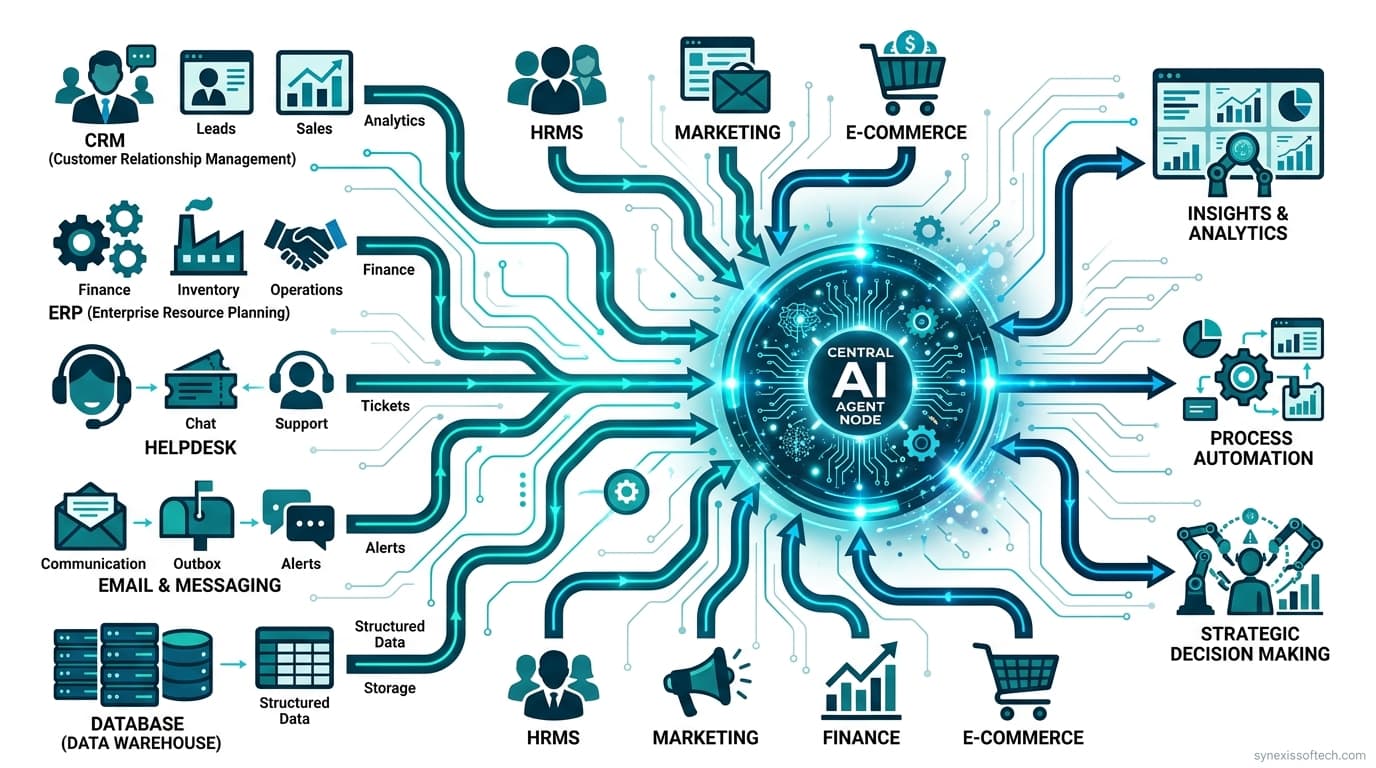
At Synexis Softech, we build AI agents that operate inside your actual enterprise environment — connected to your ERP, your CRM, your helpdesk, your data warehouse — and complete complex, multi-step workflows reliably enough to trust with real business operations.
What Separates Enterprise AI Agents From Consumer AI Tools
Enterprise AI agents are distinguished from consumer AI tools by their integration depth, their compliance architecture, and their failure handling — not just by the sophistication of their language model. A consumer AI tool answers questions. An enterprise AI agent executes workflows: it reads from your systems, applies your business rules, takes actions, logs everything, and escalates correctly when a situation exceeds its authorisation.
The bar for enterprise deployment is fundamentally different. An error in a consumer chatbot is an annoyance. An error in an enterprise AI agent processing purchase orders or managing customer escalations has operational and financial consequences. The engineering reflects that difference.
Core Capabilities of an Enterprise AI Agent
Multi-system integration. Enterprise agents connect to your existing technology stack — Salesforce, SAP, ServiceNow, Microsoft 365, Slack, custom databases, and legacy APIs. Each connection is a capability. An agent with deep system access can complete workflows end-to-end without human coordination between tools.
Role-based authorisation. Not every agent action is appropriate for every context. Enterprise agents enforce authorisation rules: an agent handling tier-1 support can resolve standard queries but cannot issue refunds above a defined threshold without human approval.
Audit logging and explainability. Every action an enterprise AI agent takes is logged with the reasoning that led to it. This is not optional for regulated industries — it is a compliance requirement. Our agents produce a complete audit trail for every workflow execution.
Human-in-the-loop escalation. The agent knows what it is authorised to handle and what it is not. When a situation exceeds its scope, it escalates to the right human with full context — not a generic "I cannot help with that."
Resilience and fallback. Enterprise agents are built with failure handling from day one. If a system call fails, the agent retries with appropriate backoff, logs the failure, and either completes with an alternative path or escalates with context rather than silently dropping the task.
Enterprise AI Agent Use Cases by Function
Procurement and supply chain. Agents that process purchase requisitions, validate against approved vendor lists and budget limits, route for approval, and update ERP records — reducing a multi-day manual process to hours.
Customer operations. Tier-1 support agents that resolve billing queries, account changes, and order issues across your helpdesk, CRM, and billing system — with full handoff context when escalation is needed.
HR and onboarding. Agents that provision system access, assign onboarding tasks, answer policy questions from your HR knowledge base, and flag completion milestones to managers.
Financial operations. Agents that process expense reports, validate against policy, flag exceptions, and route approvals — with an audit trail that satisfies finance team requirements.
Sales operations. Agents that qualify inbound leads, enrich records from external data sources, update CRM, draft personalised follow-up sequences, and schedule discovery calls — compressing the lead-to-call timeline from days to minutes.
What Enterprise AI Agent Development Requires
Enterprise agent development is primarily a systems integration and process design challenge, not a model selection challenge. The model provides reasoning; the architecture provides reliability. A successful enterprise agent build requires: a detailed process map of the workflow before any code is written, a security architecture that satisfies your IT and compliance team, integration design for each system the agent touches, a testing framework that includes adversarial cases and failure scenarios, and a monitoring layer that gives your operations team visibility into what the agent is doing.
At Synexis Softech, we run a structured discovery phase for every enterprise build that maps this architecture before development begins. Discovery is billed separately from development and produces a technical specification that can be used to evaluate the build with any vendor.
Frequently Asked Questions
How do enterprise AI agents handle sensitive business data?
Enterprise agents can be deployed entirely within your own infrastructure — cloud VPC, on-premise, or hybrid — with no data leaving your environment. We design for your specific data residency, encryption, and access control requirements as part of the architecture phase.
How long does an enterprise AI agent take to build?
A focused single-workflow enterprise agent with three to five system integrations typically takes six to twelve weeks from discovery to production deployment. Multi-workflow agents with complex compliance requirements take longer. The discovery phase, typically two to three weeks, produces a specification that gives you a reliable timeline before development commits are made.
Can enterprise AI agents be built on top of our existing technology stack?
Yes. We build around your existing systems rather than replacing them. If your CRM is Salesforce and your helpdesk is Zendesk, the agent integrates with both via API — we do not require you to change platforms to deploy an agent.
What happens when the AI agent makes a mistake?
Every enterprise agent is designed with defined error boundaries. When the agent encounters a situation it cannot resolve correctly, it escalates to a human with full context rather than proceeding incorrectly. Post-incident, the audit log lets you identify exactly what happened and why, and the agent's instructions can be updated to handle the case correctly in future.
Ready to scope your enterprise AI agent? Talk to the Synexis Softech team — we start with a discovery call, not a sales pitch.
Need help with implementation? Synexis Softech provides robust custom AI agent development to help scale your business.
Synexis Softech Team
Lead AI Engineer
Our team of experienced engineers and digital strategists at Synexis Softech specializes in building production-ready AI solutions, high-performance web applications, and data-driven marketing campaigns. Based in Pokhara, Nepal, we partner with growing businesses globally to turn complex technical challenges into competitive advantages.
Ready to grow your business with technology?
Let's build a practical digital solution for your business.
Talk to Our Team