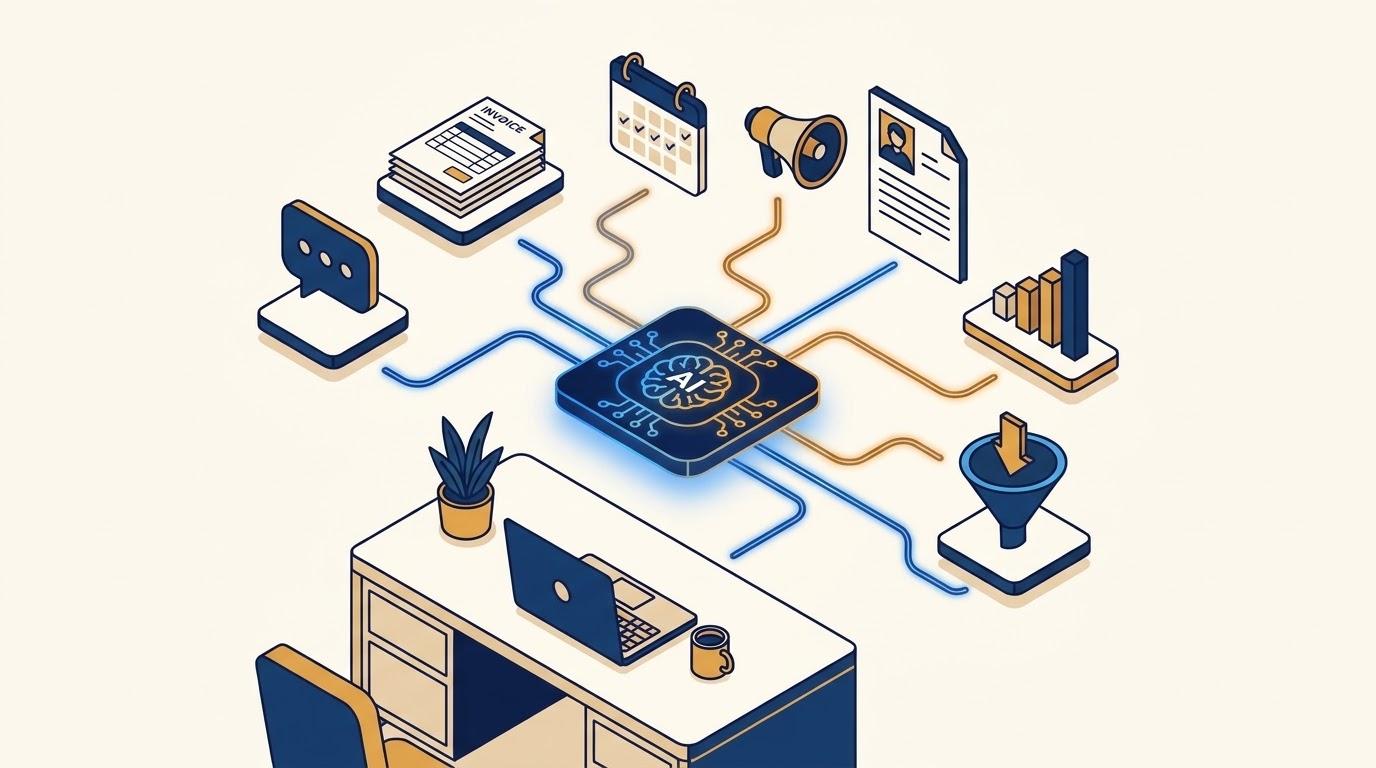
AI Automation for Small Business: 7 Processes You Should Stop Doing Manually

Table of Contents
- 1. 1. Customer Support Responses: Your Highest-Volume, Easiest First Win
- 2. 2. Lead Qualification and Follow-Up: Stop Letting Warm Leads Go Cold
- 3. 3. Invoice Processing and Financial Data Entry: The Invisible Time Sink
- 4. 4. Social Media Content and Scheduling: Keep Posting Without the Overhead
- 5. 5. Appointment and Meeting Scheduling: Eliminate the Back-and-Forth
- 6. 6. HR Candidate Screening: Hire Faster Without Reading 200 CVs
- 7. 7. Reporting and Analytics: Stop Building the Same Spreadsheet Every Month
AI automation for small business has gone from a nice-to-have to a genuine competitive necessity. The businesses that figured this out early are now operating 30–40% leaner than competitors doing the same volume with fully manual teams. Here are the 7 processes where AI automation delivers the fastest, most measurable return for a small business — in order of how easy they are to implement.
1. Customer Support Responses: Your Highest-Volume, Easiest First Win
Customer support is the number one first-automation for small businesses because it is the highest-volume, most time-consuming, and most easily defined task. Roughly 70–80% of support queries in a typical small business are variations of the same 20 questions: order status, return policy, pricing, feature questions, and account access. An AI agent trained on your knowledge base handles all of these instantly, 24/7, without human involvement.
What you keep human: complaints that require empathy and discretion, complex account issues, and anything involving a refund decision above a defined threshold. Everything else gets handled before your team wakes up.
2. Lead Qualification and Follow-Up: Stop Letting Warm Leads Go Cold
Most small businesses lose 40–60% of their potential revenue not because the leads were bad, but because the follow-up was slow. A prospect who submits a contact form at 7pm on a Friday and does not hear back until Monday morning has a low probability of converting — especially if a competitor responded the same evening.
AI lead qualification agents respond within seconds: they ask qualifying questions, segment the lead by urgency and fit, send relevant case studies or pricing information, and book a call with a human rep for qualified prospects. The unqualified ones enter a nurture sequence. Neither outcome requires a human until a qualified, interested prospect is ready for a conversation.
3. Invoice Processing and Financial Data Entry: The Invisible Time Sink
Invoice processing, expense categorisation, and financial data entry consume disproportionate time in growing small businesses — and they are almost entirely automatable. AI tools read invoices (from PDF or email), extract the relevant data, categorise it correctly, match it against purchase orders, and push it to your accounting software — without a human touching it.
For businesses processing more than 20–30 invoices per month, the time savings are significant. For businesses managing expenses across multiple locations — like our own 10-branch structure at Synexis Softech — the accuracy improvements are just as valuable as the time savings.
4. Social Media Content and Scheduling: Keep Posting Without the Overhead
Social media content is a consistent time drain for small business owners. AI automation for content means using AI to draft posts based on your brand voice and product updates, reviewing them quickly, and scheduling across platforms in bulk. What used to take 4–6 hours per week compresses to 30–45 minutes of review time.
The key is building a content brief that captures your voice and typical subject matter, then using AI to generate drafts against that brief. The human role becomes editorial: approve, adjust, reject — not create from scratch every time.
5. Appointment and Meeting Scheduling: Eliminate the Back-and-Forth
Scheduling is a low-value task that consumes disproportionate time, particularly in service businesses where meetings are central to the revenue process. AI scheduling agents integrate with your calendar, offer available slots, send reminders, handle rescheduling, and log meeting details in your CRM — with no human coordinator required.
For businesses running more than 10–15 client meetings per week, this automation alone typically saves 3–5 hours of coordination time — and eliminates the double-bookings and missed follow-ups that happen in manual scheduling.
6. HR Candidate Screening: Hire Faster Without Reading 200 CVs
Hiring is one of the highest-stakes, most time-intensive activities for a growing small business. AI candidate screening automates the first layer: reading CVs, scoring candidates against defined criteria, sending initial screening questions, and shortlisting the top 10–15% for human review. What used to require a full day of CV reading becomes an hour of reviewing a ranked shortlist.
Synexis Softech built and deployed an AI interview platform across our own 10 branches before offering it to clients. Time-to-shortlist dropped from 7–14 days to 1–3 days, and hiring consistency improved significantly across all locations because every candidate was evaluated on the same criteria.
7. Reporting and Analytics: Stop Building the Same Spreadsheet Every Month
Monthly reporting — sales performance, marketing metrics, financial summaries, operational KPIs — is entirely automatable but most small businesses still do it manually. AI reporting tools pull data from your existing sources (CRM, analytics platform, accounting software), apply your defined templates, and produce the report on a schedule. You review the output rather than building it.
The more sophisticated implementations go further: the AI surfaces the anomalies — the metric that moved unusually, the product that underperformed, the region that outperformed. The report arrives with the insight, not just the numbers.
| Process | Hours Saved / Week | Implementation Complexity | Typical Monthly Cost |
|---|---|---|---|
| Customer support responses | 8–20 hrs | Low | $200–$800 |
| Lead qualification + follow-up | 5–15 hrs | Low–Medium | $300–$1,000 |
| Invoice processing | 3–8 hrs | Low | $100–$400 |
| Social media scheduling | 3–6 hrs | Low | $50–$200 |
| Appointment scheduling | 2–5 hrs | Low | $50–$150 |
| HR candidate screening | 4–12 hrs/hire | Medium | $300–$800 |
| Reporting and analytics | 4–10 hrs | Medium | $200–$600 |
The combined saving from automating all 7 processes typically exceeds 30 hours per week for a business with 10–30 employees. That is the equivalent of a full-time employee — except the AI works 24/7 and does not need management, annual leave, or a benefits package.
Synexis Softech builds AI automation systems for small and medium businesses across the US, UK, Australia, and South Asia. If you want to know which of these 7 processes would deliver the fastest ROI for your specific business, talk to our team here.
Need help with implementation? Synexis Softech provides robust custom AI agent development to help scale your business.
Synexis Softech Team
Admin
Our team of experienced engineers and digital strategists at Synexis Softech specializes in building production-ready AI solutions, high-performance web applications, and data-driven marketing campaigns. Based in Pokhara, Nepal, we partner with growing businesses globally to turn complex technical challenges into competitive advantages.
Ready to grow your business with technology?
Let's build a practical digital solution for your business.
Talk to Our Team